Packy McCormick's latest installment of 'Weekly Dose of Optimism' cuts through the noise of quarterly earnings and political theater to spotlight a specific, high-velocity wave of technological maturation. The piece is notable not for predicting the future, but for identifying the precise moment when experimental science transitions from theoretical possibility to industrial reality. McCormick argues that we are witnessing a convergence where the tools of biology, artificial intelligence, and robotics are finally becoming safe and scalable enough to solve problems that have long seemed intractable.
The Biology of Longevity
McCormick anchors his optimism in the stealth launch of General Control, a biotech firm led by Lada Nuzhna that is moving beyond simple gene editing to epigenetic reprogramming. The author highlights Nuzhna's unique background as a physicist who entered biotech unburdened by traditional dogma. "Because she comes to biotech from outside of bio... she was able to figure out what she worked on based on what she saw as the most important problems with the right tools to make real progress now," McCormick writes. This framing suggests that the next breakthroughs in human health may come from outsiders who treat biological systems as engineering challenges rather than immutable mysteries.
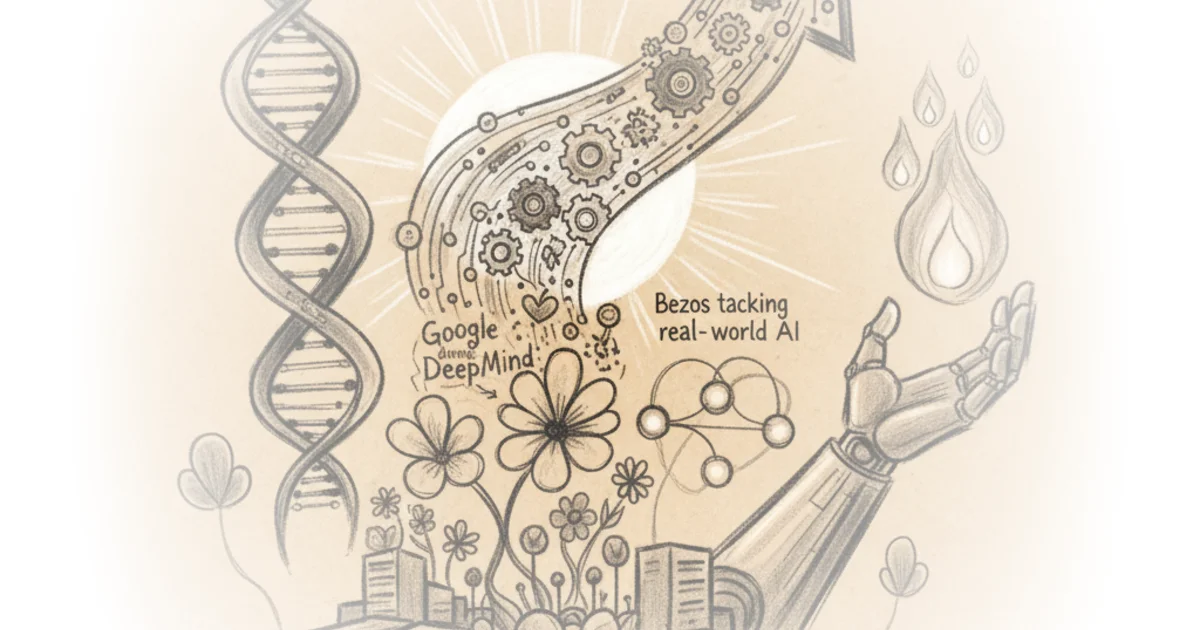
The core of the argument rests on the safety and precision of using CRISPR not to cut DNA, but to act as a delivery system for proteins that switch genes on or off. McCormick notes that this approach, once considered too risky, is now viable. "Lada's approach would have been entirely impractical even a few years ago, in my view, but with the rapid improvements in tools for both identification and delivery of tissue-specific epigenetic edits, its time has come," he quotes Aubrey de Grey. This shift from theory to practice is the critical inflection point. While critics might argue that the long-term effects of epigenetic editing remain unknown, the author's focus on immediate applications like treating obesity and liver fibrosis grounds the optimism in tangible medical needs rather than abstract immortality.
"The best cure for heat is a little rain," McCormick observes, drawing a parallel between the urgency of climate adaptation and the necessity of technological intervention.
The Physicalization of AI
The commentary then pivots to the industrial application of artificial intelligence, distinguishing between models that generate text and those that manipulate the physical world. McCormick details Jeff Bezos's new venture, Project Prometheus, which aims to deploy AI in aerospace and manufacturing. The author emphasizes the sheer scale of the investment and the caliber of the talent involved. "Billionaires get a bad rap... but it's pretty awesome to see Bezos put his vast fortune (and his time) where his mouth is for the good of society," McCormick writes. This is a deliberate reframing of capital accumulation, suggesting that private wealth is being redirected toward solving hard engineering problems that public institutions have struggled to address.
Simultaneously, McCormick celebrates Google DeepMind's release of Gemini 3 and its image generation capabilities, noting that the lab's odds of having the best model have jumped to 90%. He points out the practical utility of these tools, such as converting complex whitepapers into explanatory chalkboard images. "The Dose has long said that Google DeepMind is the best AI lab. Welcome, everyone," he declares. The argument here is that AI is no longer just a chatbot; it is becoming a visual and engineering partner. A counterargument worth considering is that the rapid deployment of such powerful models without robust safety guardrails could introduce new systemic risks, though McCormick focuses primarily on the velocity of capability gains.
Robotics and Resource Management
The final pillar of McCormick's optimism concerns the automation of labor and the management of natural resources. He contrasts two distinct approaches to robotics: Physical Intelligence's method of learning through reinforcement and trial-and-error, and Sunday's use of human demonstration via data gloves. "Act-1... trains on zero direct robot data, relying instead on high-fidelity human demonstrations captured via custom 'Skill Capture Gloves'," he explains. This diversity in approach suggests a robust ecosystem of innovation rather than a single winner-take-all path. The implication is clear: the drudgery of daily chores is nearing obsolescence.
McCormick also highlights Rainmaker's massive cloud-seeding project in Utah and Idaho, which aims to restore water levels in the Great Salt Lake. He addresses the skepticism surrounding the initiative, noting that while some confuse the science with conspiracy theories, the data supports its efficacy. "Research indicates cloud seeding can increase precipitation by 3-13%, with one documented instance producing 275 acre-feet of additional water in just 24 minutes," he writes. This section serves as a reminder that technology can also be used to repair environmental damage, provided there is the political will to deploy it. The author draws a subtle historical parallel here, much like the deep dive on Prometheus in Greek mythology or the historical context of epigenetics, suggesting that humanity has always sought to control its environment, but now possesses the tools to do so with precision.
The Cost of Progress
Despite the overwhelming optimism, McCormick includes a sobering analysis of regulatory friction. Citing Peter Reinhardt's work on carbon sequestration and electric trucking, the author argues that bureaucracy is becoming a primary bottleneck. "One of the biggest things standing in the way of progress, abundance, affordability, and a better life for humans isn't physics, but regulations that could and should be deleted with no harm to anyone," McCormick writes. This is a crucial caveat to the piece's overall tone. It suggests that the technology is ready, but the institutional framework is lagging. The argument is that the next great leap forward depends less on scientific discovery and more on the political courage to remove outdated barriers.
"Technology is the story of daring optimism. It's the belief that human ingenuity can transform the impossible into the inevitable."
Bottom Line
McCormick's strongest move is connecting disparate technological breakthroughs into a single narrative of convergence, where biology, AI, and robotics are simultaneously maturing. The piece's biggest vulnerability lies in its reliance on the assumption that capital and talent will naturally flow toward the most beneficial applications, potentially overlooking the need for public oversight. Readers should watch for how regulatory bodies respond to these rapid advancements, as the friction between innovation and policy will likely define the next decade of progress.