Justin E. H. Smith proposes a radical reorientation of human history: that the Moon, not the Sun or the mind alone, is the true architect of our consciousness, mathematics, and social rituals. This is not a poetic musing on the night sky, but a rigorous argument that the rhythmic pull of our satellite literally shaped the biological and cultural machinery of the human species. For a reader navigating a world obsessed with linear progress and solar efficiency, Smith offers a startling counter-narrative where the ancient, cyclical pulse of the tides remains the hidden engine of our civilization.
The Cosmic Shaker
Smith begins by dismantling the modern wall between science and religion, suggesting they are merely different responses to the same celestial rhythm. He writes, "La religion, j'ose le dire, n'est rien d'autre que le rituel, et le rituel n'est rien d'autre que le reflet, dans la culture, de cette même périodicité lunaire qui, dans notre coin du cosmos, contribue largement à façonner les rythmes mêmes de la vie." This framing is provocative because it strips theology of its abstract dogma, grounding it instead in the physical necessity of tracking time. The argument gains weight when Smith connects this to the origins of calculus. He notes that the Kerala school of astronomy in India, centuries before Leibniz, developed infinite series not for abstract theory, but to predict religious festivals tied to the lunar calendar. "Sans la défaite du démon Narakasura par le seigneur Krishna, en somme, il n'y aurait ni ponts suspendus, ni satellites GPS, ni semi-conducteurs," Smith asserts, linking mythic narrative directly to the technological infrastructure of the modern world.
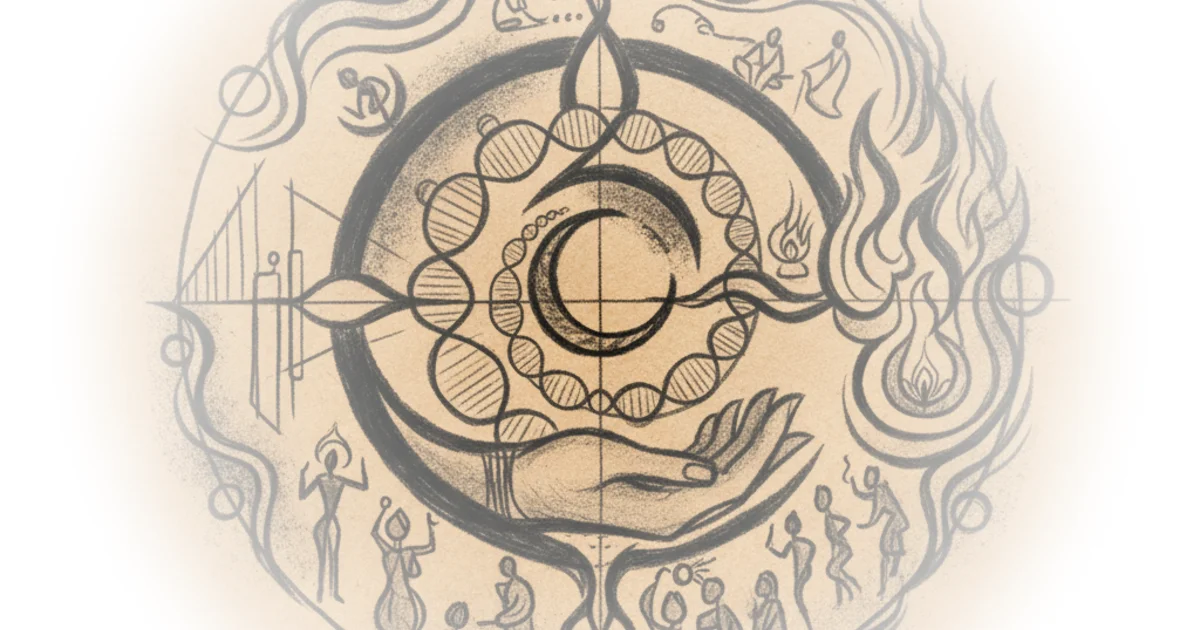
The piece's most compelling scientific claim is that the Moon acted as a biological catalyst for life itself. Smith describes the early Earth-Moon system as a natural "orbital shaker," a mechanism that agitated the primordial oceans and allowed organic compounds to autocatalyze. "Pas d'autocatalyse, en somme, sans le balancement rythmique et alterné des marées ; et pas de marées sans la Lune," he writes. This is a powerful image: the Moon did not just watch life begin; it physically shook the ingredients together. Critics might argue that the panspermia theory or other abiogenesis models offer alternative explanations for life's spark, but Smith's focus on the tidal rhythm as a necessary condition for complexity remains a robust, if underappreciated, perspective.
Pas d'autocatalyse, en somme, sans le balancement rythmique et alterné des marées ; et pas de marées sans la Lune.
The Biological Clock
Smith then turns to the human body, arguing that our internal rhythms are still tuned to the Moon, even in our light-polluted cities. He points out that while only about 2% of mammals menstruate, the timing of this cycle in pre-industrial societies was likely synchronized with lunar phases through the regulation of melatonin. "La périodicité menstruelle pourrait bien constituer le pont expérientiel entre le temps biologique et le temps culturel," Smith suggests, positing that women, by internalizing the tides, became the original keepers of the calendar. He draws a fascinating evolutionary parallel, noting that just as mitochondria were once free-living bacteria, our sense of time may have been "internalized" from the external lunar cycle.
This biological determinism is where the argument risks overreach. While the link between lunar light and hormonal cycles is empirically established in pre-industrial contexts, Smith's implication that the Moon caused menstruation is a leap. However, his point about "weak entrainment"—where the cycle aligns loosely with the moon—is a crucial nuance often ignored in modern medicine. He writes, "Au cours de l'évolution biologique, un certain nombre d'espèces... présentent des rythmes endogènes circalunaires et circatidaux qui persistent même dans des conditions de laboratoire constantes." This suggests that the Moon's influence is not just environmental but encoded in our very DNA, a legacy of our time in the intertidal zones.
The First Mathematics
The article's strongest evidentiary support comes from archaeology, specifically the engravings found at Blombos Cave in South Africa. Smith highlights the "ocres de Blombos," dated between 100,000 and 75,000 years ago, which feature geometric patterns with 28 to 31 marks. "Il se peut qu'ils ne distinguaient pas du tout deux phénomènes," Smith muses, suggesting that early humans saw no difference between tracking the moon and tracking the menstrual cycle. This challenges the traditional view that symbolic thought began with hunting or tool-making, proposing instead that the first "science" was chronobiology.
Smith expands this to the Paleolithic art of Europe, citing recent studies by Bennett Bacon and colleagues that interpret notches on animal bones as phenological calendars. These marks, he argues, were not magical incantations but data points tracking the mating and birthing seasons of prey. "Les points et les lignes représentent des unités de mois au sein d'un système de mémoire externalisée," Smith explains. This reframing of prehistoric art from "ritual magic" to "informational system" is a significant shift. It suggests that the drive to quantify time was born of survival, rooted in the same lunar cycles that governed the reproduction of the animals humans relied on for food.
From Cycles to Lines
Finally, Smith contrasts the ancient lunar worldview with the modern solar one. He argues that the agricultural revolution forced humanity to adopt the solar year, shifting our perception of time from a cycle to a line. "On peut concevoir la période moderne comme le moment de l'histoire où nous parvenons enfin à aplatir le calendrier solaire lui aussi, à faire de la succession des années une ligne plutôt qu'un cercle," he writes. This transition, he implies, is what allowed for the concept of infinite progress but severed our connection to the rhythmic, biological time that once anchored us.
The author's conclusion is that the Moon gave us the experience of time as a succession of changes, while the Sun gave us the illusion of a static, repeating year. "Et l'on peut comprendre cette transformation, à son tour, comme le moment de l'histoire où nous commençons enfin à faire accomplir à l'année solaire ce que les phases de la Lune avaient fait pour nous depuis toujours : nous donner une expérience du temps comme successif, en perpétuel changement et orienté vers l'avenir." This is a profound inversion of the usual narrative where the solar calendar represents "order" and the lunar represents "chaos." Smith flips the script, suggesting the lunar cycle was the true precursor to our modern understanding of linear time.
Bottom Line
Justin E. H. Smith's argument is a masterful synthesis of archaeology, biology, and philosophy that successfully re-centers the Moon as the silent partner in human evolution. Its greatest strength is the evidence drawn from the Blombos Cave and Paleolithic notches, which provides a tangible link between lunar cycles and the birth of symbolic thought. The piece's vulnerability lies in its tendency to conflate correlation with causation regarding the biological origins of menstruation, but this does not undermine its broader thesis: that our entire concept of time, ritual, and mathematics is a reflection of the Moon's gravitational pull. For the busy reader, this is a reminder that the rhythms we try to ignore are the very ones that built the world we live in.