Most of what knowledge workers do isn't creation. It's coordination overhead.
That's the counterintuitive claim Nate B Jones makes, and he's got the data to back it up. A Microsoft study found the average employee spends 57% of their time communicating and only 43% creating. Another industry survey put it at 60% work about work — just coordinating with each other.
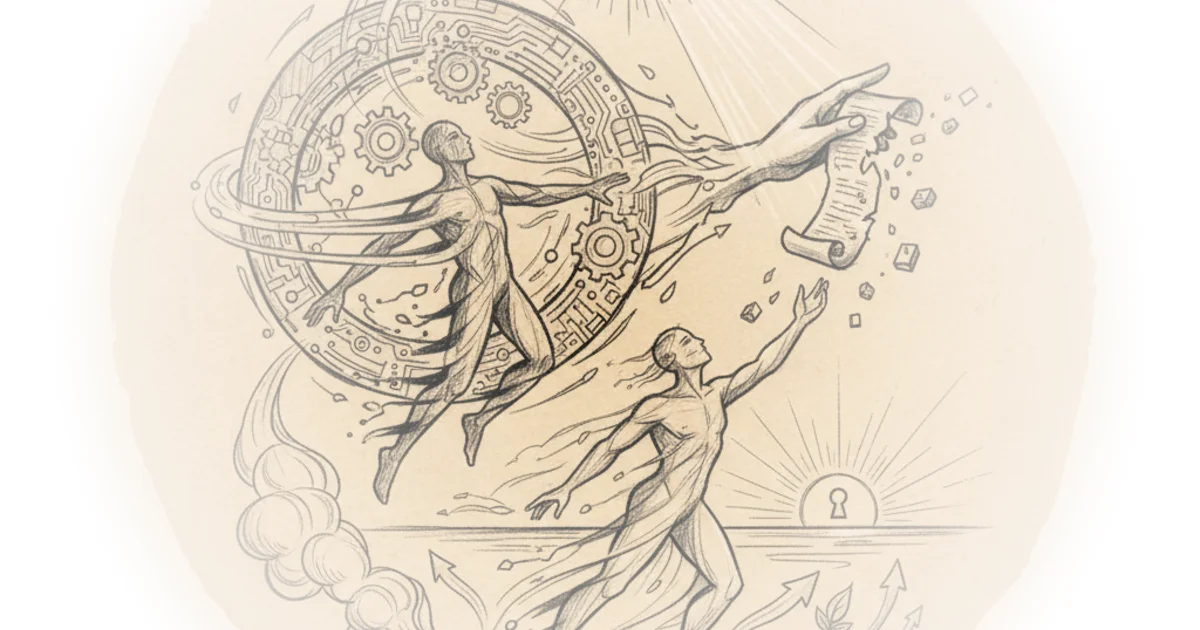
The number sounds like a failure. It's not. It's an organizational tax that humans have always paid because we can't share perfect context with zero latency. The meetings, the specs, the tickets, the sprint planning — none of these are the value. The code is the value. Everything else is just the cost of producing that value with an execution layer made out of humans.
What AI Actually Changes
Here's what happens when AI agent harnesses can go directly from insight to code in one big loop: you don't just automate tasks within your existing organization. You delete the need for the org to be structured this way at all.
The coordination layer evaporates. The roles that existed to manage human-to-human handoffs disappear — not because they're automated, but because the handoffs they managed no longer happen.
Think about what happens when a new engineer joins a team. For weeks, they produce almost nothing. Not because they're incompetent, but because they're absorbing context. Every decision the team made in the past year lives in someone's head and probably in some scattered documents. And the new hire has to reconstruct this through conversations, through old PRDs, through commit history, through Slack threads where three people answer the same question all differently.
An agent starting a new task has a much simpler problem set. The agent reads the codebase, reads the progress file and the git history — full context in seconds. The onboarding tax, the coordination tax? Neither of those exist because the problem they solve just doesn't exist for the agent.
Why This Is Good News
Here's what this looks like in practice: a person can sit at the command line and iterate directly on the design, the specification, and the code in the same session. The spec and the implementation converge into one artifact. There is no PRD. By the way, he's not making that up — Anthropic has talked about the fact that they don't use PRDs anymore.
There is no sprint planning meeting. No status update. The state of the work is the code, inspectable all the time. No design review as a separate ceremony. You iterate on the design and implementation at the same time. This isn't theoretical. For some AI-native organizations, this is just an ordinary Tuesday.
And here's what matters: it's not that the coding bit got automated. It's that the translation layers between people got deleted. So there was no PRD needed, and the person with customer insight could work directly with the agent to get that vision to come to life.
When you remove humans from the execution layer because you have agents, you don't just eliminate the coordination roles. You actually make the remaining work more verifiable than it was before. A marketing campaign becomes a deployed landing page with conversion metrics. An agent can test whether the page converts. A sales proposal becomes a configured offering with win-loss data. Once the artifact is code, you can test it.
This creates a compounding loop: less coordination means fewer coordination roles makes remaining work more verifiable means agents do more means the whole loop turns around again and we need less coordination each turn accelerates the next.
The Counterargument
Critics might note that this framing understates the disruption. The jobs lost aren't just coordination roles — they're entire categories of employment that people depend on for their livelihoods. And what about the workers who have spent years developing those coordination skills? They're not suddenly unnecessary; they're displaced. The human judgment work Jones dismisses as "coordination overhead" is actually where many professionals found meaning in their work.
A second concern: this vision assumes AI capabilities will continue advancing at their current pace. If that progress slows, the math changes significantly.
Pull Quote
When the translation layers disappear, everybody gets closer to the product. Not closer to a description of the product, closer to the product itself.
Bottom Line
Jones's strongest argument is that most knowledge work is coordination, not value creation — and AI eliminates the coordination layer entirely. The vulnerability? He's wildly optimistic about the pace of change and barely addresses what happens to the people whose jobs consist of coordinating those coordinators. Watch for whether organizations actually make this transition smoothly or whether the coordination tax reappears in different forms.