While global headlines fixate on Washington's ballooning deficits, a far more precarious financial house of cards may be hidden in plain sight in Beijing. Economics Explained challenges the conventional wisdom that China is the prudent lender and the United States the reckless borrower, arguing that when you account for off-book liabilities and state-controlled entities, China's debt burden is not just higher, but potentially three times the size of America's. This is not merely a numbers game; it is a fundamental re-evaluation of which superpower is more vulnerable to an economic collapse.
The Illusion of Control
The piece begins by dismantling the surface-level comparison of sovereign debt. Economics Explained notes that while the US federal debt sits at a staggering 123% of GDP, China's official government debt appears tame at just 84%. However, the author quickly pivots to the structural differences that make this comparison misleading. "Just a little bit of digging under the surface reveals that China is arguably more indebted than the USA is. And depending on which numbers can be believed, its debt levels could actually be more than three times as high." This framing is crucial because it forces the reader to look past the headline numbers that dominate financial news cycles.
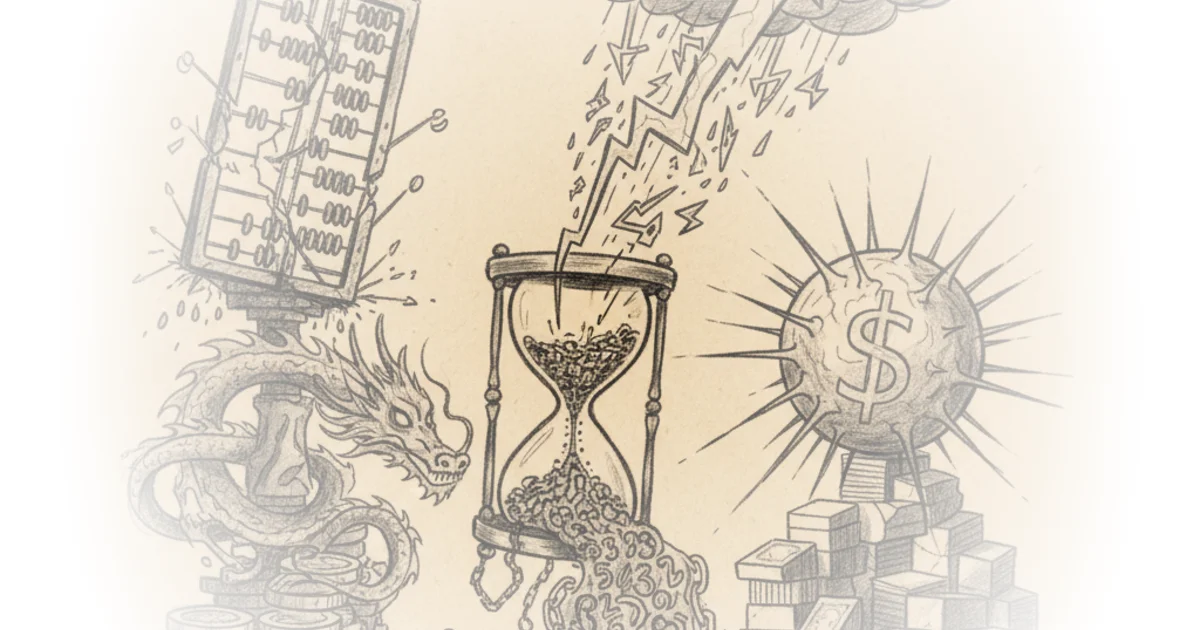
The core of the argument rests on who is actually borrowing the money. In the US, borrowing is transparent and centralized, but in China, it is fragmented and obscured. Economics Explained writes, "In China, the debt is a lot better hidden and spread out over multiple levels of government, government corporations, and special entities that exist just for taking on debt off the books." This lack of transparency is not an accident but a feature of a system where provincial governments have massive incentives to fund infrastructure projects regardless of fiscal reality. When you add the debt of local governments to the federal level, the ratio jumps to 160% of GDP, already surpassing the United States.
"These strategic developments also extend beyond the borders of the country as well... These projects serve national interests, but they are not technically conducted or funded by the government itself. Instead, these companies just borrow the money so the government doesn't have to."
This distinction between state-owned enterprises (SOEs) and the government is the linchpin of the author's thesis. The piece highlights that there are nearly 400,000 fully state-owned firms in China, many of which are highly leveraged. Economics Explained estimates these entities hold a conservative $30 trillion in debt. The implication is stark: if these companies default, the government is contractually or politically bound to bail them out, effectively merging corporate and sovereign debt. Critics might argue that state-owned banks in China are more disciplined than their Western counterparts, but the sheer scale of leverage described here suggests that discipline is secondary to political mandate.
The Data Black Box
Even if one accepts the debt figures at face value, the denominator—the GDP—may be inflated. The author raises a critical point about the reliability of Chinese economic data, noting that independent researchers suggest the economy could be 20% to 60% smaller than officially reported. "A lot of economists question the official figures and independent researchers suggested that routine compounded inaccuracies in reporting means that the Chinese economy might be between 20% and 60% smaller than officially reported." If the economy is smaller, the debt-to-GDP ratio explodes, potentially reaching 450%.
This section of the commentary is particularly effective because it addresses the elephant in the room: the opacity of the Chinese state. Economics Explained puts it bluntly, "Economic figures coming out of China, especially at a provincial level, are often unreliable." The author acknowledges that even data from the International Monetary Fund relies on government reporting, creating a circular logic where the borrower validates the lender's risk assessment. This lack of independent verification makes any risk model for China inherently speculative. The argument holds weight because it doesn't just present a higher number; it questions the very foundation upon which that number is built.
The Paradox of Low Yields
Perhaps the most counterintuitive part of the analysis is the discrepancy between risk and reward. Normally, a country with higher debt and lower credit ratings should pay higher interest rates to attract lenders. Yet, China's 10-year bond yield is roughly 1.7%, while the US pays over 4.5%. Economics Explained asks, "Why on earth would anybody lend money to the comparatively riskier Chinese government when they could instead get three times the yield lending money to the US government?"
The answer lies in China's capital controls and the lack of alternative investment vehicles. The author explains that domestic investors cannot simply move their money to US Treasuries due to strict capital controls. Furthermore, the Chinese stock market has been a poor performer, returning less than 100% since 2000 compared to over 300% in the US. "The stock market is simply too risky for the estimated returns," Economics Explained writes, pointing to government crackdowns on sectors like tutoring and technology as evidence of political risk overriding market logic. This creates a captive audience for Chinese government debt, forcing domestic savings into low-yield bonds regardless of the underlying economic health.
"Household consumption only makes up 39% of GDP... The country has been bringing in a lot of money through massive exports. It hasn't been spending it, and the stock market has been more or less ignored by most regular investors."
This dynamic reveals a deeper structural weakness: an economy reliant on exports and investment rather than domestic consumption. The author notes that while poorer countries typically spend a higher percentage of their income, China is an anomaly where savings are hoarded and funneled into real estate or state projects. This over-reliance on real estate, described as "the single largest asset class in the world," creates a massive bubble risk that is inextricably linked to the debt problem. If property values stagnate, the collateral backing much of this debt evaporates.
Bottom Line
Economics Explained delivers a compelling, if unsettling, case that China's debt crisis is far more severe than its official statistics suggest, driven by opaque state-owned enterprises and a distorted financial system that masks risk through capital controls. The argument's greatest strength is its refusal to accept surface-level GDP comparisons, instead drilling down into the structural mechanisms that hide the true scale of leverage. However, the analysis relies heavily on estimates of hidden debt and GDP inaccuracies, which, while plausible, remain difficult to verify independently. The most critical takeaway for investors and policymakers is that China's low borrowing costs are not a sign of strength, but a symptom of a closed system where capital has nowhere else to go. The next major test will be whether the Chinese government can manage a soft landing for its real estate sector without triggering a cascade of defaults that the hidden debt structure cannot absorb.