Two essays, separated by nearly two millennia of subject matter, converge on the same uncomfortable question: is what we call historical progress the unfolding of some inner logic, or is it the residue of accidents, elite calculations, and institutional convenience dressed up after the fact as destiny? Kamil Galeev, writing on the Christianization of Rome, and Then & Now, asking whether history progresses at all, arrive from opposite directions at a strikingly compatible suspicion — that the stories civilizations tell about their own ascent are almost always retrofitted.
Two Theories of How Things Change
Galeev's account is relentlessly materialist. The old Roman gods, he argues, were already a hollowed-out civic formality before any Christian missionary set foot in Italy. The deconstruction and denigration of the old religion was started by the Roman elites themselves,
he writes, and once the slaves and servants noticed their masters had stopped believing, the rituals lost whatever binding force they once had. Into that vacuum walked not a moral revolution but a Syrian priest-king dynasty — the Severans — who found in the Christian sect a useful instrument of political consolidation.
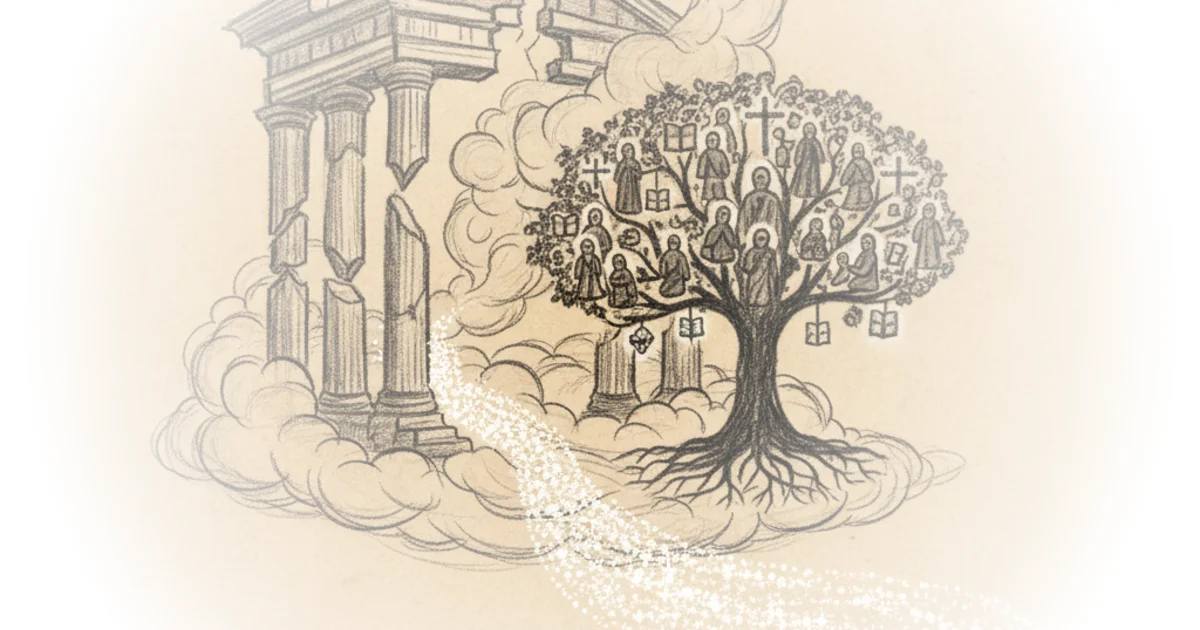
Then & Now tells a gentler story, but one with the same structural humility. Their opening image is a London policeman in 1940, dying of a rose-bush scratch, briefly resurrected by an experimental mold, then killed when the supply ran out. Not only was it discovered by accident... if the discovery of such a life-saving drug is the result of chance how can we think about progress at all,
they ask. The contrast is not subtle: the most consequential medical advance in human history was happening in the same years as the most industrialized slaughter in human history. Progress, if it exists, does not march. It stumbles.
The story civilizations tell about their own ascent is almost always written by the winners of a fight that had nothing to do with the moral they later draw from it.
The Retrofit Problem
Where the two pieces sharpen each other is on the question of narrative laundering. Galeev is brutal about it. The Battle of the Milvian Bridge, he insists, was not a clash between cross and eagle but a succession dispute between rival patrons of the same sect. By the moment of the battle, both Constantine, the emperor of Gaul, and Maxentius, the emperor of Italy were patrons and protectors of the Christian creed,
he notes. So what happened is that one protector of Christianity killed and defeated the other.
The theological drama was added later, by a church that needed a founding miracle.
Then & Now performs a quieter version of the same operation on the Enlightenment. The Greek polis, the printing press, the Scientific Revolution — these are not, in their telling, links in a providential chain but contingent breakthroughs in the human capacity for self-criticism. Without these mechanisms for self-criticism there can no movement in history,
they argue. The implication is that the absence of such mechanisms — as in the centuries Galeev describes, when one Syrian emperor after another quietly tucked Christ into the household shrine — produces stasis dressed as continuity.
Liberty as the Yardstick — and Its Limits
Then & Now's boldest move is to propose a metric. Rather than argue endlessly about whether health, wealth, or virtue defines progress, they nominate liberty: Liberty broadly speaking is the freedom to think to speak to do to act to be oneself.
More possibility, they say, is better than less. It is a pragmatic choice, and a clarifying one. By this yardstick, the institutional Christianity Galeev describes — hierarchical, centralizing, eventually intolerant of rivals — would have to count as a regression, even as it preserved literacy, codified law, and built the scaffolding of medieval Europe.
This is where Galeev's cynicism becomes a useful corrective. He observes, with characteristic dryness, that Communists, when they came to power, were slaughtering each other way more diligently and zealously than they had been ever persecuted by the Tsarist authorities.
The parallel he draws is to the Christian emperors who, once secure, proved far more theologically violent than the pagan magistrates they replaced. The lesson is that movements promising liberation routinely become more coercive than the orders they overthrew. Then & Now's faith that history bends toward freedom needs to reckon with this pattern, not wave it away.
The society that has better access to penicillin is better than the one where you're more likely to be sent to a gas chamber.
What Neither Source Quite Says
Both pieces leave a counterpoint underexplored. Galeev's elite-driven model of religious change is persuasive but incomplete: it cannot fully explain why ordinary people, given a menu of Eastern mystery cults, kept choosing the Christian one. Something in the offer — communal meals, care for the sick, a moral universe in which slaves had souls — was doing work that pure top-down imposition cannot account for. Then & Now, conversely, never quite confronts the possibility that the "space of reasons" they celebrate may be a local achievement of a few centuries in a few places, not a universal trajectory. The Hegelian faith that freedom is the destination of history is, as they half-admit, an article of faith.
There is also a question neither essay addresses directly: what happens when the institutional machinery built to expand liberty becomes the thing that constrains it? The same printing press that scattered the Reformation also industrialized propaganda. The same scientific method that produced penicillin produced the gas chambers Then & Now invokes. Galeev's Rome offers the template — a tool adopted for one purpose almost always ends up serving another — but neither author follows the implication into the present.
Bottom Line
Read together, these two essays form an unintended dialogue about how change actually happens. Galeev supplies the mechanism: elites, vacuums, opportunism, and the retroactive sanctification of whatever won. Then & Now supplies the yardstick: liberty as the rough measure of whether a given arrangement expanded or contracted human possibility. The honest synthesis is bleaker than either piece alone. Progress is real but not guaranteed; it is the contingent product of accidents the winners later claim as providence. The policeman saved by penicillin and the policeman killed when the supply ran out are the same story. Which one history remembers depends entirely on who is writing the next chapter, and what they need the past to mean.