This piece from Reason cuts through the noise of sports gossip to expose a deeper rot in how modern athletics handles power, money, and accountability. While the headline fixates on a quarterback's public relations misstep, the real story is a triad of scandals revealing how institutional safeguards are crumbling under the weight of celebrity entitlement and regulatory capture.
The Entitlement Trap
The editors open with a sharp critique of Washington Commanders quarterback Jayden Daniels, framing his demand that Louisiana State University cease using his name, image, and likeness (NIL) as a masterclass in self-sabotage. "Any famous athlete ever had such an unnecessary public relations fumble as Jayden Daniels' demand that LSU stop using his name, image, and likeness?" Reason asks, noting that the backlash has been universal, extending even to professional teams in other leagues. The piece argues that Daniels' cease-and-desist letter, sent just as his college career ended, was a textbook case of the Streisand effect—a phenomenon where an attempt to hide information only makes it more visible. This historical parallel is apt; just as Barbra Streisand's legal threat to remove a photo of her home from a public database drew millions of eyes to the image, Daniels' legal maneuver drew the entire sports world to a jersey number he thought he could control.
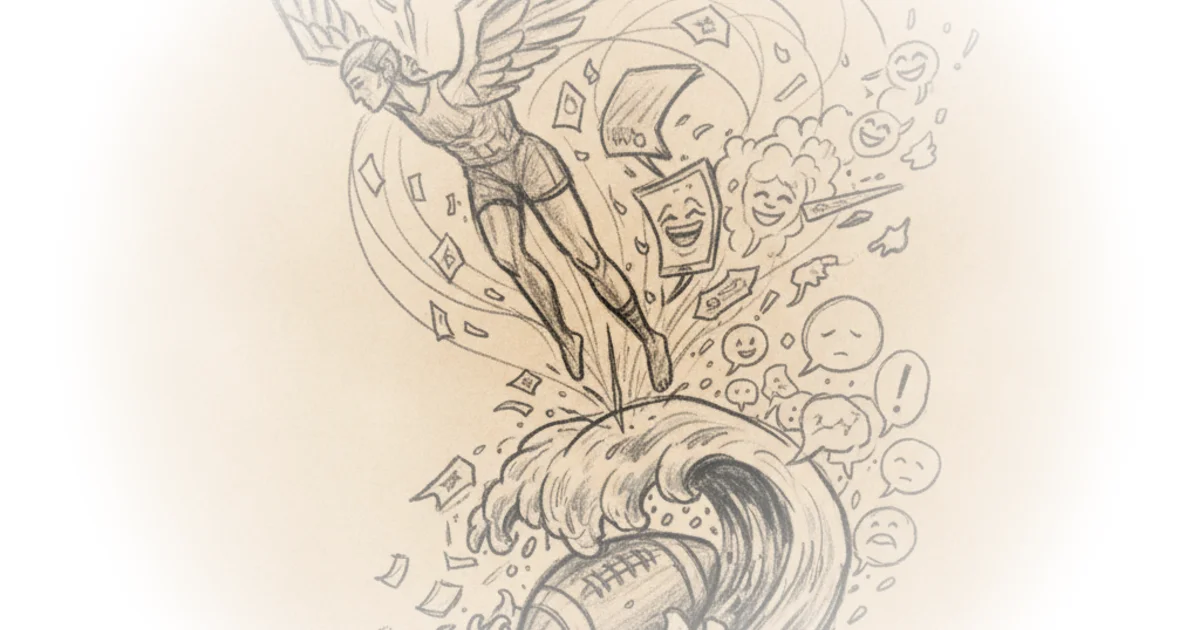
The article highlights the absurdity of the situation: "Daniels was apparently so bitter at LSU assigning his no. 5 jersey to sophomore cornerback D.J. Pickett that Daniels sent a cease-and-desist letter... telling the school to stop using his NIL." The editors point out that while Daniels won the Heisman Trophy, his teams were merely 9–3 in his regular seasons, making his demand for a retired number seem like "reeks of entitlement" rather than earned legacy. By treating a marketing asset as a personal grievance, he turned a potential revenue stream into a public relations disaster. "If you like us," the piece suggests, the marketing implied, "why not go buy this very successful former player's NFL jersey?" Daniels missed the chance to monetize this naturally, choosing instead to litigate against free promotion.
There are malevolent P.R. fumbles (drunk driving, domestic abuse, etc.) and ones the victim can eventually laugh along with (butt fumble), but Daniels found the sweet spot as a totally unnecessary loser in this fight.
Critics might argue that NIL rights are a legitimate legal frontier and athletes should be allowed to protect their brand value aggressively. However, the piece effectively counters this by noting that on the collegiate level, football numbers rarely get retired due to roster size, and Daniels' demand ignored the reality that he was complaining about someone marketing him for free.
The Illusion of Oversight
Shifting from individual ego to institutional corruption, the commentary turns to the NBA's handling of the Kawhi Leonard salary-cap scandal. The editors express deep skepticism regarding the league's investigation, which reportedly found "no evidence showing LA Clippers owner Steve Ballmer funneled money through team sponsors to pay Kawhi Leonard in order to circumvent the salary cap." The piece finds this conclusion baffling given the "smoking gun" of a $48 million endorsement deal Leonard signed with Aspiration, a bank in which Ballmer had invested $50 million just seven months prior. "What is the point of a marketing deal that doesn't actually involve any marketing?" the editors ask, highlighting the absurdity of a deal where Leonard was paid millions but had no obligation to promote the brand.
The argument here is that the NBA is failing to enforce its own rules, potentially because the league is negotiating with powerful owners rather than punishing them. "The NBA is apparently negotiating with Ballmer for how to resolve the investigation," Reason notes, suggesting that the rules are too easy to game. This connects to broader concerns about how wealthy stakeholders manipulate systems meant to ensure fair play. The editors warn that if the league accepts this explanation, "they would be far too easy to game, especially now that team owners, players, and sponsors see what they're allowed to do without reporting anything to the league."
A counterargument worth considering is that without concrete proof of a direct money trail, the league may be legally constrained in its ability to levy fines. Yet, the piece insists that the lack of marketing activity in the endorsement deal is, in itself, a violation of the spirit of the salary cap, and the league's refusal to see it as such undermines the integrity of the sport.
The Cost of Blind Trust
Finally, the piece addresses the scandal involving Dodgers star Shohei Ohtani and his interpreter, Ippei Mizuhara. Unlike the Leonard case, the editors argue that Ohtani was rightfully cleared of wrongdoing, not because he was perfect, but because the evidence points squarely to Mizuhara's deception. "All that money came out of a private bank account set up by Mizuhara, an account he'd always managed to convince everyone that Ohtani didn't want touched," the article explains. The tragedy here is one of misplaced trust; Ohtani entrusted his financial and personal affairs to a single individual who exploited that trust to fund a massive gambling addiction.
The editors highlight the disturbing details of Mizuhara's actions: "He even called the bank pretending to be Ohtani to get his $500,000 wire transfers to the bookie approved." The piece notes that Mizuhara bet on sports constantly, averaging "25 bets a day" for over two years, and that the pattern of losses coming from Ohtani's accounts while winnings went to Mizuhara is undeniable. "Everytime you think 'How could this scandal have gotten to this point, and then that point, and then an even worse point?' it comes back to one thing: Ohtani always trusted Mizuhara with everything," the editors conclude. This section serves as a sobering reminder that in an era of complex financial transactions, even the most talented individuals are vulnerable to those closest to them.
Mizuhara bet on sports constantly (something like 25 bets a day averaged for more than two years) and lost millions. He bet when Ohtani was on the field and clearly wasn't betting himself.
Bottom Line
Reason's analysis succeeds by refusing to treat these stories as isolated sports trivia, instead weaving them into a narrative about the erosion of accountability in modern sports. The strongest part of the argument is its ability to distinguish between genuine victimhood and self-inflicted harm, particularly in the contrast between Ohtani's betrayal and Daniels' entitlement. The piece's biggest vulnerability is its reliance on the assumption that institutions like the NBA will eventually face pressure to act, a hope that history suggests may be misplaced. Readers should watch for whether the NBA's investigation into the Leonard case actually results in penalties or if it becomes another example of regulatory capture, and whether Daniels' legal stance sets a dangerous precedent for future NIL disputes.