Yascha Mounk presents a startling thesis: the most dangerous figure in American politics may not be the incumbent, but the man who just declared him a sinner. In a piece that dissects the sudden, theatrical rupture between Tucker Carlson and the White House, Mounk argues that this is not a moment of moral awakening, but a calculated maneuver to seize the mantle of Christian nationalism for a 2028 presidential bid. For the busy observer tracking the fracturing of the MAGA coalition, this analysis offers a chilling prediction: the next major fissure in the Republican Party will not be about policy or personality, but about a specific, weaponized theology.
The Theater of Repentance
Mounk opens by dismantling the narrative that Carlson's break is driven by genuine principle. He notes that Carlson's sudden outrage over the administration's aggressive posturing in the Middle East—specifically the rhetoric surrounding the Strait of Hormuz and potential strikes on Iran—arrives with suspicious timing. The author points out that Carlson had previously criticized the administration's actions, including the 2020 killing of Qasem Soleimani, yet remained a loyal campaigner until the wedge of foreign intervention widened.
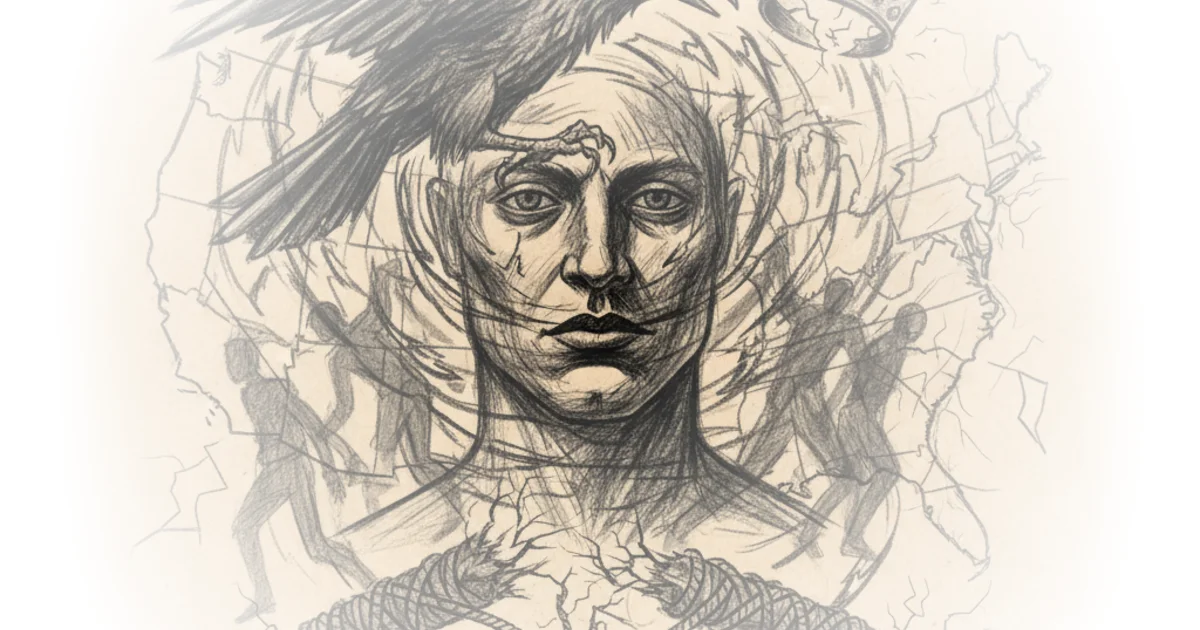
"So there was something refreshingly quaint about Tucker Carlson's recent break with Trump right at the moment when a wedge issue formed in the MAGA coalition and Carlson could start to position himself for a 2028 presidential run," Mounk writes. This observation cuts to the core of the political calculation. The author suggests that the "principles" Carlson claims to have discovered are merely those that serve his long-term ambition.
The commentary highlights the performative nature of Carlson's apology. Mounk describes how Carlson hosted his brother to deliver a sermon-like confession, claiming, "We'll be tormented by this for a long time, I mean I will be. And I want to say I'm sorry for misleading people. It was not intentional." The author finds this difficult to believe given the decades of prior behavior, noting that Carlson has a history of character flaws that he previously dismissed. Mounk argues that Carlson is attempting to reframe his past support not as complicity, but as a tragic error of judgment, a "Road to Damascus" moment that conveniently clears the path for his own ascent.
Faith and patriotism are, in the end, the last refuge of a scoundrel—and they are formidable sanctuaries.
Critics might argue that political realignments are often messy and that a genuine shift in foreign policy views can occur without a hidden agenda. However, Mounk's evidence of Carlson's contradictory stances on foreign intervention and protectionism over the last thirty years suggests a pattern of opportunism rather than ideological evolution.
The Christian Nationalist Gambit
The piece then pivots to the most significant aspect of Carlson's strategy: his appeal to Christian nationalism. Mounk posits that while other potential successors like JD Vance or Marco Rubio are tied to the administration's current trajectory or lack a distinct media base, Carlson has a unique ability to speak the language of the religious right. He identifies Christian nationalism as the "single most stable voting bloc in American politics," a group that has historically supported the administration despite character concerns.
Mounk writes, "Tucker really is one to watch... and this break with Trump may well be the start of the Making of the President 2028, when he would be the first modern candidate to run on a Christian nationalist platform." The author draws a parallel to the uneasy alliance between evangelicals and the administration, suggesting that Carlson can smooth over the theological dissonance that has plagued the movement. He notes that Carlson is positioning himself as a candidate who can claim moral high ground while maintaining the populist fervor of the base.
The analysis takes a darker turn as Mounk examines the theological underpinnings of this new coalition. He references a contentious interview between Carlson and Mike Huckabee, where the two debated the meaning of Genesis and the future of Israel. Mounk observes that while Huckabee articulated a vision of "Greater Israel" rooted in dispensational premillennialism, Carlson offered a more conspiratorial, New Testament-infused critique. The author highlights Carlson's speculation about "dual loyalty" and his comparison of political opponents to the conspirators in the Passion narrative.
"Carlson, in the opposite vein, took a much more, er, New Testament view speculating on whether Jews 'have dual loyalty' and claiming that Huckabee's 'priorities are very clear' in reference to being overly sympathetic to the Jewish state," Mounk writes. This section underscores the author's concern that Carlson is not just adopting Christian rhetoric, but is actively injecting anti-Semitic tropes into the mainstream of conservative politics under the guise of theological inquiry.
The Conspiracy as a Superpower
Perhaps the most disturbing element of Mounk's analysis is his assessment of Carlson's ability to weaponize conspiracy theories. The author details how Carlson has shifted from promoting election fraud narratives to suggesting that the administration itself is a hostage to a shadowy cabal, possibly involving foreign powers and wealthy donors. Mounk points to Carlson's recent comments about the assassination attempts on the former president, framing them not as attacks on a leader, but as evidence of a deeper plot orchestrated by figures like Miriam Adelson.
"As a conspiracy theory, it's a neat reversal of QAnon—with Trump held hostage by a shadowy cabal and needing to be rescued by a white knight, and a white knight with a mega-popular TV show," Mounk writes. This reframing allows Carlson to absolve himself of past support while positioning himself as the only one capable of seeing the truth. The author notes that this narrative is particularly potent because it exculpates the base for their previous actions while directing their anger toward a new, invisible enemy.
Mounk argues that this adaptability is Carlson's greatest strength. He writes, "He is as chameleonic as they come, and, in this era, with the kind of politics we have, what else can his gift for hypocrisy and shape-shifting be but a superpower?" The author suggests that in a political landscape where truth is fluid and loyalty is transactional, Carlson's ability to reverse his positions without consequence makes him a formidable threat.
Hypocrisy is a superpower. Tucker has, as so often happens, changed his stance on every single major issue.
A counterargument worth considering is that the public may eventually tire of such blatant contradictions, leading to a rejection of the conspiracy-laden narrative. However, Mounk's analysis of the current media ecosystem suggests that for a dedicated audience, the consistency of the conspiracy is more important than the consistency of the facts.
Bottom Line
Yascha Mounk's piece is a vital warning that the next chapter of American political turmoil may be written in the language of faith and conspiracy rather than policy. The strongest part of the argument is the identification of Christian nationalism as the new fault line in the Republican Party, with Carlson uniquely positioned to exploit it. Its biggest vulnerability lies in underestimating the resilience of the current administration's base, which may reject any attempt to fracture the coalition. Readers should watch closely to see if Carlson's rhetorical shift translates into a viable political movement or if the contradictions in his narrative ultimately collapse under their own weight.