In a legal landscape often dominated by high-stakes corporate litigation, Devin Stone turns his analytical lens to a peculiarly absurd dispute: a homeowner suing a neighbor because bees are stealing pollen to make honey. Stone's coverage is notable not for the likelihood of a courtroom victory, but for how it dissects the fundamental principles of property and tort law through the lens of a viral internet complaint. He transforms a ridiculous hypothetical into a masterclass on why the law struggles to categorize the natural world, proving that even the most outlandish claims can illuminate serious legal doctrines.
The Illusion of Theft
Stone immediately dismantles the plaintiff's emotional framing, noting that the core of the complaint rests on a misunderstanding of how nature and property intersect. The Reddit poster argues that the neighbor is "unreasonably enriched" by the bees' activities, comparing the insects to a dog stealing tools. Stone writes, "The way I see it this is equivalent to a person's dog coming into my yard to steal balls or tools... then gives it back to his owner who then sells it for profit." While the analogy is vivid, Stone points out that the legal theory of conversion requires proving the defendant intentionally interfered with possession. He argues that the plaintiff would face a nearly impossible burden of proof regarding intent, stating, "We can't know the intent of the bees unless of course they are voiced by Jerry Seinfeld." This highlights a critical gap in the plaintiff's case: the law generally does not impute criminal or tortious intent to the actions of wild or semi-wild animals acting on instinct.
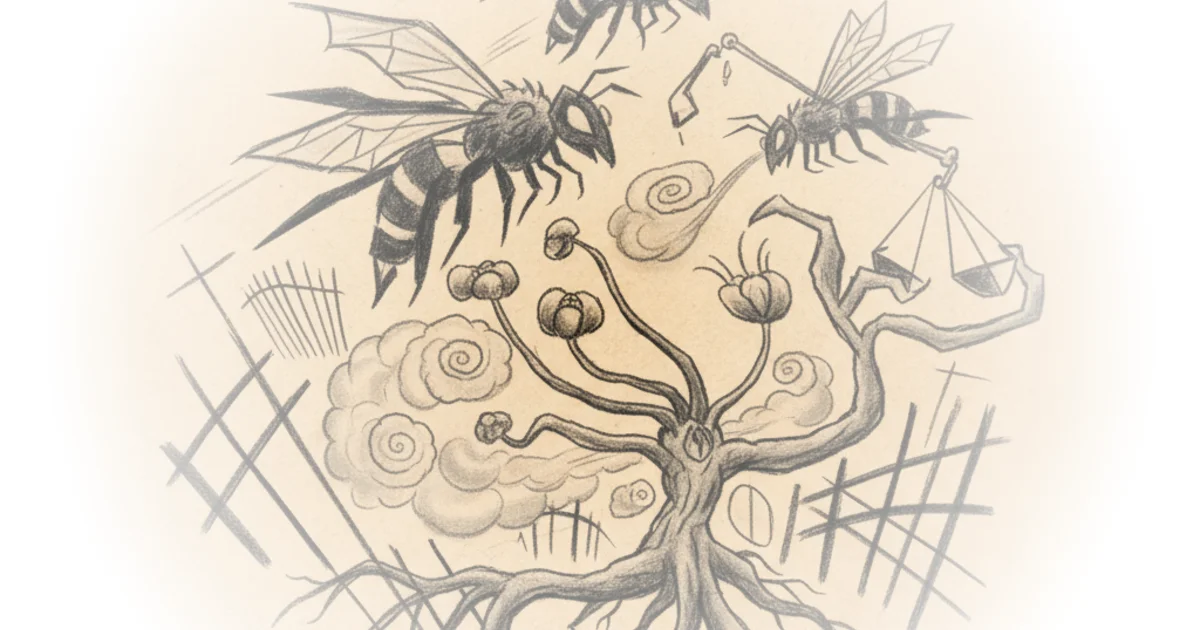
Furthermore, Stone challenges the very notion that the plaintiff suffered a loss. He notes that the bees are likely providing a net benefit to the garden through pollination. "No harm was done to the flowers," Stone observes, adding that "people pay good money for having bees come to their property to pollinate the different flowers there." This reframing is effective because it shifts the focus from the plaintiff's perceived grievance to the objective reality of agricultural economics. A counterargument worth considering is that the plaintiff might value the specific aesthetic or genetic integrity of their flowers over the general benefit of pollination, but Stone correctly identifies that the law rarely protects such subjective preferences without tangible damage.
The Duty of Care and the Reasonable Person
Moving beyond theft, Stone explores the theory of negligence, which hinges on whether the beekeeper owed a legal duty to the neighbor. He explains that negligence requires a breach of the "reasonable person standard," a concept he defines as "a person of ordinary prudence would have exercised under the circumstances." Stone contrasts the Reddit poster's situation with a real-world case in Miami Beach, where a building owner was held liable because they knew of a massive beehive inside the walls and failed to act. In that instance, the owner had a duty because they were aware of a specific, known danger. "The building owners had a duty to act as a reasonable landlord towards the tenants but here they didn't do anything about the problem," Stone writes regarding the Miami case.
However, he argues that the neighbor in the hypothetical scenario has no such duty. Bees flying freely in the air do not constitute a known, actionable hazard in the same way a hidden hive does. Stone notes, "Nobody had a clear duty to stop the bees from flying in the air to a different property." This distinction is crucial; it separates the management of a known risk from the regulation of natural behavior. The argument holds up well because it respects the boundaries of tort law, which generally does not impose liability for the natural movements of animals unless the owner has been negligent in controlling a known danger.
Strict Liability and the Wild Animal Exception
The most complex part of Stone's analysis involves strict liability, a doctrine where a defendant is liable regardless of intent or negligence. Stone explains that this applies to "ultra hazardous activities" or the keeping of "wild animals." He defines a wild animal as one that is "not by custom devoted to the services of mankind in the time and place that it is kept." This definition is the pivot point of the entire legal debate. If bees are considered wild, the neighbor could be strictly liable for any damage. If they are domesticated, the plaintiff must prove negligence.
Stone points out that while bees are often kept in hives, they are not fully domesticated in the legal sense because they still roam freely. "Owners of domesticated animals are generally only liable if they are negligent," he writes, contrasting this with the strict liability applied to wild animals like tigers. This nuance is where the case becomes fascinating. Stone suggests that because bees are so integral to agriculture and so difficult to contain, courts are unlikely to treat them as wild animals for the purpose of strict liability in a residential setting. He notes that "few lawyers, if any, actually deal with wild animals on a regular basis," suggesting that the legal precedent here is thin and likely to favor the beekeeper.
We can't know the intent of the bees unless of course they are voiced by Jerry Seinfeld.
Critics might note that Stone's reliance on the "wild vs. domesticated" distinction may be outdated in an era of industrial agriculture where bees are managed with the precision of livestock. However, his analysis remains grounded in current common law principles, which have not yet caught up to the complexities of modern beekeeping.
Bottom Line
Devin Stone's commentary succeeds by treating a frivolous claim with the seriousness it deserves, revealing how the law struggles to adapt to the fluidity of nature. The strongest part of his argument is the dismantling of the "theft" narrative, showing that the law requires intent and tangible harm, neither of which exist in this scenario. The biggest vulnerability in the plaintiff's case is the inability to prove that the neighbor's actions were anything other than the natural behavior of a beneficial insect, a reality that makes a lawsuit not just unlikely, but legally incoherent.