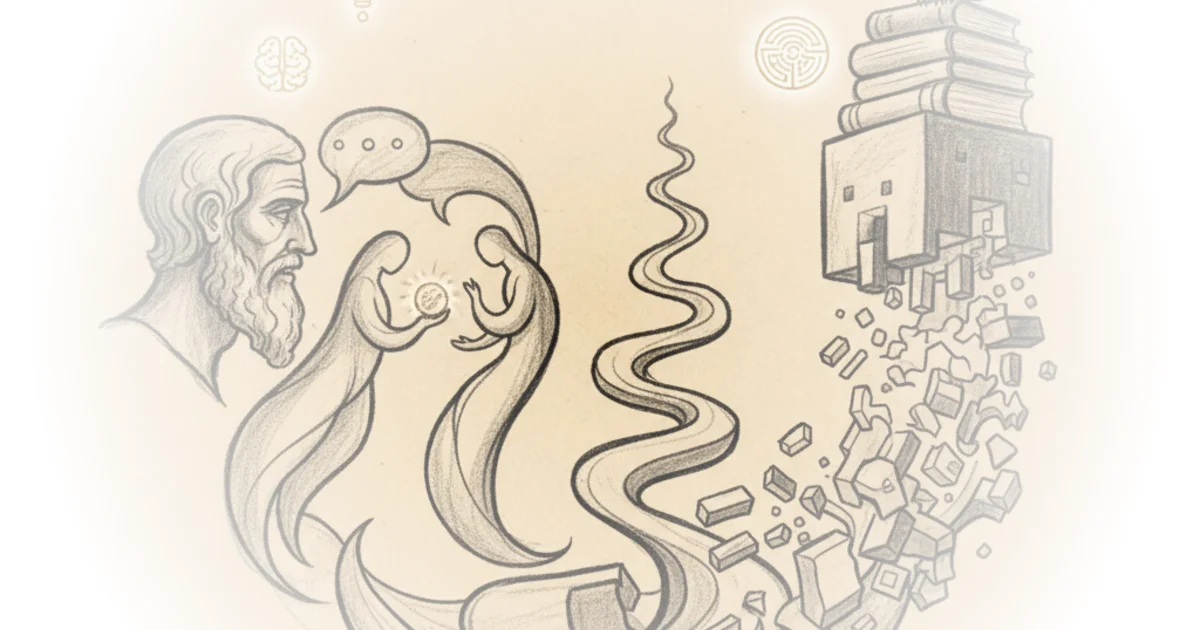
Most guides to philosophy drown beginners in dense treatises and historical timelines, but Jeffrey Kaplan flips the script by arguing that the best entry point isn't the most famous book, but the most conversational one. He bypasses the intimidating weight of Kant and the dry systematicity of Aristotle to curate a list defined not by canonical prestige, but by clarity of argument and immediate intellectual friction. For the busy reader, this is a radical reframing: philosophy is not a museum of dead ideas to be admired, but a live toolkit for dismantling assumptions about God, language, and money.
The Art of the Dialogue
Kaplan makes a bold claim right out of the gate regarding the starting point for any serious student. He writes, "the reason that I think you should start with Plato and not his student Aristotle is not that Plato is more important or more influential than Aristotle but just that Aristotle is weird." This is a refreshing admission that accessibility matters more than historical hierarchy. He champions Plato's Euthyphro not for its antiquity, but for its format: a dialogue that forces the reader to watch two people tear a theory apart in real time. Kaplan notes that Socrates asks a question 400 years before the year zero that "still to this day there is no satisfying agreed upon good answer," highlighting the enduring nature of the Euthyphro dilemma regarding whether actions are good because God loves them or if God loves them because they are good. This approach works because it models the activity of thinking rather than just the result of thinking.
"The point of reading a philosophical work on topic X is to understand topic X to come to some insights about it. The point is not to feel like a smarty pants or to convince other people or to convince yourself that you're sophisticated or cool."
Descartes and the Foundation of Doubt
Moving two millennia forward, Kaplan tackles René Descartes' Meditations on First Philosophy, but with a specific, pragmatic filter. He acknowledges the famous "I think, therefore I am" phrase does not actually appear in the text, yet insists this is the work one must read to understand the concept. Kaplan advises skipping the confusing fourth meditation entirely, calling it "too confusing" for a first pass, and focusing instead on the core project of building knowledge from a foundation of doubt. He frames this not as a dry theological exercise, but as a methodological breakthrough where Descartes argues he has found something he knows to be true for certain: "that he himself exists." This selective reading strategy is a masterclass in efficiency, stripping away the dense metaphysical proofs to get to the epistemological core.
However, a counterargument worth considering is that skipping the theological arguments might leave the modern reader with a fragmented view of why Descartes felt the need to prove God's existence in the first place. Kaplan's pragmatic approach serves the beginner well, but it risks presenting a sanitized version of a thinker whose entire system was inextricably linked to his theology.
The Mind-Body Problem in a Letter
Perhaps the most surprising inclusion is a brief letter from Princess Elizabeth of Bohemia to Descartes. Kaplan highlights how this obscure figure "introduces a problem the foundation for the central debate in the philosophy of mind" with just a few sentences. He quotes her precise question: "I beg of you to tell me how the human soul can determine the movement of the animal spirits in the body so as to perform voluntary acts being as it is merely a conscious substance." Kaplan praises this as a "staggeringly good example of a clear precise question that cuts to the heart of a philosophical Theory and sort of Blows the whole thing up in one move." This choice underscores his editorial thesis: great philosophy often comes from a single, well-posed question rather than a thousand-page answer. It shifts the focus from the grandeur of the philosopher to the sharpness of the problem.
Language, Law, and the Shattering of Ethics
Kaplan continues his curation with David Hume's Dialogues Concerning Natural Religion, explicitly rejecting Hume's masterpiece, A Treatise on Human Nature, because it is "utterly incomprehensible" to the uninitiated. He argues that the goal is insight, not sophistication, and that Hume's later work offers a "clear but subtle and utterly riveting" discussion of the problem of evil. He then pivots to the 20th century with H.P. Grice, using the example of a professor recommending a student with "excellent handwriting" to mean the opposite. Kaplan explains that Grice's solution rests on the idea that "language and conversation in general are a Cooperative Enterprise." This is a vital insight for the modern reader, revealing how much of our communication relies on unspoken agreements rather than literal definitions.
The list concludes with a heavy hitter: Peter Singer's Famine, Affluence, and Morality. Kaplan warns that this paper "will shatter your whole ethical worldview" and might make it "hard for you to sleep for several days after reading it." He quotes Singer's assertion that "the moral reaction that most people in affluent countries have to the of death and starvation of other people in other places in the world cannot be justified." This is the most provocative selection, moving from abstract logic to immediate moral obligation. Critics might note that Singer's utilitarian calculus can feel overly demanding, potentially ignoring the psychological limits of human empathy. Yet, Kaplan's inclusion of it as a foundational text for applied ethics is spot-on; it forces the reader to confront the gap between their stated values and their actual behavior.
Bottom Line
Jeffrey Kaplan's strongest move is his refusal to treat philosophy as a hierarchy of difficulty, prioritizing instead the clarity of the argument and the sharpness of the question. The piece's only vulnerability is that its highly curated, "skip this chapter" approach might inadvertently teach readers to avoid the necessary struggle of wrestling with difficult texts. Ultimately, this is a brilliant guide for the busy intellectual who wants to engage with the practice of philosophy without getting lost in the weeds of academic history.