The most consequential Nobel Prize in history was awarded to a man who helped feed half the world — and whose research also enabled one of the cruelest weapons ever used against humanity. That's the paradox at the heart of Derek Muller's piece on Fritz Haber, and it's precisely why this story deserves attention.
The Guano Islands and the Nitrogen Crisis
Muller opens with a vivid historical detour: American citizens can claim islands covered in bird poop and receive military protection under a law passed in 1856. It's an absurd premise that makes visible something urgent — the global scramble for nitrogen was once as contentious as any territorial dispute.
"The price Rose as high as $76 per pound, meaning you could trade 4 lb of guano for one lb of gold"
This detail matters because it shows how valuable bird excrement once seemed. The guano economy wasn't just curiosity — it was big business driving international conflict. Spain went to war against Peru, Chile, Ecuador, and Bolivia "for control of their guano Laden Islands." By 1872, the guano was running out. The world needed a new way to get its nitrogen fix.
The Science of Breaking Nitrogen's Bond
Muller builds the scientific stakes carefully. Nitrogen is essential for all life — it's part of amino acids, hemoglobin, and DNA. But there's a catch: diatomic nitrogen (N₂) has one of nature's strongest bonds.
"To break apart two atoms of nitrogen requires 9.8 electron volts a tremendous amount of energy"
This is the key to understanding why fixing atmospheric nitrogen was so difficult. The triple bond holding two nitrogen atoms together is extraordinarily strong, requiring immense energy to break. Lightning and soil bacteria produce small amounts of nitrogen compounds naturally, but "there's not enough lightning to produce nitrogen compounds at scale."
The problem: the world faced a potential catastrophe. In 1898, British chemist William Kroos made "a dire prophecy" — without nitrogen, "people all over the world will be dying of starvation in less than 30 years time." He argued that only chemists could save humanity from this crisis.
Fritz Haber and the Discovery
Fritz Haber entered the story in 1904 as "joining a long line of failed chemists" who attempted to synthesize ammonia. But unlike his predecessors, he combined nitrogen and hydrogen at high pressure and high temperature using a catalyst — osmium, obtained from a light bulb company.
"In the third week of March 1909, hobber placed his sheet of osmium in the pressure chamber and then he pressurized and heated the nitrogen and hydrogen to 200 atmospheres and 500° C under these conditions"
The result: "6% turned into ammonia" — a breakthrough that would transform agriculture. BASF commercialized Haber's process within four years, opening a factory producing five tons of ammonia daily.
The Impact on Humanity
Muller calculates the consequences with striking precision:
"On the same plot of land farmers were able to grow four times as much food and as a result the population of the Earth quadrupled"
And more pointedly: "There's a good chance you owe your life to hobb's invention." Around 50% of the nitrogen atoms in your body came from the Haber process. The Earth now supports 4 billion more people than it could without nitrogen fertilizer — this is perhaps the most consequential scientific achievement in human history.
But Muller also documents what happened next, and it's darker.
From Bread to Bombs
When World War I broke out, Haber "volunteered for military duty" unlike pacifist Einstein. He lobbied to convert fertilizer factories into explosives manufacturing — "from bread out of the air to bombs out of the air." But he went further:
"Hober believed that he could do better" — meaning chemical weapons. In December 1914, he witnessed a chemical weapons test and was "unimpressed," believing he could design something deadlier.
On April 22, 1915, German troops released 168 tons of chlorine gas. The effect was devastating:
"Since chlorine gas is 2 and a half times heavier than air it sank into the trenches of the Allied soldiers any soldier that inhaled a lungful of the gas suffered a terrible death chlorine irritates the mucous lining of the lungs so violently that they fill with liquid"
More than 5,000 Allied soldiers died in this first attack. The chemical weapons killed 100,000 soldiers in total during World War I.
The Darker Legacy
After the war, Haber's institute developed a cyanide-based insecticide — Zyklon B. "The Nazis requested chemists remove the foul smelling component" and this chemical was used to perpetrate the Holocaust. This connection is perhaps the most uncomfortable part of Muller's narrative: the same scientist who fed millions also enabled genocide.
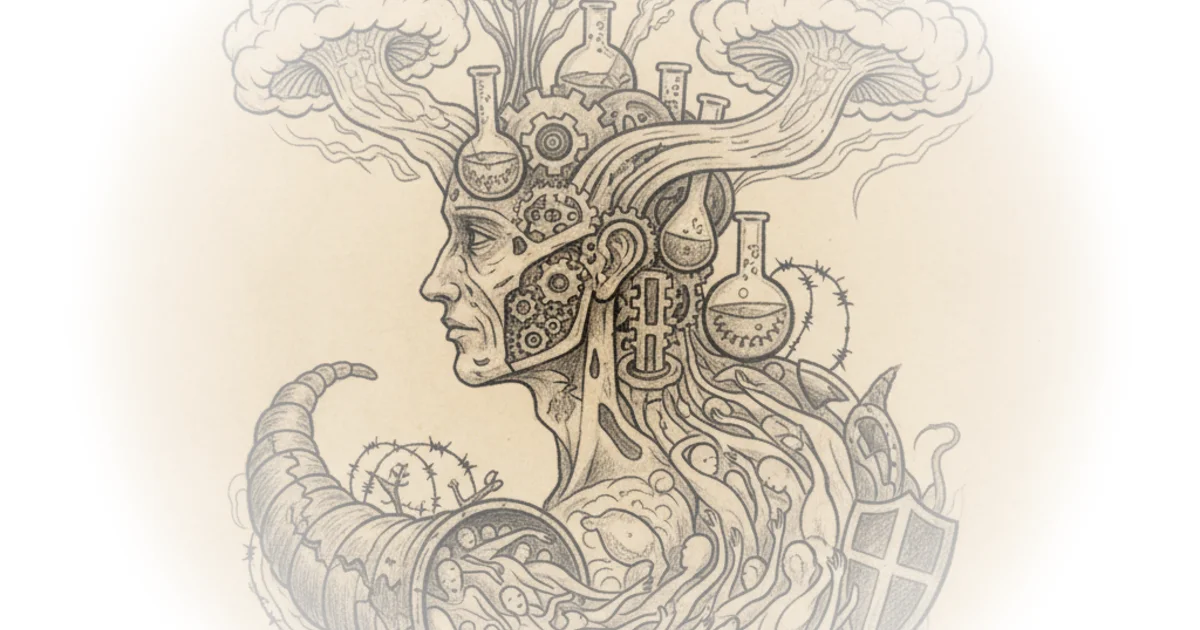
Science gives us ever increasing ways to destroy ourselves, just as it has improved our lives immeasurably.
Muller's conclusion is that every piece of information is a "potential double-edged sword" — ammonium nitrate is both fertilizer and explosive. The question becomes how we control this knowledge without destroying everything in the process.
Counterpoints
Critics might note that attributing too much to individual scientists obscures the broader social and economic systems that enabled both agricultural transformation and chemical warfare. Haber was one scientist, but the infrastructure supporting his work — the factories, the military request for explosives, the later Nazi exploitation — came from elsewhere. The piece occasionally frames the story as heroes and villains when history is more systemic.
Bottom Line
Muller's strongest move is the dual framing: nitrogen fertilizer literally enabled billions of lives, while chemical weapons killed tens of thousands in a single war. The piece's biggest vulnerability is that it sometimes simplifies the moral complexity into individual choice — "it would be easy to paint hober as a villain or as a hero" — when the real story is about how scientific knowledge flows through political and economic systems that shape its use. The tension between feeding humanity and enabling genocide isn't justHaber's personal dilemma; it's built into how research gets funded, applied, and weaponized.
The question Muller leaves us with is the right one: "how do we keep increasing our knowledge and control of the natural world without destroying ourselves" — but it deserves more than rhetorical emphasis. The answer lies not in hoping for better scientists, but in building institutions that channel discovery toward nourishment rather than destruction.