Stephen West of Philosophize This! reframes Fyodor Dostoevsky's notoriously difficult novel Demons not as a historical political thriller, but as a prophetic diagnosis of the modern spiritual crisis. While most literary criticism treats the book's chaotic opening as a narrative hurdle, West argues this disorientation is the very point: it mirrors the confusion of living in a world where traditional moral anchors have been replaced by cold, transactional rationality. For the busy reader navigating a fragmented information landscape, this analysis offers a startling lens through which to view 2025's cultural fatigue.
The Architecture of Chaos
West begins by dismantling the assumption that Demons is merely a story about Russian revolutionaries. He writes, "if Crime and Punishment is a book about a guy that murders a couple of people, but the true drama of the book is in his internal experience... then Demons is a book that masquerades as a political novel." This distinction is crucial; it shifts the reader's focus from external plot mechanics to the internal erosion of meaning. West suggests that the book's surface-level political violence is actually a symptom of a deeper theological void.
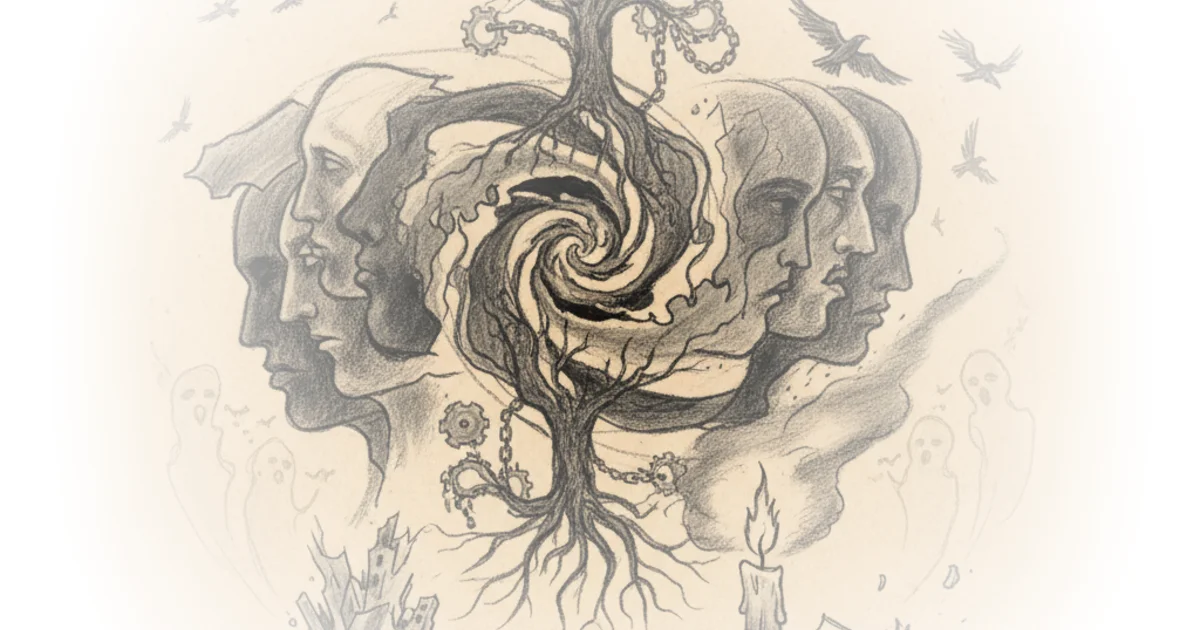
The commentary highlights how Dostoevsky intentionally confuses the reader in the first part of the novel, introducing a dozen characters without clear context. West notes, "Dostoevsky, at no point throughout this entire scene... ever lays out any of the details of these characters in a straightforward way." He argues this isn't a failure of storytelling, but a deliberate simulation of "collective psychology," where we are all dropped into conversations that began long before we arrived. This framing is effective because it validates the reader's frustration, turning a literary obstacle into a philosophical mirror. As West puts it, "unless you're willing to become a political moron and sacrifice your self-respect to some ideology, then we're forced, as honest people, to do the best we can."
Collective psychology is chaotic and disorienting at times. We're born into a world where conversations have been going on politically and philosophically long before we were ever here.
The Trap of Utilitarianism
The core of West's argument targets the specific intellectual currents Dostoevsky feared: the rise of Western liberalism and utilitarianism. He identifies the character Stepan as a proxy for the "highly respected intellectual who's bought and paid for," representing those who believe rational coordination can solve all human problems. West writes, "if you set society up in this way without replacing the connection people have to something bigger than themselves, you might also start to notice people having a hard time not seeing the world through a utilitarian lens."
This section of the commentary is particularly sharp in its critique of modern efficiency. West acknowledges the material successes of this worldview—"it can definitely reduce the infant mortality rate, it can make electricity cheaper and more widely available; it's great at making iPhones for people to read Substack posts on." However, he pivots quickly to the human cost, arguing that without a moral foundation, these gains lead to alienation. He posits that "Western liberalism, despite being a great critical endeavor, doesn't offer a sufficient replacement for these things," leaving people "living in a meaningless universe." Critics might note that this view risks romanticizing pre-modern suffering or underestimating the genuine ethical frameworks that can exist within secular societies. Yet, West's point remains compelling: material abundance does not automatically cure spiritual hunger.
The Enduring Question of Virtue
West concludes by challenging the reader to reconsider the source of social progress. He asks whether improvement comes from better policies or from the "inner virtues of those people, and in the ways they feel connected to those around them." He writes, "if you had a society that wasn't especially well ordered from a rational perspective but was filled with people who felt connected to one another... it would still be a great place to live." This stands in stark contrast to the prevailing narrative that technological or bureaucratic optimization is the only path forward.
The commentary suggests that Dostoevsky's warning is timeless. West argues that "suffering just is a part of the human experience... and trying to rationally coordinate it away entirely is always going to be a losing battle." This is a sobering reminder for an era obsessed with solving every problem through data and policy. While the argument leans heavily on a specific religious worldview, its critique of the "transactional" nature of modern relationships resonates across the ideological spectrum. The danger, as West describes it, is a society where "people can have everything but still feel like they have nothing."
Bottom Line
Philosophize This! delivers a powerful, if uncompromising, reading of Demons that exposes the fragility of a society built solely on rational utility. The argument's greatest strength is its ability to connect 19th-century Russian literature to the modern feeling of alienation, though it occasionally glosses over the complexities of secular moral systems. The reader should watch for how this tension between material progress and spiritual connection plays out in current policy debates, as the cost of ignoring the "inner life" of a society may be higher than ever.