Joeri Schasfoort does something rare in the world of economic forecasting: he admits that predicting the global economy is "frankly madness," yet proceeds to do it with surgical precision. By distinguishing between unpredictable short-term chaos and predictable long-term structural shifts, Schasfoort cuts through the noise of daily headlines to identify five megatrends that will define 2026, including a bold and controversial prediction about a Chinese blockade of Taiwan.
The Art of Predicting the Unpredictable
Schasfoort begins by dismantling the very premise of his own job. He acknowledges that economists have a "bad reputation making predictions" and that the global economy is a "nonhuman complex system" akin to weather, which can only be forecast reliably for a few days. Yet, he argues that while specific events are chaotic, "big macro trends such as globalization or deglobalization... are actually these trends are pretty predictable." This distinction is the anchor of his entire analysis. It allows him to bypass the paralysis of uncertainty that traps many analysts.
"To think that anyone can reliably predict the global economy for a full year ahead is frankly madness."
By accepting this limitation, Schasfoort positions his 2026 outlook not as a crystal ball, but as a map of tectonic plates already shifting. He notes that his previous year's predictions materialized because he focused on these slow-moving forces rather than daily political theater. This approach is effective because it grounds high-stakes speculation in historical patterns rather than wishful thinking. However, critics might note that even long-term trends can be derailed by black swan events that render structural analysis temporarily irrelevant.
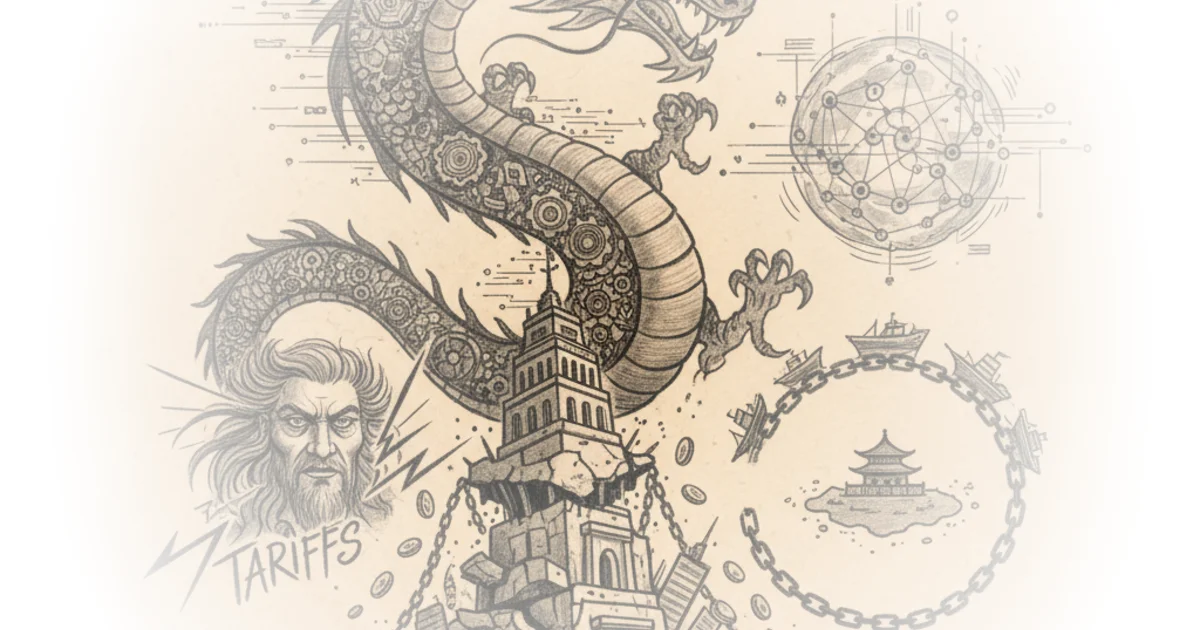
China's Industrial Onslaught
The centerpiece of Schasfoort's 2026 forecast is the relentless expansion of Chinese industrial dominance. He argues that after muscling into sectors like smartphones and electric vehicles, China will now challenge "previously untouchable Western giants like Elon Musk's SpaceX." The author details how China's government uses a specific playbook: first, subsidize a sector to create intense competition, then let the market cull the weak, leaving only the toughest survivors.
"When Europe got rich, when Japan got rich, when Korea got rich, they all naturally started to compete globally in advanced industries. What differentiates China though is that its government is making these 5-year plans."
Schasfoort applies an 80% probability to the idea that China will dominate more industries in 2026, specifically targeting space, advanced chips, and bio-pharmaceuticals. He cites the shipbuilding and battery sectors as proof of concept, noting that China moved from heavy state support in 2006 and 2015 to total global dominance in those fields. The logic is sound: state capital can outlast private capital in the short term, forcing a consolidation that Western firms struggle to match. Yet, the author admits this strategy is not infallible, pointing to China's failed attempts to dominate commercial aviation as a counter-example.
"China's incredible industrial successes are the result of the country getting richer... Then second, they let this intense competition process play out and they stop subsidizing as much."
The Broadening Trade War
If China's rise is the engine, the reaction to it is the exhaust. Schasfoort predicts that the trade war will not remain a US-China bilateral dispute but will broaden globally. He observes that nations from Brazil to Mexico to the Netherlands are already responding to "perceived unfair competition" with tariffs and nationalizations. The core of his argument is that China is breaking the traditional "flying geese" economic model, where wealthier nations pass low-wage manufacturing down to poorer neighbors. Instead, China is using automation to keep manufacturing at home, threatening both advanced and developing economies simultaneously.
"China is breaking the traditional Asian growth model known as the flying geese economic model... Therefore, it's now promoting factory automation which helps to keep simple manufacturing stuff like pencil manufacturing for example in China despite rising wages."
This creates a unique geopolitical friction where developing nations feel squeezed out of their traditional growth path. Schasfoort assigns a 60% probability to this trend broadening, acknowledging that 2026 could be a "correction year" where trade temporarily recovers. This nuance is crucial; it prevents the commentary from becoming a doomsday narrative. He correctly identifies that while the trend is deglobalization, the path will be jagged, with years of recovery interspersed with sharp reversals.
The AI Bubble and the Debt Ceiling
Schasfoort tackles two of the most contentious financial topics with a cool head. On Artificial Intelligence, he argues that while a bubble exists, it will not pop in 2026. He draws parallels to the dot-com era but highlights a key difference: today's AI leaders like Nvidia are generating the revenue to justify their valuations, unlike the unproven startups of 2001.
"Yes, we see signs of a bubble, but looking back at the Chinese real estate bubble, for example, that was called already in 2015 and didn't pop for five more years, then it's very unlikely that the AI bubble will pop in 2026."
He suggests the bubble might burst in 2027 or 2028, or perhaps never, depending on whether the technology delivers on its promise. This is a pragmatic take that avoids the binary "boom or bust" trap. Similarly, on government debt, he predicts that aging populations in Europe and Japan will force "tough choices" that were previously politically impossible. He notes that public debt in advanced economies is now at levels "only seen during the times of Napoleon," creating a ticking time bomb for democratic stability.
"The more people age, the more difficult it will become for democracies to lower pensions... global public debt compared to GDP in advanced economies is now higher than it was during the First World War."
The Geopolitical Wildcard
The most startling prediction in the piece is Schasfoort's fifth megatrend: a Chinese blockade or quarantine of Taiwan. He admits the difficulty of this forecast, noting, "I am an economist. What do I know about geopolitics?" However, he leans on data from the Center for Strategic and International Studies, which surveyed dozens of experts. The consensus is that while China cannot yet invade Taiwan, it has the capability to isolate the island via a naval blockade tomorrow.
"Under international law, a blockade against another nation is considered an act of war. However, only a few nations recognize Taiwan as a nation. So, if Taiwan is not a nation, then maybe its coastline is simply Chinese waters."
Schasfoort suggests China could use the Coast Guard to enforce a "quarantine," blurring the line between law enforcement and acts of war. This is a chilling possibility that reframes the Taiwan conflict not as a binary invasion or peace, but as a gray-zone strategy that could destabilize the global economy without a full-scale war. Critics might argue that the economic cost of a blockade would be so high that it serves as a deterrent, but Schasfoort's reliance on expert consensus gives the prediction weight.
"The experts overwhelmingly think the Chinese Coast Guard is ready to enforce such a quarantine of Taiwan tomorrow if it wants to."
Bottom Line
Schasfoort's strongest asset is his refusal to pretend he can predict the unpredictable; by focusing on structural megatrends like China's industrial strategy and demographic debt, he offers a roadmap that is far more reliable than standard economic forecasting. His biggest vulnerability lies in the geopolitical realm, where the "blockade" scenario, while plausible, hinges on a miscalculation by Beijing that could trigger a conflict far more devastating than any economic model can capture. Readers should watch for the intersection of these trends: if the AI bubble bursts while debt limits bite, the global reaction to a Chinese blockade could be catastrophic.