Ryan Grim & Jeremy Scahill deliver a harrowing inventory of global collapse, where the most immediate threat to human life isn't a new battlefield, but a predictable winter storm hitting a population already stripped of shelter. This daily recap refuses to let the humanitarian catastrophe in Gaza fade into the background noise of geopolitical maneuvering, instead presenting a stark reality: 850,000 people are facing imminent flood risk while the world watches. The piece's distinctiveness lies in its refusal to separate the weather from the war, framing the coming storm not as a natural disaster, but as a man-made amplification of suffering.
The Weather as a Weapon
The authors anchor the narrative in the immediate physical reality of Gaza, where the infrastructure has been so thoroughly dismantled that nature itself becomes an executioner. Ryan Grim & Jeremy Scahill write, "Three days of winter storms are expected to hit Gaza today with flash floods, high winds, and hail," noting that the mayor of Gaza City has already confirmed roads are cut off and tent shelters are submerged. The commentary here is devastatingly clear: the storm is hitting a population that has no capacity to resist it. As Ryan Grim & Jeremy Scahill puts it, "According to the UN, more than 760 displacement sites, housing 850,000 people, face imminent flood risk."
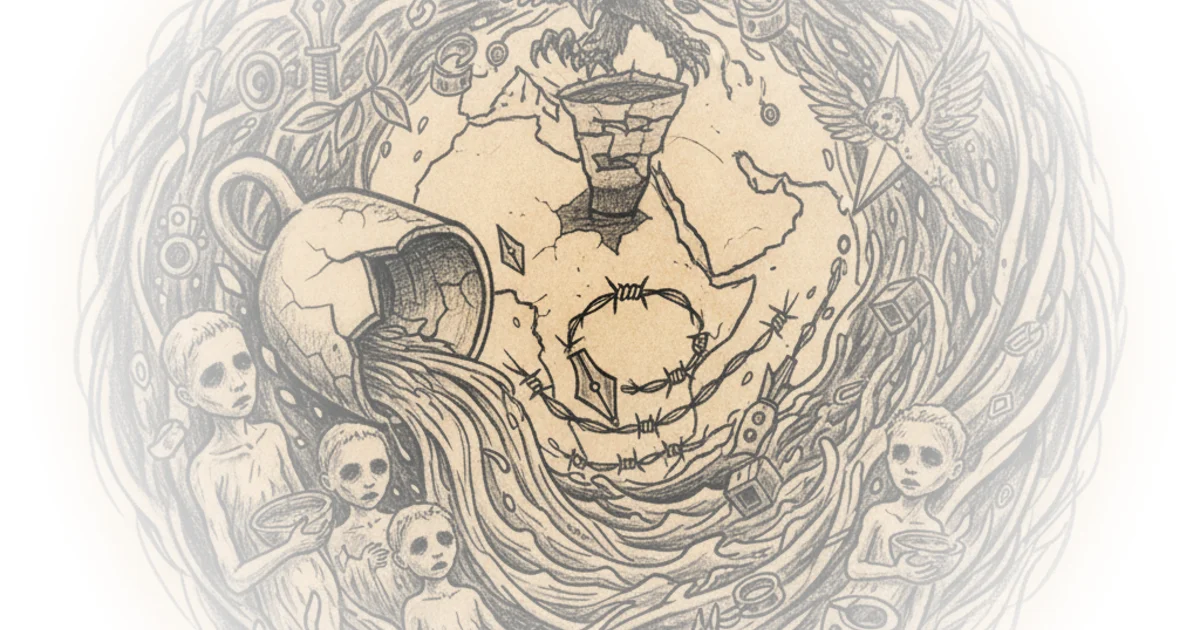
This framing forces the reader to confront the absurdity of the situation. The authors highlight a chilling moment where a broadcaster celebrates the impending deluge, quoting Israeli Channel 14 host Shimon Riklin who, upon hearing the storm would "drown Gaza," replied that he was "happy" to hear it. This isn't just political rhetoric; it is a moral indictment of a system where human suffering is viewed as a tactical victory. The authors rightly point out that while Save the Children calls for tents and blankets, the blockade remains. The evidence suggests that the lack of aid is not an oversight but a policy choice.
"Only a little over one-third of Gaza's school-aged population is enrolled for the 2025–2026 school year, highlighting the severe loss of educational access in the enclave after two years of U.S.–Israeli destruction."
The loss of education is presented not as a temporary setback but as a generational erasure. With 390 temporary classrooms serving nearly 221,000 students, the math is brutal: 567 children per learning space. The authors connect this to the broader casualty counts, noting that since the ceasefire began on October 11, at least 379 Palestinians have been killed and 992 wounded. The ceasefire, in this context, appears to be a pause in active bombardment rather than a restoration of safety or normalcy. Critics might argue that a ceasefire is a necessary first step, but the data presented by Grim and Scahill suggests that without the immediate flow of winter aid, the pause in fighting will not prevent mass death.
The Architecture of Impunity
The coverage expands to the West Bank and the broader region, revealing a pattern of institutional violence that extends far beyond the Gaza Strip. Ryan Grim & Jeremy Scahill report that "More than 100 Palestinians were detained on Wednesday in a wave of Israeli military raids across the occupied West Bank," with many of those detained having been formerly incarcerated. The human cost is personalized through the death of 21-year-old Abdul Rahman al-Sabateen, who died in custody despite showing no signs of health issues during a recent court visit. This detail dismantles the official narrative of safe detention.
The authors also tackle the issue of press freedom with a damning statistic: "Israel killed more journalists in 2025 than any other country for the third consecutive year, with Israeli forces responsible for the deaths of 29 Palestinian reporters—accounting for more than 40 percent of 67 journalists killed worldwide." This is not a byproduct of war; it is a systematic silencing of the truth. The piece further notes that a new B'Tselem report "refutes the IDF's claim that two brothers killed in Nablus in June were 'terrorists,' finding instead that soldiers shot them 'without justification and without them posing a threat.'" This direct contradiction of military claims by independent investigators underscores the authors' argument that official accounts cannot be trusted.
On the diplomatic front, the authors highlight a significant shift with Bolivia restoring full ties with Israel, despite Bolivia being a key member of the Hague Group formed to coordinate legal actions against alleged violations of international law. Ryan Grim & Jeremy Scahill write, "Bolivia had severed formal ties with Israel in October 2023, soon after Israel launched its genocidal assault on Gaza." The reversal suggests a complex diplomatic chess game where legal accountability is being traded for political expediency. A counterargument worth considering is that maintaining diplomatic channels is sometimes necessary to facilitate aid, yet the authors imply that this move weakens the pressure needed to stop the violence.
Global Shadows and Domestic Overreach
The piece masterfully weaves the crisis in Gaza with parallel catastrophes in Sudan and the creeping authoritarianism within the United States. In Sudan, the authors note that while the U.S. sanctioned a "transactional network" funding the Rapid Support Forces (RSF), it "fails to mention the UAE," despite the UAE being the RSF's principal backer. This omission is framed as a deliberate blind spot in U.S. foreign policy. Ryan Grim & Jeremy Scahill write, "UNICEF estimates 10 million have been displaced in Sudan—half of them children—making it the largest child displacement crisis in the world." The connection to the Gaza crisis is clear: when the international community ignores the root causes of conflict, the human toll becomes unmanageable.
Domestically, the authors turn their gaze to the executive branch's expansion of power. The U.S. military's adoption of Google's AI technology is described as part of an "AI-first" push, with Secretary of War Pete Hegseth declaring the military "all in on artificial intelligence as a fighting force." This is juxtaposed with a Senate report finding that immigration officials "detained and brutalized at least 22 American citizens," directly contradicting DHS Secretary Kristi Noem's claim that no citizens were arrested. The authors argue that these are not isolated incidents but symptoms of a system where constitutional rights are eroded in the name of security.
"A Senate investigation found that federal immigration agents unlawfully detained and abused at least 22 U.S. citizens between June and November 2025... and warns that these cases likely represent only a fraction of the citizens harmed."
The coverage also touches on the administration's aggressive stance toward the press, noting that the President accused The New York Times of publishing "fake" stories and suggested it should "cease" publication. This rhetoric, combined with the proposal to scrutinize foreign tourists' social media profiles, paints a picture of a government increasingly hostile to transparency and dissent. The authors do not shy away from the implications: a state that attacks its own press and detains its own citizens is a state in crisis.
Bottom Line
Ryan Grim & Jeremy Scahill have constructed a narrative that refuses to let the reader look away from the convergence of environmental disaster, military aggression, and democratic backsliding. The strongest part of their argument is the seamless integration of the Gaza winter crisis with the broader global context, proving that these are not isolated events but symptoms of a failing international order. The piece's biggest vulnerability is its sheer density of tragedy, which risks overwhelming the reader, yet the authors' unflinching tone ensures that the gravity of the situation is felt rather than just read. The reader must now watch for whether the international community will treat the coming floods in Gaza as a humanitarian emergency or another footnote in a war of attrition.