Sabine Hossenfelder delivers a sobering reality check on the climate crisis, stripping away the comforting narrative that "Net Zero" is a simple finish line we can cross. Her most striking claim is that the term itself is a dangerous oversimplification: reaching Net Zero does not mean temperatures stop rising, nor does it guarantee a stable climate, because the goal ignores the total accumulated carbon and the lag in oceanic heating.
The Illusion of Balance
Hossenfelder begins by dismantling the official definition of Net Zero provided by the International Standards Organization. She notes that the definition describes a state where "human caused residual greenhouse gas emissions are balanced by human lead removals over a specified period." While technically precise, she argues this framing is misleading for the public. The core of her argument is that balancing the books annually does not mean the account is closed; the planet continues to warm until it reaches a new thermal equilibrium, a process that lags decades behind emission cuts.
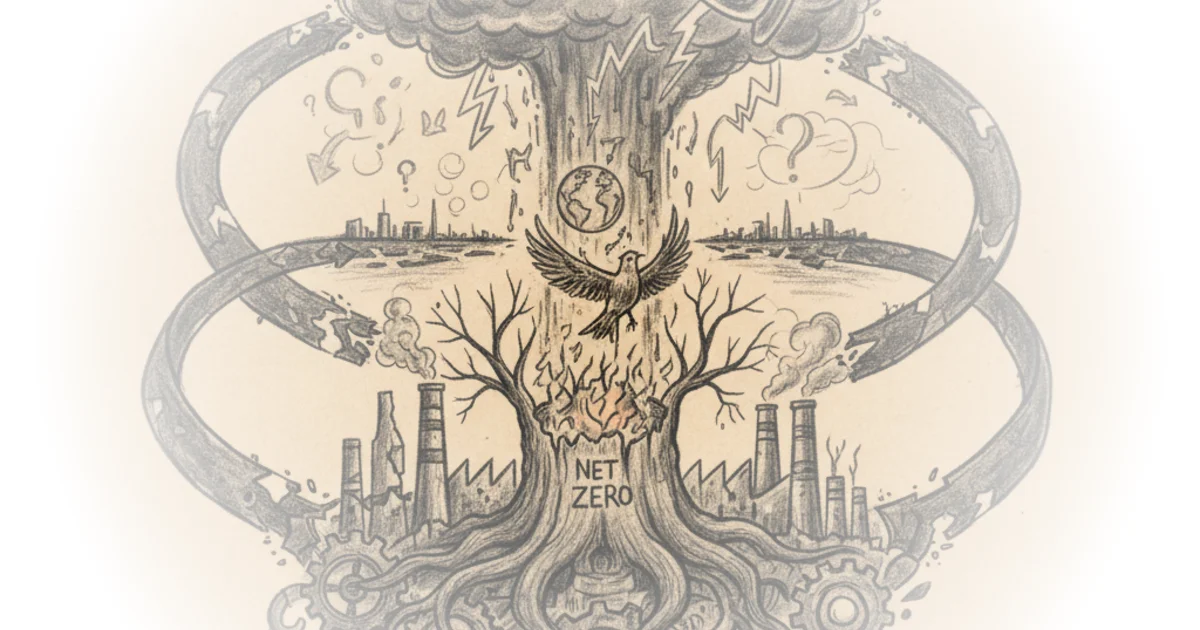
She writes, "Temperatures will not start to decrease once we reach it... rather the temperatures are expected to stabilize." This distinction is crucial. Many policymakers and citizens assume that hitting a Net Zero target is a cure, but Hossenfelder clarifies that it is merely a pause button. The planet retains more energy than it sends back into space, and that excess heat must dissipate before warming halts. This is a vital correction to the prevailing optimism, forcing a shift from "stopping emissions" to "managing the heat we've already trapped."
The Carbon Budget Reality
The piece pivots to the math that makes the current trajectory look dire. Hossenfelder points out that Net Zero only makes sense when paired with a total emissions target. "Net Zero only makes sense in combination together with a total emissions Target basically you need a requirement for the integral over the annual emissions," she explains. Without a cap on the total amount of carbon released, reaching Net Zero at 800 parts per million is a catastrophe compared to doing so at 400 parts per million.
The current data suggests we are far from the necessary path. Hossenfelder observes that "it looks more like net Infinity" rather than a decline toward zero. With global emissions rising and the 1.5°C budget likely exhausted by 2030, the window for a smooth transition is slamming shut. Critics might argue that historical data shows economies can decouple from emissions—citing the EU's 23% reduction in greenhouse gases alongside 61% economic growth—but Hossenfelder counters that these regional successes are being drowned out by the sheer scale of emissions from China and India, which account for over a third of the global population.
The situation is that we're not doing remotely enough to curb emissions and the only thing we can do to get to Net Zero is to actively remove carbon dioxide from the atmosphere.
The Carbon Removal Gamble
Perhaps the most controversial part of Hossenfelder's analysis is her assertion that active carbon removal is no longer optional; it is the only remaining lever. She notes that the International Energy Agency concluded that "reaching Net Zero by 2050 is virtually impossible without carbon dioxide removal." This shifts the debate from prevention to remediation, a massive technological and logistical undertaking.
Hossenfelder highlights a critical confusion in the public discourse: the conflation of Carbon Capture and Storage (CCS) at fossil fuel plants with actual carbon removal. She clarifies, "Carbon capture and storage at fossil fuel plants is not a method of carbon removal it's just a method to reduce carbon emissions." True removal requires methods like Bioenergy with Carbon Capture and Storage (BECCS) or Direct Air Capture. Yet, the current capacity is negligible. "The part that we can improve the one that comes from new technologies of carbon removal is at present 2.3 million tons a year that's about 0.1% of the total," she writes. To meet the 2050 goals, we need to scale this to 5 billion tons annually.
The gap between current reality and necessary scale is staggering. Hossenfelder points out that even optimistic industry projections suggest we might reach 40 million tons by 2030, a drop in the bucket compared to the billion-ton requirement. A counterargument worth considering is whether this focus on unproven technology serves as a moral hazard, allowing governments to delay immediate emission cuts. Hossenfelder acknowledges the friction, noting that environmental groups often lump all carbon capture together, "throwing out the baby that's the carbon removal with the bath water that's fossil fuels with ccs."
Bottom Line
Hossenfelder's strongest contribution is her insistence that Net Zero is a flawed metric if viewed in isolation from the total carbon budget and the physics of oceanic heat lag. Her argument exposes the fragility of relying on future carbon removal technologies that currently exist only on paper. The biggest vulnerability in the current global strategy is the assumption that we can continue emitting until the last minute and then magically scrub the atmosphere clean; the math simply does not support that fantasy.
We've seen it's possible to decarbonize even large economies without sacrificing Prosperity still the challenge is enormous and we're not doing remotely enough.