The Playbook That Never Changes
Glenn Greenwald opens his latest essay with a historical fact that sets the tone for everything that follows: in April 1965, President Lyndon Johnson stood at Johns Hopkins University and told the American public that the escalation in Vietnam was driven by pure benevolence. The Vietnamese people wanted to be freed, Johnson insisted, and the United States had no selfish motives whatsoever. Greenwald uses this as the first exhibit in what becomes a sweeping indictment of American war propaganda across six decades.
The core thesis is blunt. Every major American military intervention since Vietnam has relied on the same four rhetorical pillars, and the current push toward conflict with Iran is no exception.
Despite all of this, the same exact propaganda and deceitful tactics used to sell, justify, and glorify that war have been used for selling every new American war since then. As discredited as these war justifications proved to be, those in the American government and media have never changed the script even slightly for subsequent wars.
The Four Pillars of War Propaganda
Greenwald structures his argument around four recurring tactics. The first is the claim of humanitarian liberation: the insistence that American military force serves the oppressed population of the targeted country. He traces this from Johnson's 1965 assertion about Vietnam through Bush's identical framing on Iraq:
We have no ambition in Iraq, except to remove a threat and restore control of that country to its own people.
Obama used the same language for Libya, describing the bombing campaign as a response to "a plea for help from the Libyan people themselves." The pattern, Greenwald argues, is not merely similar across conflicts. It is virtually identical.
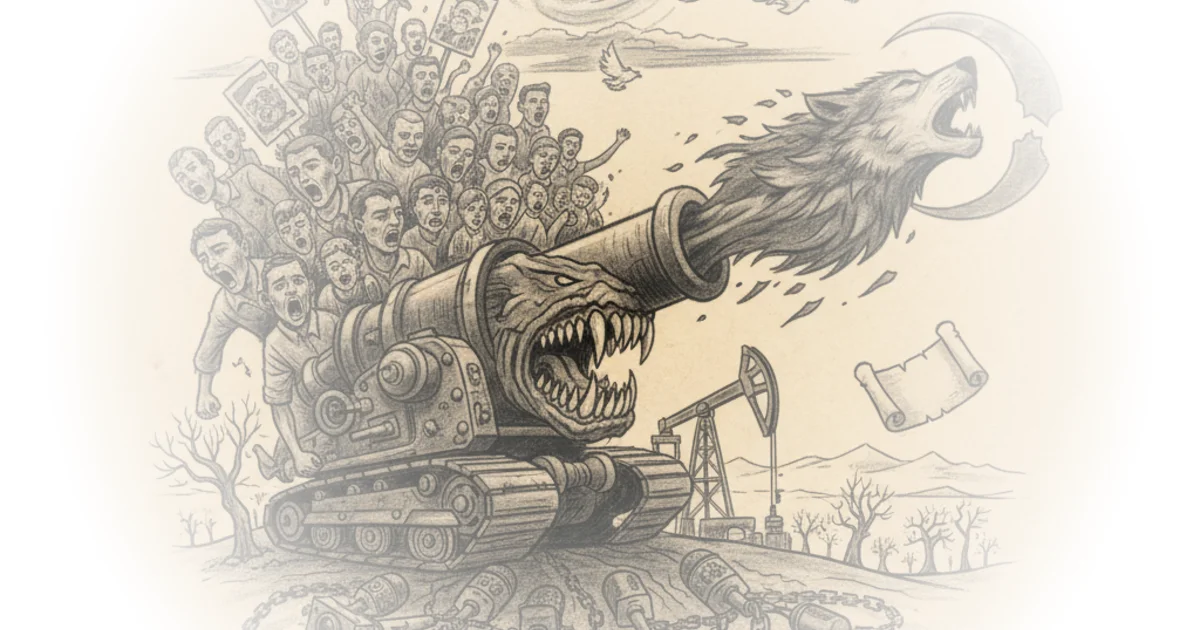
The second pillar involves the manufacture of exile spokespeople. In every conflict, carefully selected dissidents living in the West are presented as authentic voices of the population back home. Greenwald names specific examples: CIA-fronted groups like the American Friends of Vietnam, the fraudster Ahmed Chalabi rebranded as "the George Washington of Iraq," and Libya's National Transitional Council.
Someone sees a Venezuelan living in Miami who says that everyone hates Maduro and wants the U.S. to depose him, and suddenly that becomes proof that the 27 million people who actually live in that country share that sentiment.
The third pillar is the demonization of the target regime as uniquely evil, surpassing ordinary authoritarianism to reach the level of Hitler or worse. Greenwald cites the fabricated testimony of Nayirah al-Sabah before Congress during the first Gulf War, in which she claimed to have witnessed Iraqi soldiers pulling babies from incubators. The story was later revealed to be entirely invented. He notes that similar escalating atrocity claims now surround Iran, with casualty figures for slain protesters climbing from thousands to tens of thousands to over a hundred thousand in rapid succession.
To justify a new U.S. war, it is woefully inadequate to simply allege that the government to be attacked is repressive or even violent. After all, the U.S. has long not only supported but installed and propped up some of the most savage tyrannies on the planet, and still does: from Saudi Arabia and Egypt to Rwanda and Uganda.
The fourth pillar is the vilification of domestic opposition. War skeptics are branded as supporters of the enemy regime, indifferent to the suffering of foreign populations. Greenwald rattles off the accusations with practiced fluency: anti-Vietnam activists loved Ho Chi Minh, Iraq War opponents were "objectively pro-Saddam," critics of the Libya intervention were pro-Gaddafi, and now those questioning an Iran campaign are dismissed as admirers of the mullahs.
The Iran Application
Having laid out the template, Greenwald turns to the present. President Trump has ordered the largest American military buildup in the Middle East since the Iraq War, all directed at Iran. Greenwald contends this represents the fulfillment of a neoconservative ambition stretching back to the aftermath of September 11, when the original plan was to march from Baghdad to Tehran.
The U.S. is closer than ever to carrying out the neocons' primary goal. None of those actual motives for wanting regime-change war in Iran make an appearance in the war propaganda pushing this war.
He describes the current propaganda campaign as more intense than even the run-up to Iraq in 2002 and 2003. Iran, he notes, has three times Iraq's population. The stakes of miscalculation are proportionally larger.
Greenwald points to polling data showing that Americans overwhelmingly oppose new regime-change wars. A majority now view Vietnam as a mistake. Supermajorities reject interventionism. But he argues that public opinion has never been the decisive factor.
But enough people are cowed by these tactics -- and understandably so: who wants to be accused of being pro-Saddam or pro-Putin or pro-Ayatollah? -- for just long enough that the U.S. can launch the new war without substantial resistance.
Where the Argument Stretches Thin
The pattern Greenwald identifies is real and well-documented. The repetition of humanitarian justifications, fabricated atrocity stories, and exile-as-spokesperson tactics across American conflicts is a matter of historical record, not conjecture. Where the argument loses some precision is in its treatment of every targeted regime as functionally interchangeable. The Iranian government's repression of women, religious minorities, and political dissidents is not a fiction invented by war propagandists, even if the specific casualty figures Greenwald flags are inflated or unreliable. Acknowledging that a regime is genuinely authoritarian does not automatically validate military intervention against it, but collapsing the distinction between real abuses and manufactured pretexts weakens an otherwise rigorous case.
There is also the question of what Greenwald proposes as an alternative. The essay is diagnostic rather than prescriptive. He excels at identifying the disease but offers no treatment beyond the implicit counsel of skepticism. For readers already inclined to oppose intervention, that may be sufficient. For those genuinely torn, the absence of any framework for when force might be justified leaves a gap.
The Weight of Repetition
The article's greatest strength is its accumulation of evidence. Greenwald does not merely assert that propaganda repeats; he walks through Vietnam, both Gulf Wars, Afghanistan, Libya, Syria, Ukraine, Venezuela, and Iran, quoting presidents, vice presidents, and manifestos at each stop. The effect is deliberately overwhelming.
Every time the U.S. Government is gearing up for a new war, it assures Americans that the war will free the oppressed peoples of that country from their never-before-seen evil dictators, so everyone can feel good about the bombs falling and the resulting carnage.
The Vietnam section is particularly effective. Greenwald notes that 62 percent of Americans now view that war as a mistake, and 74 percent of Vietnam veterans say Johnson misled the public. He connects this to the revelation that the Gulf of Tonkin incident, the stated reason for war, was a complete fabrication, as even the United States Naval Institute now documents.
The consensus of historians is that much, if not all, of the most lurid stories were fabricated. Such inventions were necessary because the CIA and Pentagon understood that Americans could be convinced to support virtually any new war if they believed that the enemy's crimes were not ordinary but of the greatest historical evil.
Bottom Line
Greenwald has written what amounts to a field guide to American war propaganda, using sixty years of examples to argue that the current push toward conflict with Iran follows an unchanged script. The historical parallels are striking and well-sourced. His strongest point is also his simplest: the people who were wrong about Vietnam, Iraq, Libya, and Syria are using the same arguments, in the same sequence, with the same emotional manipulation, to sell a new war against a country three times the size of Iraq. Whether one shares his conclusions or not, the pattern he documents deserves serious engagement from anyone being asked to support the next intervention.