In an era defined by algorithmic convenience, Daniel Parris makes a startling claim: the most rational economic choice for film lovers is now an irrational emotional one. While data confirms the death of the DVD as a mass-market product, Parris argues that its survival as a collector's item reveals a deeper human need for tangibility in a digital world—a nuance lost in the standard obituaries for physical media.
The Economics of Obsolescence
Parris begins by dismantling the nostalgia trap with hard numbers, noting that 2023 was a "disastrous year" for the industry, marked by the simultaneous decline of sales, the end of Netflix's disc service, and Best Buy's exit from the market. He writes, "In the first half of 2023, physical media sales in the U.S. decreased to $754 million, down from $1.05 billion during the same period in 2022." This statistical drop is not merely a trend; it is a structural shift. The author correctly identifies that the rise of streaming in 2007 created a friction-free alternative that made ownership impractical for the average consumer. As Parris puts it, "Consumers didn't have to settle for video rental stores or cable reruns... consumers could watch something remarkable whenever they pleased."
The argument here is compelling because it acknowledges the sheer efficiency of the streaming model. Parris calculates that building a physical library of one's favorite films is financially and spatially inefficient compared to a subscription. He notes, "To collect DVDs is to embark upon a path of financial inconvenience." This framing is effective because it validates the reader's likely skepticism before pivoting to the core thesis: that the hobby has shifted from utility to identity. Critics might note that this analysis underestimates the risk of digital libraries disappearing entirely, a genuine concern for archivists, but Parris's point is that for the mass market, the convenience of streaming has already won.
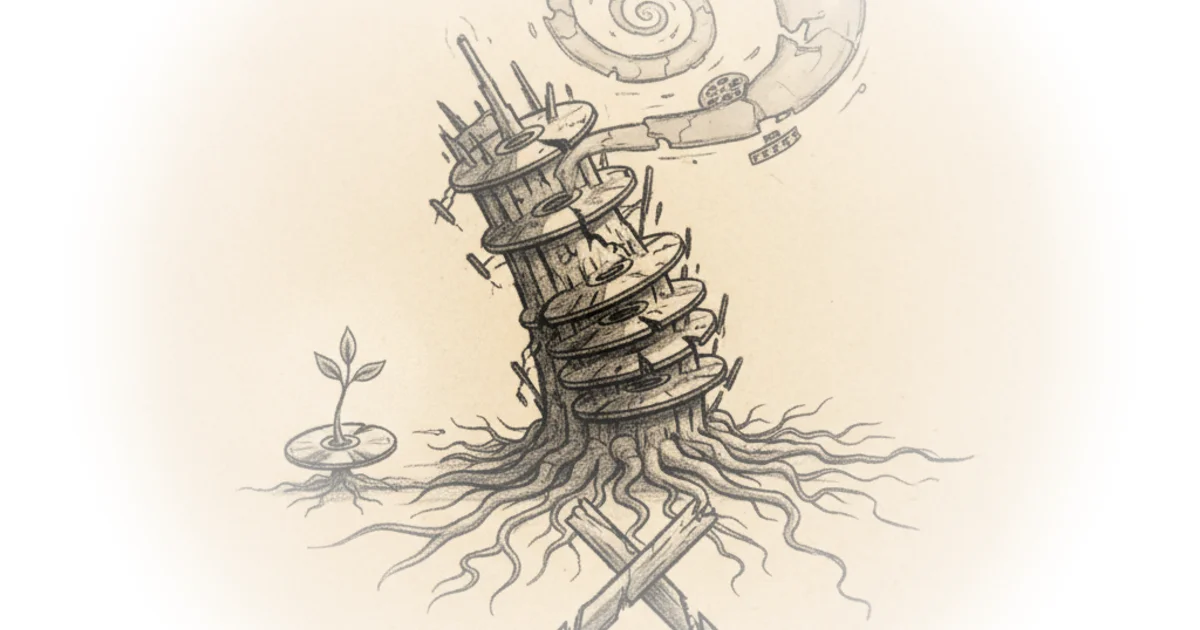
The discontinuation of Best Buy and Netflix's DVD programs was broadly seen as a death knell for physical media.
The Collector's Paradox
The piece's most distinctive contribution is its reframing of the DVD not as a storage medium, but as a "form of self-expression." Parris observes that while retail channels have collapsed, a vibrant secondary market has emerged on platforms like eBay, creating a "bizarre market bifurcated into two distinctive product offerings." On one end, bulk lots sell for pennies; on the other, boutique labels like the Criterion Collection have seen search traffic nearly triple. He describes the allure of the high-end market: "On one end are sellers indiscriminately unloading boxfuls of Blu-rays for less than $2 a disc... On the other end of the spectrum is an upscale market for collectors interested in high-quality packaging."
This observation connects to a broader historical pattern. Just as the decline of VHS paved the way for the DVD's dominance in the late 1990s, the decline of the DVD is now fueling a niche market for premium physical artifacts. Parris admits the absurdity of this pursuit, asking, "Should I indulge myself or be a rational actor?" He candidly admits that buying a $73 copy of The Social Network is "quantifiably foolish," yet he proceeds anyway. This honesty is the piece's strength; it refuses to romanticize the hobby as a noble act of preservation, instead labeling it a pursuit of "emotional gratification." As Daniel Parris writes, "People (myself included) are trading convenience and economic efficiency for emotional gratification."
A counterargument worth considering is that this "revival" is merely a redistribution of wealth among a tiny subset of wealthy enthusiasts, offering no real benefit to the broader film ecosystem. However, Parris suggests that for the individual, the value is intrinsic. He notes that the act of collecting allows cinephiles to "retreat online and turn backward," finding community in the shared obsession with the tangible object.
The Irrational High
The commentary culminates in a personal confession that transcends the data. Parris describes the thrill of finding a bargain and the subsequent realization of the hobby's inherent contradiction. "Standing outside the record store, prize in hand, I couldn't help but rejoice... And then, standing there, holding a relic of a dying technology, I realized that I might have been the idiot." This moment of self-awareness is crucial. It prevents the piece from becoming a manifesto for luddites and instead positions it as a meditation on human psychology.
The author concludes that the motivation is simple: "I have one reason for collecting physical media: Movies have been a big part of my life, and I want to own the things I love in material form." He compares the feeling to a child collecting Pokémon cards, a metaphor that perfectly captures the irrational joy of ownership. While he admits he does not believe his collection is preserving film history or that streaming will fade away, he chooses to "suspend my cynicism." This willingness to embrace the irrational in a world of data is a powerful counter-narrative to the purely utilitarian view of modern consumption.
Forming an emotional attachment to a piece of cardboard or a DVD case is bizarre, but is it wrong?
Bottom Line
Daniel Parris's analysis succeeds by refusing to force a logical justification onto an illogical hobby, instead arguing that the value of physical media has migrated from the screen to the shelf. The piece's greatest vulnerability is its reliance on a niche collector's perspective that may not resonate with those who view media purely as content, but its strength lies in its honest admission that in a digital age, the desire to "own" something is a deeply human, if economically inefficient, impulse.