Dan Carlin has a habit of making listeners rethink everything they thought they knew about history. In this episode, he turns his attention to something that seems simple but is actually revolutionary: the vast majority of human history happened before anyone wrote anything down.
"anatomically modern human beings have been around from between 250 and 350,000 years ago"
This is Carlin's opening gambit — a number so large it reframes everything. He's not talking about the last five thousand years (the typical scope of what we call "history"). He's talking about the entirety of human existence.
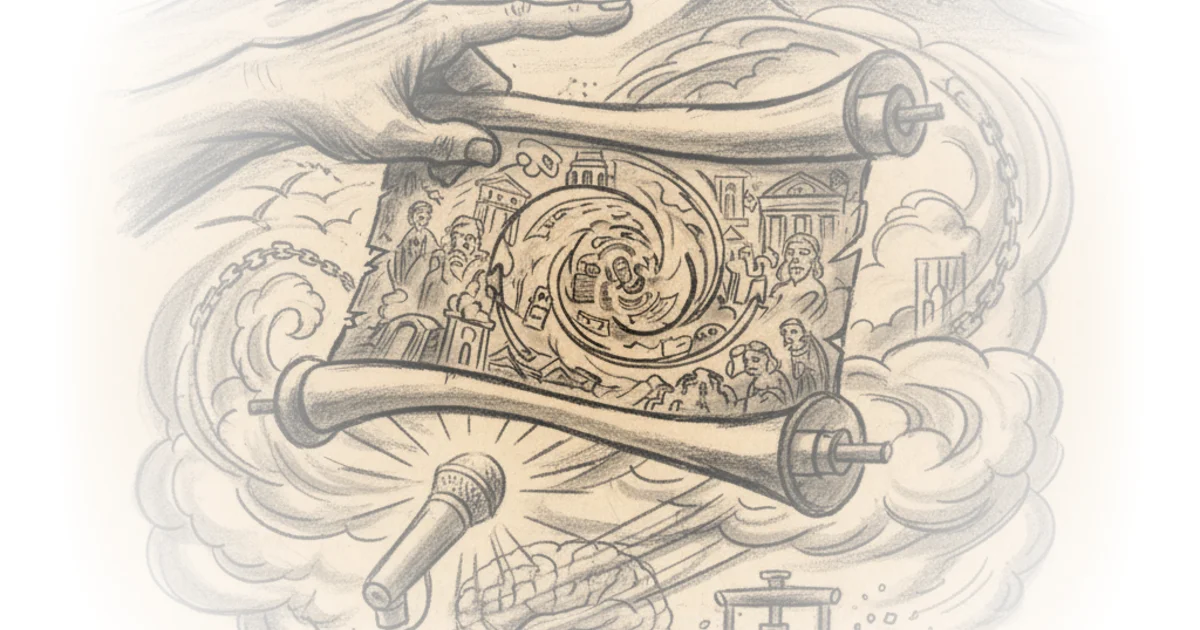
Carlin frames this through an unusual lens: he's thinking about what a great galactic history book would say about Earth. Not a newspaper column, but something like Tolkien's Middle-Earth — a time period in our own world before the so-called age of man began. The analogy is playful, but the point is serious. When aliens condense humanity's entire existence down to a few points, what do they prioritize?
The piece's real power comes from Carlin's DNA ancestry test experience. He sent away expecting to learn whether he was Irish or Scandinavian. Instead, he got something profoundly different: results about ancestors who moved out of Africa 150,000 years ago, lingered in what's now Southern Russia, and stopped long before modern ethnicities developed.
"it never even got to the point where Modern ethnicities developed right stopped before then"
This is what Carlin calls deep genealogy — ancestry that goes far beyond what ethnicity tests typically tell you. And it's his way of making a larger argument: we tend to assume human history starts where our history books start, but that's an illusion created by convenience rather than reality.
Carlin points out that traditional history combines with archaeology and anthropology to uncover the prehistoric past, yet traditionally history started with writing and urban societies. The implication — stated rarely but felt constantly — is that nothing of real value happened before urbanism.
This framing works because it inverts what we consider important. Carlin notes that anatomically modern humans have been around for 300,000 years, while conventional historical records cover maybe five or six thousand. The vast majority of human history happened before the Agricultural Revolution, before Sumeria, before any of the markers we treat as civilization's birth.
"the vast vast majority of the history of the human species predates where your history books start"
The piece also touches on behavioral modernity — a distinction anthropologists make between anatomically modern humans and behaviorally modern ones. Use of fire and that sort of deal goes back around 150,000 years. It's another reminder that what we consider "recent" in human development is still just the thinnest edge of an enormous timeline.
Critics might note that Carlin's framing risks romanticizing prehistory — there's no actual evidence of complex societies or great leaders from 300,000 years ago. But he's not claiming we had full-fledged civilizations then; he's asking what might have happened in those 295,000 years before recorded history, and suggesting it deserves more attention than we give it.
Bottom Line
Carlin's strongest move is the galactic history book thought experiment — imagining how aliens would summarize human existence. His biggest vulnerability is that the piece stays in hypothetical territory rather than grounding itself in specific archaeological finds. The DNA test story works as a personal hook, but readers looking for concrete evidence of prehistory won't find it here. What they're getting instead is a provocation: 300,000 years of human history we barely know anything about, and Carlin makes a convincing case that maybe we're the ones missing out.