Cory Doctorow delivers a searing indictment of the artificial intelligence boom, arguing that it is not a technological inevitability but a psychological escape hatch for the ultra-wealthy. He posits that the trillions poured into AI are driven by a desire to eliminate the friction of human interaction, creating a solipsistic fantasy where the only real people are the owners and everyone else is an expendable NPC. This is not a story about efficiency; it is a story about the refusal to accept that other people have valid, conflicting priorities.
The Solipsism of the Billionaire
Doctorow frames the current AI rush as the ultimate expression of a specific worldview: the belief that "hell is other people." He argues that while humanity has evolved social structures to coordinate and persuade, the wealthy have chosen a different path. "Rather than coercing other people into arranging their affairs to suit our needs, we've devoted trillions of dollars to replacing people with pliant chatbots," Doctorow writes. The goal is a world where one does not have to negotiate, compromise, or consider the needs of a stubborn, living human being.
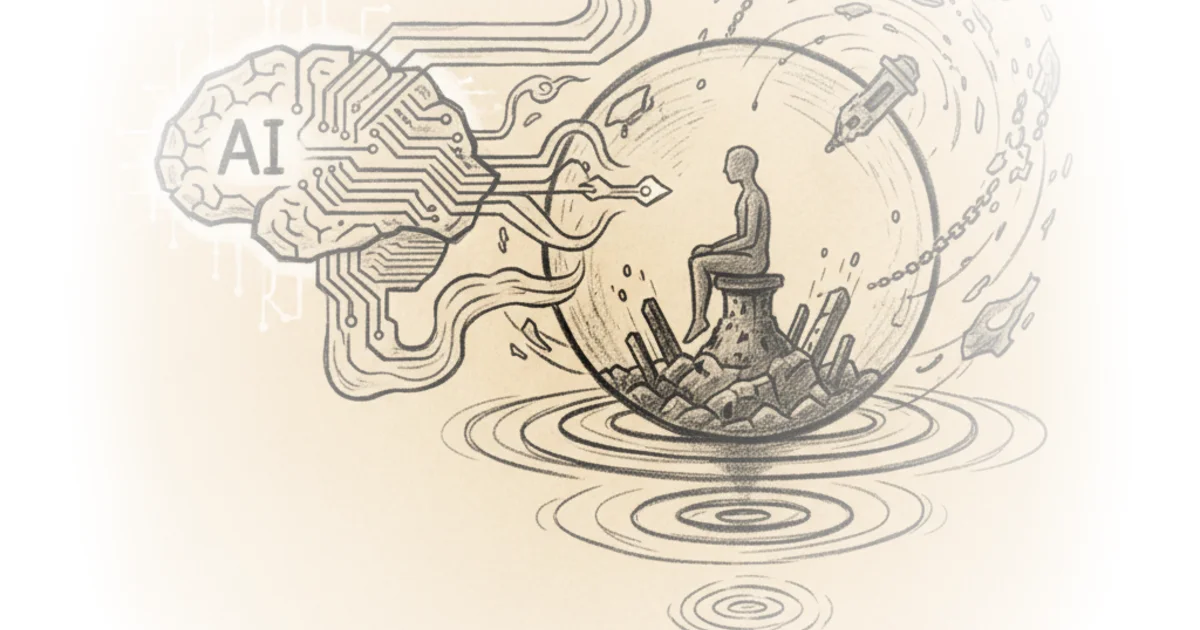
This framing is powerful because it connects disparate phenomena—from AI boyfriends to automated warehouses—under a single, disturbing psychological motive. Doctorow notes that this is not new; it is simply a privilege that was once the exclusive purview of the ultra-rich. "AI has democratized solipsism, a privilege that was once the exclusive purview of billionaires, whose belief that most other people weren't fully real let them inflict the kind of mass pain on millions that is a prerequisite for amassing a truly vast fortune." The argument suggests that the technology is merely a tool to enact a pre-existing desire to dehumanize.
AI has democratized solipsism, a privilege that was once the exclusive purview of billionaires.
The piece draws a sharp line between human collaboration and the automation of labor. Doctorow points to the logistics industry, where the drive for automation has led to inhumane working conditions. He observes that "Jeff Bezos's machines don't just use humans, they use them up," because the massive capital investment in automation requires humans to be pushed to their absolute physical limits to justify the expense. The system is designed to treat people as bottlenecks to be squeezed rather than partners in production.
Critics might argue that automation is a natural economic progression that lowers costs for consumers and creates new types of jobs. However, Doctorow's focus on the intent behind the investment challenges the notion of neutral technological progress. He suggests that the drive is not about solving labor shortages but about removing the agency of the worker entirely.
The Political Double-Bind and the Migrant Question
The commentary takes a darker turn as Doctorow connects this technological fantasy to the political crisis of aging nations. He argues that politicians in wealthy countries face a contradiction: their economies desperately need young, skilled migrants to sustain growth, yet their voter bases are increasingly xenophobic and hostile to immigration. "In feeding the fantasy of a world without people, AI serves the fantasy of a world without migrants," he writes.
This is a crucial insight that reframes the AI narrative from a purely economic one to a geopolitical and moral one. Doctorow explains that for autocrats and populists, AI offers a way to bypass the need for human labor without the political cost of welcoming outsiders. Unlike human workers, AI "makes no demands, requires no moral consideration, and does not attempt to germinate a culture, a cuisine, or a language in your sacred soil." The technology becomes a tool to satisfy the "racist sadism" of a base while keeping the economy running.
Doctorow references the film Big Hero 6 to illustrate this cultural undercurrent, noting that the story's premise is essentially that "it will be more politically possible to have robots look after our aging parents than it will be to welcome the millions of skilled health-workers in the Pacific Rim who are eminently qualified to do the job." This historical parallel highlights how automation has long been a substitute for social solidarity and international cooperation.
The argument extends to the concept of the "unnecessariat." Doctorow warns that the ultimate goal of total automation is to render the entire working class surplus to requirements. "The wealthy have always dreamed of transforming the proletariat into the precariat: desperate workers who do as they're told. But in the automation story of which AI is the latest chapter... the precariat becomes the unnecessariat: workers who are surplus to requirements and can be vaporized or liquidated or warehoused or simply ignored." This echoes the themes of "enshittification" found in his other work, where platforms degrade to serve only the interests of the owner, but here the degradation is existential.
In the fantasy world of total automation, the owners of AI can make the world go around without any of us.
The Illusion of Control
Doctorow also critiques the specific visions of the future promoted by tech leaders, such as Sam Altman's proposal for a biometrically controlled universal basic income. He describes this as a "charter school for everything," where the state's only role is to distribute vouchers redeemable only for services provided by the tech oligarchy's robot army. This vision relies on the belief that people are not real agents but data points to be managed.
The piece concludes by linking this attitude to "effective altruism," a philosophy that Doctorow argues is predicated on the devaluation of living people. He writes that proponents of this view "genuinely don't think other people are really, truly real," preferring to focus on the hypothetical welfare of trillions of future artificial beings rather than the suffering of the eight billion living. This is a scathing critique of the moral calculus driving the AI industry.
A counterargument worth considering is that AI could eventually augment human capabilities rather than replace them, leading to a post-scarcity society. However, Doctorow's evidence suggests that the current trajectory is defined by the desire to eliminate human friction, not to enhance human potential. The investment patterns and the rhetoric of industry leaders support his claim that the goal is replacement, not augmentation.
Bottom Line
Doctorow's most compelling contribution is his identification of solipsism as the driving force behind the AI boom, shifting the debate from technical feasibility to moral intent. The argument's greatest strength is its ability to connect the dots between warehouse automation, social media algorithms, and immigration policy under a single, coherent critique of power. The biggest vulnerability lies in the assumption that the current trajectory is inevitable, potentially underestimating the resilience of human labor movements and the regulatory pushback that could alter the course of development. Readers should watch for how this "world without people" fantasy plays out in the next wave of labor negotiations and immigration debates.