Jordan Schneider's travelogue does something rare for a piece about South Korea: it refuses to let the glossy veneer of K-pop and skincare obscure the brutal machinery of history and the fragility of its democracy. While most observers fixate on the aesthetic exports of the "Korean Wave," Schneider and their co-reporters, Irene and Lily, pivot sharply to the dark underbelly of the nation's beauty standards and the haunting, meticulously preserved memory of the Gwangju Uprising. This is not a vacation diary; it is a forensic examination of how a society processes trauma, commodifies its women, and navigates a terrifying political present that echoes its violent past.
The Price of Perfection
The piece begins by dismantling the romanticized view of Hallyu, the "Korean Wave," revealing it as a survival mechanism born from historical coercion rather than mere cultural soft power. Schneider writes, "Goryeo (the royal dynasty that ruled the Korean Peninsula from 918 to 1392) began sending women by the hundreds as tributary gifts to the Chinese empire during the Tang dynasty." This historical context reframes the modern obsession with beauty not as a choice, but as a continuation of a centuries-old pattern where female bodies were treated as currency for political stability. The authors trace a direct line from these tributary gifts to the Japanese colonial era's forced sexual slavery and the post-war sex trade around American military bases, arguing that "beauty remains one of Korea's most prominent exports."
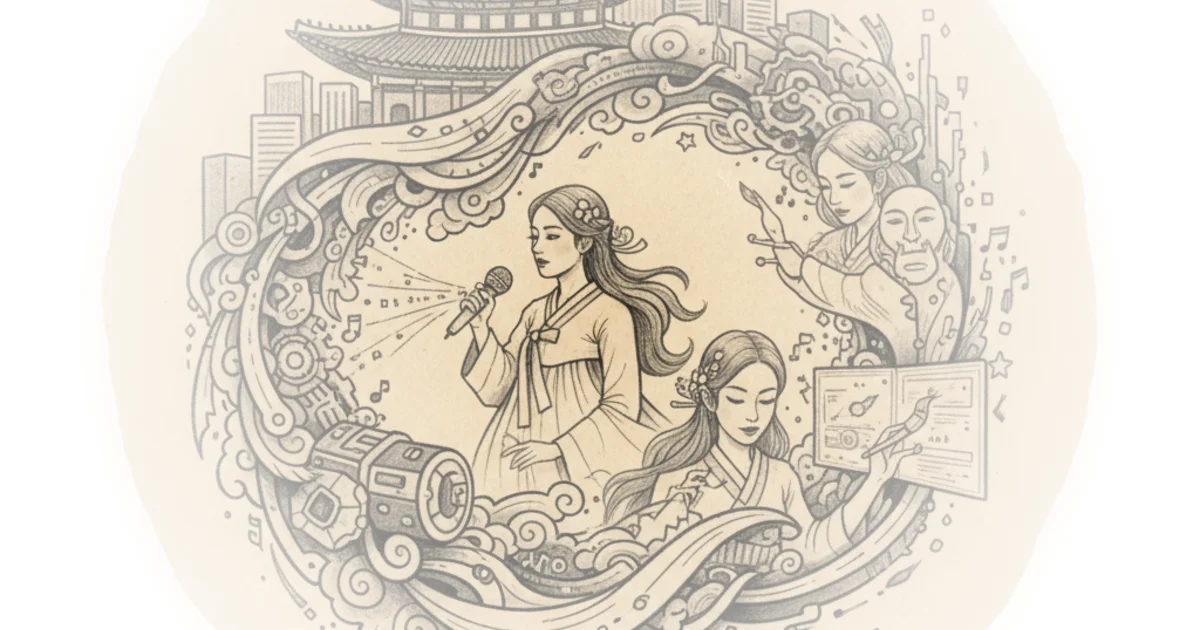
The commentary on the modern beauty industry is particularly stinging. Schneider notes that while American cosmetics are marketed as tools of self-expression, Korean advertising relies on language of correction. "Cosmetic advertisements in Korea use words like 'perfection' 완벽 and 'improvement' 개선 to draw consumers' attention," the author observes. This linguistic shift is not trivial; it signals a societal demand for conformity over individuality. The authors describe the "surveillant gaze"—a concept from sociologist Rosalind Gill involving measuring tapes and microscopes—that incites women to constantly police their own appearance. As journalist Elise Hu is quoted in the text, looking pretty has become "the price of entry in the labor market."
"Appearance-based discrimination is endemic; for Korean women in the 21st century, looking pretty is 'the price of entry in the labor market.'"
Critics might argue that the global success of K-beauty suggests a form of empowerment through economic agency, yet Schneider's evidence of the limited product range—where "nearly every Korean lip product is sheer, glossy, and pink"—suggests a rigid standard that leaves little room for deviation. The observation that American and European brands occupy a "totally desolate" aisle in Seoul's most popular stores reinforces the idea that the local market is not just dominant, but exclusionary.
The Land of Light and the Weight of Memory
The narrative shifts dramatically from the superficial to the profound as the authors travel to Gwangju, the site of the 1980 massacre. Here, the piece becomes a meditation on how a nation remembers its dead. Schneider details how the military dictatorship under Chun Doo-hwan attempted to erase the event, yet the city has responded with an almost obsessive archival precision. The authors highlight the renaming of the Jeonil Building to "Jeonil 245" after the 245 bullet traces found on its facade, a physical testament that "conclusively prove that paratroopers shot at people from helicopters."
The human cost is brought into sharp focus through the words of Nobel laureate Han Kang. Schneider quotes her description of the aftermath: "The national anthem rang out like a circular refrain, one verse clashing with another against the constant background of weeping, and you listened with bated breath to the subtle dissonance this created. As though this, finally, might help you understand what the nation really was." This passage underscores the tragedy of a democracy built on a foundation of silence and blood. The authors note that the official death toll is 164, but the reality likely involves thousands, including a four-year-old child buried in an "unknown martyr" grave.
The piece does not shy away from the uncomfortable role of the United States in this history. Schneider points out that "Washington's complicity in the Gwangju Massacre is a delicate topic for the US-ROK alliance." Declassified documents reveal that the Carter administration prioritized the security status quo over human rights, authorizing the use of South Korean troops against their own citizens and dismissing the protests as "riots" fueled by regional antagonisms. This historical betrayal casts a long shadow over current events, especially as the authors note the eerie prescience of recent political developments.
"Fears of martial law, borders, gender wars — it all felt eerily prescient in the first months of new presidential administrations in both Korea and the US."
The authors draw a chilling parallel between the Gwangju Uprising and the recent imposition of martial law by President Yoon Suk-yeol in December 2024. The fact that citizens once again sang the protest song "March for Our Beloved" in response to Yoon's actions demonstrates the resilience of the Gwangju spirit, even as the political landscape threatens to regress. The piece suggests that the "Red Scare paranoia" that fueled the 1980s is not a relic but a living, breathing threat that continues to haunt the peninsula.
The Fragility of Democracy
Schneider's analysis extends to the broader implications for Asian democracy, noting how Gwangju has become a beacon for activists across the region. The song "March for Our Beloved" has been adapted by movements in Hong Kong, Taiwan, Thailand, and mainland China, turning a local tragedy into a pan-Asian ritual of resistance. However, the authors also highlight the fragility of this progress. The dystopian short story "Escape from America" by translator Anton Hur, which the authors read on the bus, serves as a metaphor for the current moment: a world where democracy persists in some places but is under siege in others.
The piece concludes with a reflection on the "Land of Light" (Gwangju) and its insistence on sifting through the ashes of history. "The Land of Light, like the rest of us, is surrounded by the haunted fires of history. It insists on sifting through the ashes," Schneider writes. This final image captures the essence of the report: a society that refuses to look away from its past, even as it faces a future that threatens to repeat it. The authors' journey reveals that the true export of Korea is not just beauty or technology, but a hard-won, painful lesson in the cost of freedom.
Critics might argue that the focus on historical trauma overshadows the genuine economic and cultural achievements of modern South Korea. However, the authors' point is precisely that these achievements are inextricably linked to the unresolved tensions of the past. To ignore the history is to misunderstand the present.
Bottom Line
Jordan Schneider's "Notes from Korea" is a masterful blend of cultural critique and historical reckoning that exposes the deep fractures beneath South Korea's polished surface. Its greatest strength lies in connecting the commodification of beauty to a long history of political coercion, while its most urgent warning is that the democratic gains of the Gwangju Uprising remain perpetually vulnerable to the same authoritarian impulses that once nearly destroyed them. Readers should watch closely as the tension between the "Land of Light" and the rising tide of political instability plays out in the coming years.