Tim Mak does not just report on a calendar reform; he exposes how a single date change can fracture a family and become a proxy for a century-long imperial struggle. While the world watches tank movements and missile strikes, Mak reveals a quieter, more insidious front where the weapon of choice is tradition itself. This is not a story about religion in the abstract, but about how the executive branch and foreign powers have weaponized faith to divide neighbors, turning a holiday of reunion into a battlefield of identity.
The Calendar as a Weapon
Mak frames the shift from January 7 to December 25 not merely as a liturgical adjustment, but as a deliberate act of decolonization. He writes, "The shared religious calendar was one of the tools used to sustain the myth of Slavic unity, allowing Moscow to maintain its influence long after Ukrainian independence." This observation cuts to the core of the conflict: the calendar was never neutral. It was a mechanism of control. By aligning with the Gregorian calendar, Ukraine is physically and spiritually severing a tether that dates back to the Russian Empire, a move that echoes the historical break from Moscow's authority seen when the Organization of the Eastern Orthodox Church was granted autocephaly in 2018.
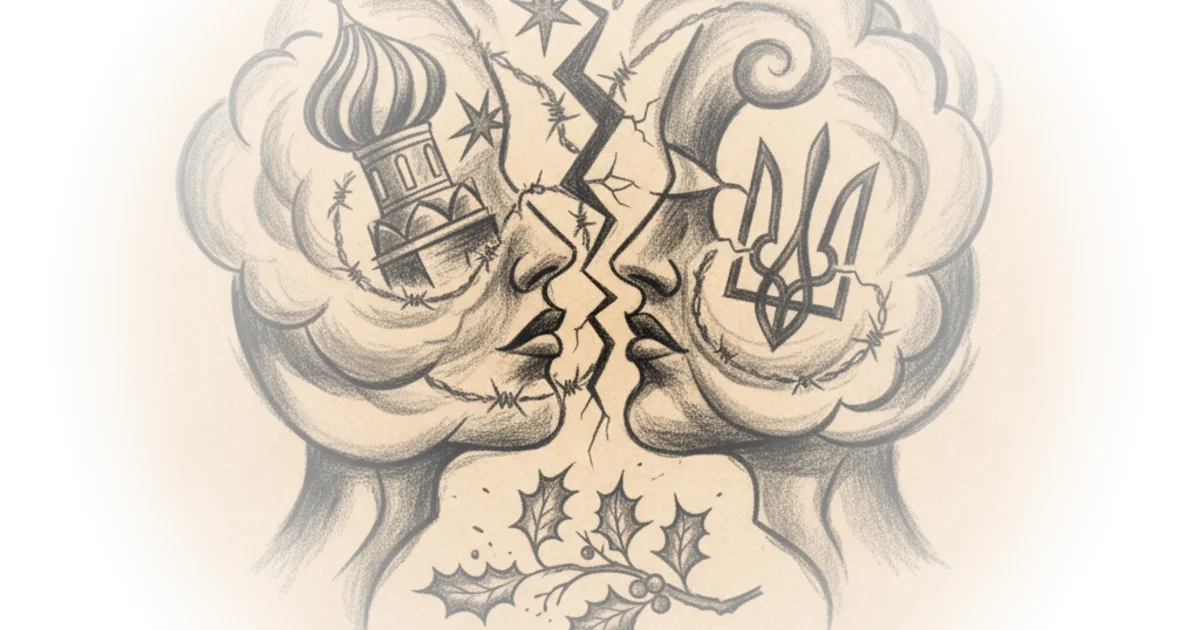
The author's personal narrative grounds this geopolitical maneuver in raw human emotion. He describes his grandmother, a woman who is not a pro-Russian ideologue, yet remains tethered to a church subordinated to the Moscow Patriarchate. "My grandmother was never a supporter of pro-Russian ideas. Still, she remains a parishioner of the 'Ukrainian' Orthodox Church, which has never fully severed its ties with Russia," Mak notes. This distinction is crucial. It challenges the binary view of the war as a simple clash of patriots versus traitors. Instead, Mak illustrates how the administration's efforts to ban religious formations linked to Moscow have collided with the deep, personal grief of an elderly woman who found solace in a community that outlived her husband.
"A holiday that typically unites people has instead become a source of division — and a weapon in Russia's hands."
The piece effectively argues that the Russian Orthodox Church was never just a spiritual institution. Mak points out that "even during the Soviet era, priests were recruited to become secret agents, tasked with surveillance and spreading Soviet propaganda." This historical context is vital for understanding why the current friction is so intense. The church served as a bridge to cement Russian ideology, a role that persisted even after independence. When the author's grandmother refuses to celebrate on December 25, she is not necessarily endorsing the Kremlin; she is clinging to the only stability she has left after her world collapsed with her husband's death. Critics might argue that Mak romanticizes the grandmother's position, but his account of her strict fasting while her family feasts underscores the tragedy of a tradition hijacked by foreign policy.
The Cost of Decolonization
The transition has been violent and painful. Mak recounts how "people in my region would go as far as to physically beat each other to assert their beliefs." This is the human cost of institutional change. The law introduced in 2024, which banned religious formations associated with Moscow, was a necessary step for national security, yet it created a rift within families that no legislation can easily mend. The author describes the tension in his own home: "It was my mother who argued. My grandmother cried."
This dynamic reflects a broader societal struggle. The executive branch has pushed hard to align Ukraine with the West, but the cultural inertia of the Julian calendar, imposed in 1918 by the Soviets to unify occupied territories, is a heavy burden to lift. Mak writes, "It was already ours before the Soviets and the Russian Orthodox stole it. Our ancestors celebrated it on December 25 as a way to revive our national identity and separate Kyiv from Moscow." This reframing of Christmas as a reclaimed heritage rather than a Western import is a powerful rhetorical move. It transforms the holiday from a foreign imposition into a restoration of pre-imperial sovereignty.
"It feels like we've brought real Christmas back."
Yet, the path to this restoration is littered with personal loss. The author admits that for years, the subject was taboo in his family. "But the crack kept widening whenever the holidays came around." The resolution, when it came, was not a total conversion but a compromise born of love. His grandmother agreed to mark two Christmases, a concession that highlights the complexity of the situation. She did not abandon her church, but she chose to spend the holiday with her family. This nuance is often missing in broader coverage, which tends to focus on the legal bans rather than the emotional negotiations happening in living rooms across the country.
Bottom Line
Tim Mak's most compelling contribution is his refusal to simplify the conflict into a story of good versus evil, showing instead how imperial legacy infiltrates the most intimate spaces of family life. The piece's greatest vulnerability is its reliance on a single family's experience, which, while poignant, may not fully capture the political calculations of the Moscow Patriarchate's leadership. However, the emotional truth of the narrative remains undeniable: the war for Ukraine's soul is being fought not just on the front lines, but at the dinner table, where a change in the calendar date has become the ultimate test of loyalty and love.