Most animation histories focus on the static image—the flat, modernist design of the 1950s that defined the United Productions of America (UPA) studio. This piece from Animation Obsessive makes a far more provocative claim: the true legacy of that era wasn't the look, but the rhythm. It argues that the kinetic DNA of 1990s Cartoon Network hits like Dexter's Laboratory and Johnny Bravo traces back not to the general studio style, but to the specific, often overlooked timing techniques of a single animator, Robert Cannon.
The Geometry of Motion
The article dismantles the common assumption that the "UPA revival" was merely a stylistic homage. While Genndy Tartakovsky, creator of Dexter's Laboratory, acknowledged that "UPA was a huge deal" for the studio, the piece clarifies that the influence went deeper than flat design. "Tartakovsky noted that most people would associate Dexter's art direction with UPA, but to him, timing was most important," the editors report. The argument centers on Cannon, a man who treated animation not as realistic movement, but as "design in motion."
This distinction is crucial. While Disney artists like Frank Thomas and Ollie Johnston chased the illusion of life through realistic physics, Cannon sought a new language. The piece cites Disney artist Iwao Takamoto, who observed that Cannon's work was "completely fascinated with movement for its own sake, a fascination that spread into an abstract type of movement." This wasn't just a budget-saving measure; it was an artistic rebellion against the "Disney playbook." Cannon famously raged against the standard "anticipation" moves of the era, with Takamoto recalling that Cannon "used to say that if he saw one more animated character drop his shoulder and lead with his elbow in anticipation of a turn, he was going to scream."
The evidence presented is compelling because it connects specific, technical choices to the final product. The editors note that Cannon developed "funny, interesting movement and timing for each character, so that every character moves in its own unique way." This philosophy directly birthed the distinct personalities of Dexter and Dee Dee. Dee Dee's dance-like, erratic motion is explicitly linked to Cannon's 1954 short Ballet-Oop, a film that utilized the same long-limbed, stylized choreography. Critics might argue that attributing an entire era's aesthetic to one man risks oversimplification, yet the piece backs this up with the testimony of Van Partible, creator of Johnny Bravo, who credited Cannon's work on The Dover Boys as the key to his own signature "smear technique."
"He was the one who really added that refinement to enact a performance of this gesture. Because there is nothing more minimal... And this is what Bobo Cannon was able to do on film."
The Human Cost of Creation
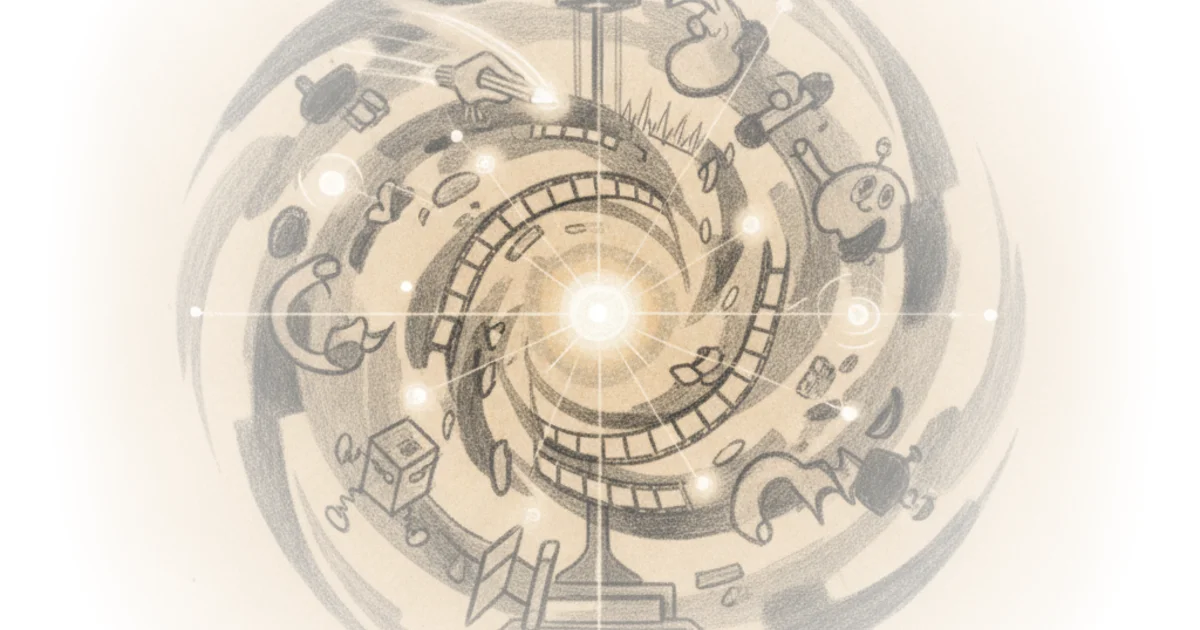
The coverage then pivots from historical analysis to a contemporary story that carries a heavier, more urgent weight. It introduces Anastasia Kazhuk, an animator from Ukraine who has spent a decade building "Different Light," an interactive storybook sanctuary. The piece frames her work not as a career ladder, but as a survival mechanism. "In such unstable moments, when any day could take the ground from under your feet, you don't want to think about success or prestige," Kazhuk is quoted saying. "All you want is to pull the blanket over your head and find yourself somewhere far away in your microscopic imaginary world."
The editors do not shy away from the context of the war. They detail how Kazhuk's project began in 2008, born from a childhood move to a cottage without electricity, but evolved into a refuge during the 2022 Russian invasion. The narrative highlights the grim reality of her daily life: "There are times when, having made a backup of my current scene the day before, I wake up to air raid sirens or jarring explosions at four in the morning." This juxtaposition of the creative process against the backdrop of active conflict is handled with necessary gravity. The piece notes that while she considered joining the military, she stayed to protect her work and her family, realizing she "couldn't leave everything as it was."
This section serves as a powerful counterpoint to the historical analysis. Where Cannon's work was a rejection of realism for artistic freedom, Kazhuk's work is a rejection of the chaotic reality of war for emotional safety. The piece argues that her project is a "videobook" that sits between a film, a comic, and a game, created to "sow a spark of hope" and show that "every being... is not left to fend for themselves." The human cost here is palpable; the article mentions that the project sustained her through "massive creative burnout" while her country burned. It is a reminder that for many artists, the act of creation is not a luxury, but a lifeline.
Bottom Line
Animation Obsessive succeeds in redefining the legacy of mid-century animation by shifting the focus from static design to dynamic timing, proving that Robert Cannon's "simplified" movement was the true engine behind the Cartoon Network revolution. However, the piece's most resonant moment lies in its final section, where it uses the story of Anastasia Kazhuk to illustrate that animation is not just a medium for entertainment, but a vital tool for human resilience in the face of existential threat. The strongest argument is that the "minimalism" Cannon pioneered was not just a style, but a philosophy of efficiency and expression that remains essential today—both for creating memorable characters and for surviving impossible times.