In an era obsessed with data dashboards and measurable outcomes, Andreas Matthias revives a dangerous philosophical question: what if the very act of demanding evidence is what blinds us to the truth? This piece is not a rejection of facts, but a warning that our rigid adherence to "evidence-based" mantras may be systematically filtering out the most critical, unquantifiable aspects of human expertise and decision-making.
The Trap of Measurable Truth
Matthias introduces the piece by highlighting a paradox that feels increasingly urgent in our algorithmic age. He writes, "Having evidence (usually in the form of some measurable quantity) does not guarantee that one will make good decisions — and the other way round." This observation cuts through the modern assumption that more data automatically equals better judgment. The author frames this not as a minor technical glitch, but as a fundamental flaw in how institutions—from universities to hospitals—approach complex problems.
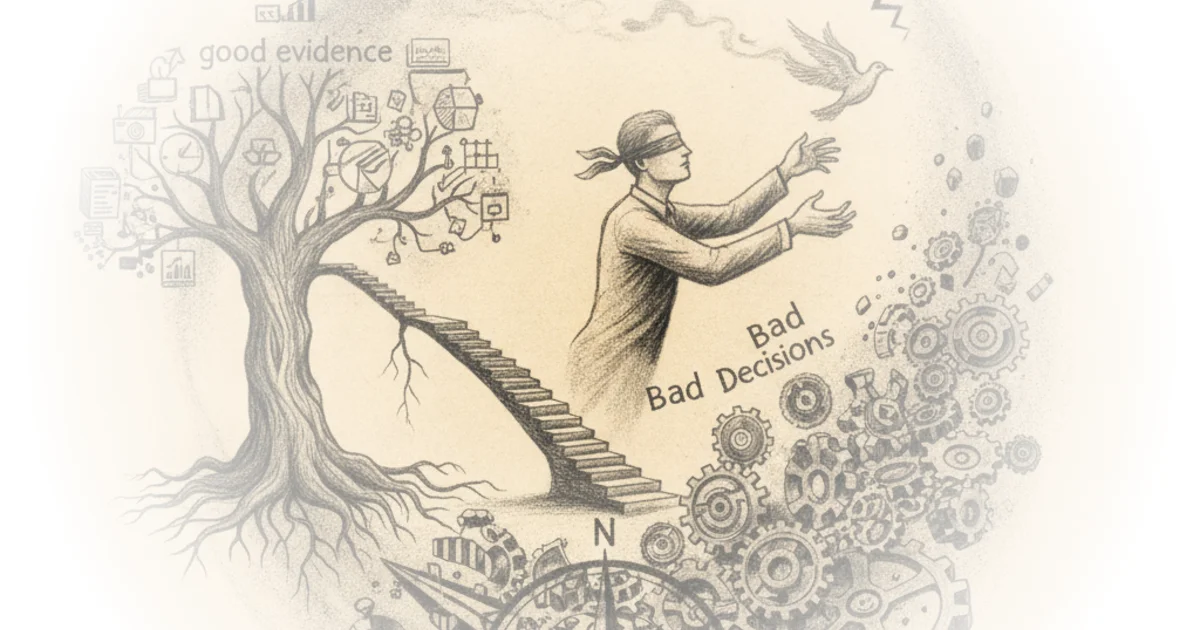
The commentary leans heavily on the work of philosopher Hubert Dreyfus to bolster this claim. Matthias notes that Dreyfus, drawing on Heideggerian ideas, argued that "calculative rationality" misses all that is essential to true expertise. This is a crucial distinction. It suggests that when we reduce teaching, medicine, or leadership to a set of metrics, we are not refining our understanding; we are discarding the very intuition that makes those fields work. Matthias points out the irony in how this plays out in higher education: "Given what our universities are doing with outcomes-based education, measurable markers of teaching quality, and other such nonsense, it is particularly important to emphasise these points."
If one is determined to base truth, judgement, and decisions based on evidence, then one limits these to all to only that for which evidence may be gathered -- leaving those features which fail to qualify as evidence neglected.
This limitation is the core of the argument. Matthias explains that the "evidence-based" mantra creates a self-fulfilling prophecy where we only pay attention to what we can measure. If a factor cannot be pinned down in a spreadsheet, it is treated as irrelevant. This echoes the historical concept of Goodhart's law, which states that when a measure becomes a target, it ceases to be a good measure. By chasing the measurable, we inevitably ignore the messy, unquantifiable variables that often determine success or failure.
The Exclusion of the Unarticulatable
The piece argues that this bias toward the quantifiable actively harms decision-making by excluding vital context. Matthias writes, "The dangerous tendency then is that a tight or rigorous notion of evidence will put out of consideration as not-really-evidence factors that cannot be rigorously articulated, but which might be more relevant to determining well truth, judgement, and decisions." He illustrates this with the example of a teacher or lecturer, whose effectiveness may rely on a "heuristic gestalt view" that cannot be easily codified into an algorithm.
Critics might argue that without rigorous evidence, decision-making becomes arbitrary or prone to bias. However, Matthias counters that the alternative—ignoring the unmeasurable—is far more catastrophic. He suggests that the current obsession with evidence leads to "decisions being poorer than they need to be" because we are operating with a deliberately incomplete map of reality. As he puts it, "If one skews decisions so that they are based only on what counts as measurable evidence, the decision will be the poorer, as relevant features that do not count as measurable evidence will not be included in the decision making process."
The author also touches on the normative trap within evidence-based decisions. Even when data is clear, the interpretation often relies on value judgments that data cannot provide. Matthias notes, "Many of these get assumed, when they may be opened up reasonably or even unreasonably, to disagreement. In which case the decision that a certain treatment is beneficial in a normative sense cannot follow from the factual evidence alone, no matter how strongly it may appear to." This is a vital reminder that data can tell us what is happening, but rarely what we should do about it.
The Atrophy of Human Judgment
Perhaps the most striking claim in the commentary is the long-term psychological impact of this mindset. Matthias suggests that over-reliance on gatherable evidence leads to a degradation of our innate ability to judge complex situations. He writes, "There is a further a bolder claim one may make: that over consideration of gatherable features of a situation that may count as 'evidence' leads to the atrophy and perhaps moribundity of those faculties and habits of mind that lead one to understand a situation in a heuristic gestalt way."
This aligns with the Dreyfus model of skill acquisition, which posits that true mastery involves moving beyond rigid rules to a fluid, intuitive understanding of the environment. By forcing every decision back into a box of measurable evidence, we risk stunting the development of this higher-level expertise. Matthias warns that this isn't just a theoretical risk; it is a practical one where "the evidence will shift the focus on decisions being based on truths that may be determined by evidence crowding out other considerations which are not part of the assembled evidence one has."
The power of the evidence outweighs matters one might otherwise consider, but which strictly speaking do not count as evidence as what they are has not been pinned down in a way that is transparent in its factual precision.
Bottom Line
Matthias delivers a compelling critique of the uncritical worship of data, arguing that the most dangerous decisions are often those made with the most confidence in their evidence. The piece's greatest strength is its ability to reframe "evidence-based" from a virtue into a potential blind spot, forcing readers to question what they are ignoring in their own data-driven strategies. Its vulnerability lies in the difficulty of operationalizing this insight; without clear metrics, how do institutions avoid sliding into pure subjectivity? The answer, Matthias implies, is not to abandon evidence, but to stop pretending it tells the whole story.