Billie Eilish walked onto the Grammy stage to accept Song of the Year and used thirty seconds to ignite a constitutional argument that would ricochet from a Senate hearing to a thousand dinner tables across America. What sounded to many like a protest chant — "no one is illegal on stolen land" — is, in the hands of Kahlil Greene, something sharper: a claim about the plumbing of American government itself.
The Slogan, the Speech, the Backlash
Greene opens by noting the contrast that made the moment impossible to ignore. In January 2026, federal immigration officers tear-gassed an infant in Minneapolis, dragged a disabled woman from her car, detained a five-year-old boy who left detention "not the same," and killed two American citizens on city streets. Weeks later, on the Grammy stage, Eilish declared that no one is illegal on stolen land and told the audience: "Fuck ICE."
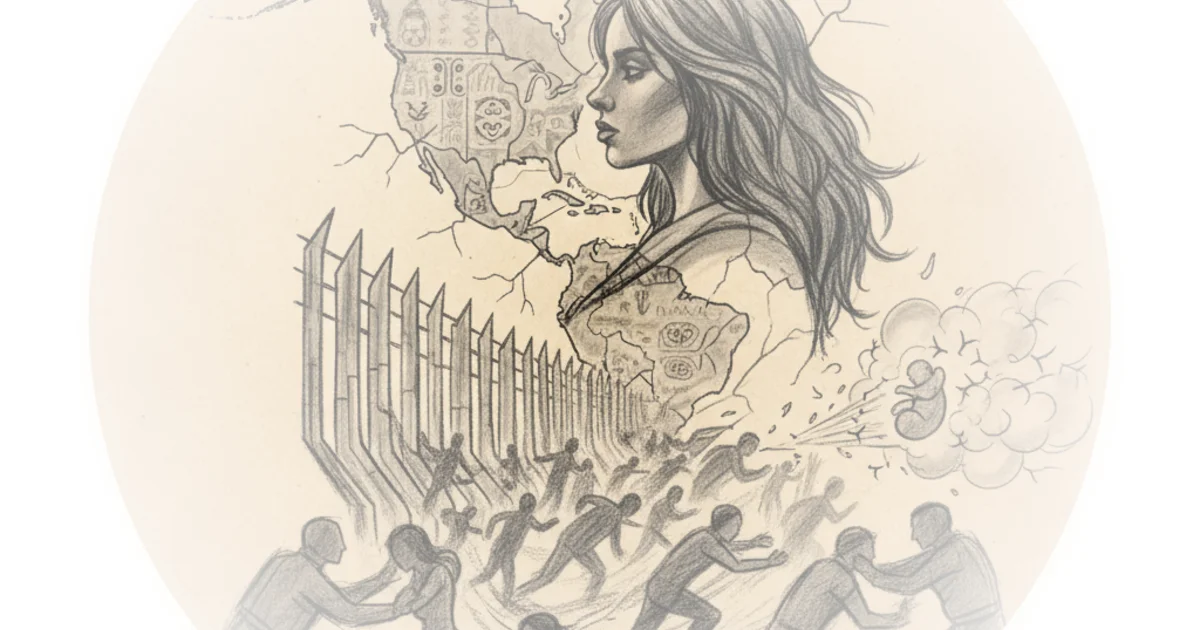
The standing ovation in the room became a flashpoint outside it. Greene recounts how Senator Ted Cruz took the phrase to a Senate hearing days later, asking a Netflix executive whether the company believed "America is fundamentally illegitimate." The slogan had crossed from a music awards speech into a debate about national legitimacy.
"No one is illegal on stolen land" is a way for Native people to say to immigrants: you are welcome here. And to point out the deep hypocrisy of a country that invaded our homelands now calling other people the invaders.
The Two Faces of Government
Here is where Greene's argument deepens. The piece was contributed by Rebecca Nagle, a citizen of the Cherokee Nation, and her thesis is structural, not symbolic. The United States, she argues, was built with two faces.
One face governs citizens — due process, free speech, elected representation, the whole vocabulary of constitutional democracy. The other face governs through conquest: military rule, executive power without judicial limits, the authority to separate children from parents and round up entire populations. That second face was forged first in the seizure of Indigenous land. It never went away.
"What the U.S. did to Native Americans became the blueprint for how we treat those pushed to the edge of our democracy."
Greene traces the lineage directly. The border is heavily militarized because for the first century and a half of the republic, it was a literal war zone. Immigration law was designed without constitutional protections because its architects looked at the precedent of federal Indian law — a system that treated colonized peoples as subjects of administrative power, not citizens with rights — and replicated it.
The argument draws on the work of Ojibwe legal scholar Maggie Blackhawk, whose Harvard Law Review article The Constitution of American Colonialism makes the case that federal Indian law is not a historical footnote but the foundation of how the government exercises unchecked power over people at the margins of U.S. empire. When current immigration authorities detain people without judicial warrants, they are operating within a system modeled on colonial administration — the same legal architecture used to govern the Philippines, Guam, and Puerto Rico.
Citizenship as Shield — and as Weapon
Greene notes that the U.S. conception of citizenship is unusual. In most countries, citizenship grants access to benefits. In the United States, it also functions as a gate around constitutional protections. The Constitution was written in a way that deliberately does not extend its full shield to non-citizens. From Indigenous nations to territorial possessions to immigrants in detention, there have always been people living under the raw power of government without its protections.
"It is because the land is stolen that the U.S. government is able to decide whose presence is legal or not. It is the reason our immigration policies are so inhumane."
The slogan, when spoken by Native people, carries a specific meaning that does not translate directly when repeated by others. It is an assertion of Indigenous sovereignty — the authority to determine who is welcome on their own land, separate from the federal government's power to exclude. Tribes govern more than 300 reservations. They have exercised that welcome and that exclusion independently, from the Oceti Sakowin camp at Standing Rock to South Dakota tribes banning a sitting governor from their lands.
Greene's point is not to police who can use the slogan but to argue that the debate it sparked finally forced a conversation about the architectural link between the seizure of Native land and the treatment of immigrants today.
The connection is not metaphorical, the piece insists. It is as structural as the load-bearing walls of a building. The Indian Removal Act didn't just displace the Cherokee Nation — it established a legal framework in which the executive could exercise plenary power over populations the Constitution was never intended to protect. That framework outlived the Trail of Tears. It migrated.
Where the Argument Faces Friction
Critics might note that drawing a straight line from 19th-century Indian policy to modern immigration enforcement flattens two centuries of legal evolution, court challenges, and statutory reforms that have meaningfully reshaped both domains. The analogy, however compelling, risks reducing complex legal history to a single throughline. Others could argue that invoking stolen land as a response to contemporary border policy sidesteps the real question of how sovereign nations manage migration — including Indigenous nations, which also regulate who enters their territories. Still others might contend that Eilish's slogan, intended as moral solidarity, was never meant to withstand legal scrutiny, and that subjecting it to constitutional analysis misses the point of a protest phrase.
"Like the structure of a building, it is foundational."
Bottom Line
Greene's piece does not ask readers to agree with a slogan. It asks them to look at the legal architecture underneath one — and to recognize that the same system that authorized the displacement of the Cherokee Nation still shapes how the government treats the people it calls "illegal." Whether you find that argument illuminating or overstated, it forces a reckoning with a history most political speeches carefully avoid.