In a landscape often defined by theological ambiguity, a rare moment of absolute clarity has emerged from Scandinavia. The Nordic bishops have issued a definitive pastoral letter dismantling decades of local speculation that Catholic membership in Freemasonry might be permissible in their region. This is not merely a repetition of old rules; it is a surgical strike against the idea that geography or cultural nuance can alter universal Church law, forcing a confrontation with the incompatibility between Masonic philosophy and Christian revelation.
The Myth of Regional Exceptionalism
The core of this intervention addresses a persistent rumor mill. For years, faithful in Denmark, Sweden, Norway, Finland, and Iceland have operated under the assumption that their local lodges were distinct enough to warrant an exception to canonical bans. The Pillar reports that the bishops wrote the letter specifically "to clarify a matter that for many years, if not decades, has generated uncertainty, speculation and diverging opinions in our countries." This is significant because it exposes how localized interpretations can erode universal doctrine when left unchecked.
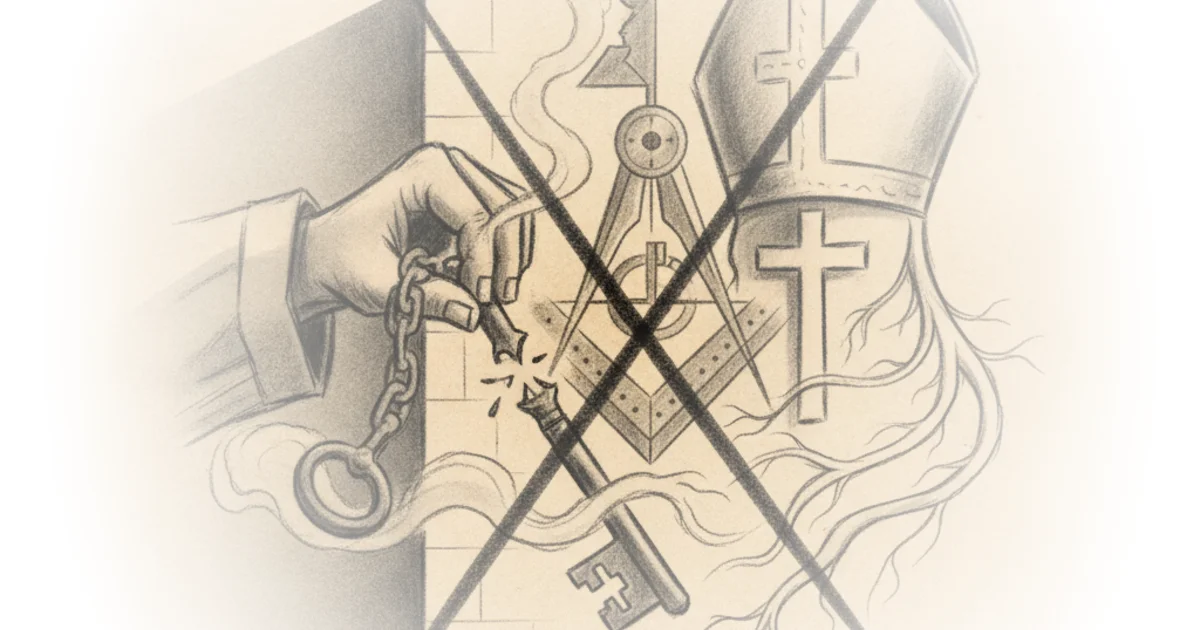
The editors of the piece highlight the bishops' firm rejection of this regionalism. They state unequivocally: "there exists no exception, no particular norm or rule, and in consequence no dispensation in the Church that distinguishes adherence to Freemasonry in the Nordic countries from the provisions of the universal law of the Church." This phrasing is deliberate; it closes every door that local custom might have left ajar. The argument lands with force because it refuses to entertain the idea that a Catholic can be "a little bit Masonic" and "a little bit Christian."
To be a Christian is to make fundamental choices. Our speech is to be 'Yes, yes' or 'No, no', not 'A little bit of this and a little bit of that'.
Bishop Erik Varden, the conference president, frames this as an act of charity rather than hostility. The piece notes his assertion that "the preaching of the truth in love is a high form of charity." This reframing is crucial for busy readers who might otherwise view such bans as bureaucratic obstacles; instead, it presents them as protective measures for the integrity of faith.
Historical Confusion and the 1983 Code
The commentary effectively traces how this confusion arose in the first place. The Pillar explains that a shift in legal wording created a dangerous loophole in public perception. When the 1983 Code of Canon Law was promulgated, it removed the explicit term "Masonic" from its text regarding prohibited societies. This change, intended to broaden the ban to cover all similar secret societies, ironically led many canonists and laypeople to believe the specific prohibition on Freemasonry had been lifted.
The article clarifies that this was a misunderstanding of legislative intent. The committee responsible for the revision decided to remove the explicit reference because they feared the canon would be "too narrowly interpreted" if it only named Masonry. Yet, as the piece argues, the underlying theological ban remained absolute, rooted in the 1983 Declaration signed by then-Cardinal Joseph Ratzinger. That declaration stated clearly that "the faithful who enroll in Masonic associations are in a state of grave sin and may not receive Holy Communion." The Nordic bishops' letter serves as a necessary corrective to forty years of this specific legal ambiguity.
A counterargument worth considering is whether such rigid adherence to historical bans ignores the evolution of modern fraternal organizations. Critics might argue that contemporary lodges have shed their anti-clerical roots and function merely as charitable social clubs. However, the bishops anticipate this by pointing out that the issue is not the activities of the lodge, but its underlying philosophy.
The Incompatibility of Worldviews
The most compelling section of the coverage dives into the theological reasons for the ban, moving beyond legalism to metaphysics. The Pillar details how the bishops, citing a 1980 German bishops' conference declaration, identify the core conflict: Freemasonry promotes religious indifferentism. This is the belief that all religions are equally valid paths to truth, a concept the Church views as fundamentally opposed to the claim of Christ's unique divinity.
The piece quotes the bishops noting that "the theological and philosophical principles of freemasonry are incompatible with confession of the Catholic faith." It goes further, describing Masonic rituals as having a "quasi-sacramental character" that rivals Christian sacraments. The article provides a stark description of initiation rites, where candidates strip away symbols of their previous faith—such as crucifixes—and undergo ceremonies that promise enlightenment through the Order itself rather than through God.
The truth that liberates and saves is the truth revealed by God in Christ, none else.
This historical context is deepened by a nod to the Rite of Strict Observance and the 1738 papal bull In Eminenti, which first condemned Masonry for promoting the idea that natural virtue alone suffices for salvation. The coverage reminds readers that this isn't new; it is a continuous thread from Pope Clement XII through Leo XIII, who warned against the "secularist agenda" of removing God from public life.
Bottom Line
The strongest element of this piece is its refusal to let nuance obscure principle; it successfully argues that the ban on Freemasonry is not about policing behavior but protecting the coherence of Catholic identity. Its greatest vulnerability lies in the pastoral challenge: how to enforce these provisions with "clarity and charity" without alienating faithful who have long believed they were acting within acceptable bounds. The reader should watch for how local parishes implement the four specific sacramental provisions outlined, as this will test whether the Church can maintain doctrinal unity while addressing individual cases of sincere confusion.