Noah Smith makes a chillingly plausible claim that the most profound social upheaval of our century won't come from ideology or economics, but from the quiet obsolescence of the human soldier. While most analysis fixates on geopolitical flashpoints, Smith argues that the rise of autonomous drone swarms is forcing a historical pivot as significant as the invention of gunpowder, one that will fundamentally rewrite how nations organize their economies and societies.
The Death of the Infantryman
Smith opens by revisiting a 2013 prediction that the "human race is on the brink of momentous and dire change," specifically the end of the era where the "gun-wielding human infantryman" dominates the battlefield. He draws a sharp parallel to 1400, when the armored horse archer was suddenly rendered vulnerable by a "poor no-count farmer armed with a long metal tube." This historical framing is effective because it strips away the mystique of military tradition, revealing war as a series of technological disruptions that humble the powerful.
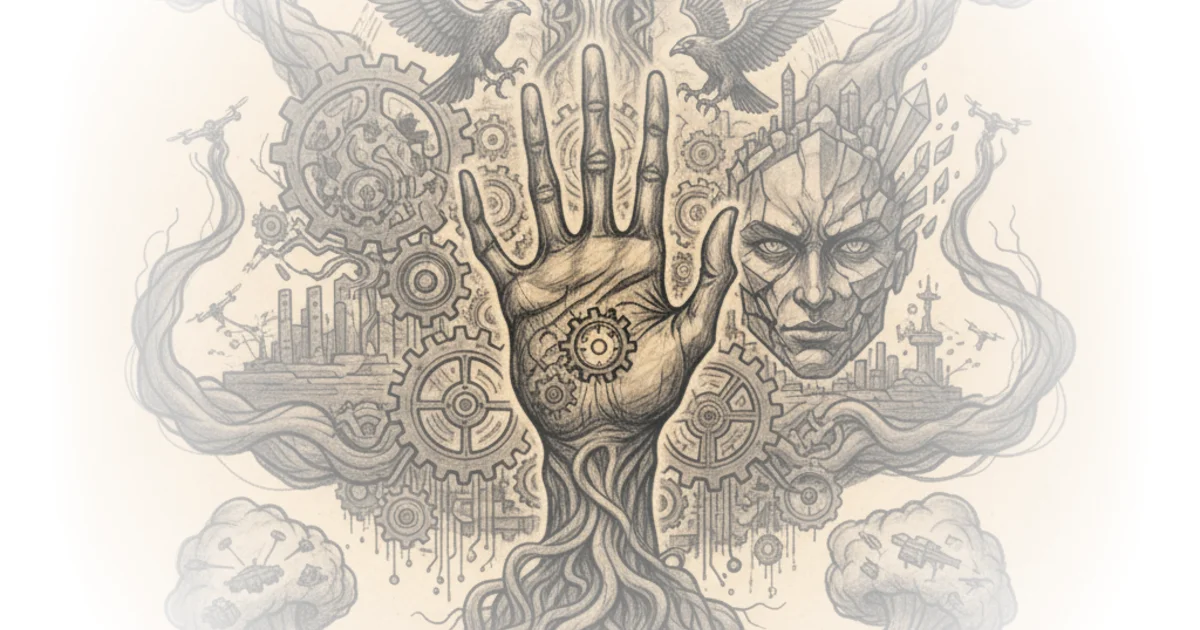
The author notes that while skeptics once dismissed the idea that drones could overcome electronic warfare or lack firepower, recent conflicts have vindicated the forecast. Smith cites Michael Kofman to illustrate the grim reality: "Drones continue to be responsible for most daily casualties, with the front line defined by overlapping drone and artillery fire engagement zones 20-25km from the forward line of troops." This data point is crucial; it shifts the narrative from a tactical curiosity to a strategic reality where the "kill zone" has expanded to swallow entire logistical networks.
"The drone is increasingly regarded as the infantryman's basic weapon."
Smith argues that the current reliance on human operators is a temporary bottleneck. He suggests that as artificial intelligence matures, the "killer robots" of science fiction will become the norm, replacing not just infantry but also boats, fighter jets, and submarines. The driving logic is simple economics: "Soldiers and big vehicles cost a lot; drones cost much less." This cost-benefit analysis is the engine of his argument, suggesting that the shift is inevitable because machines are getting cheaper while human labor becomes more expensive.
Critics might note that this purely economic determinism overlooks the resilience of human ingenuity in asymmetric warfare, where motivated irregular forces have historically outmaneuvered technologically superior states. However, Smith counters that the sheer scale of production required to sustain a drone war favors industrial giants, a point that carries significant weight given current global supply chain dynamics.
The Historical Lag and Social Upheaval
The piece's most compelling section connects military hardware to social architecture. Smith observes that major waves of war—the Mongol conquests, the Thirty Years' War, and the World Wars—always coincided with a "dominant package of military technology." He points out a critical lag: the technology often existed long before the society could fully exploit it. For instance, while stirrup-equipped horses were known earlier, it took Genghis Khan's social reforms to create a force capable of conquering settled civilizations.
Similarly, firearms existed in the 1400s, but it wasn't until the 1600s that they drove the creation of massive standing armies and the modern state apparatus. Smith writes, "Charles Tilly argues that gunpowder-era wars made the modern state, because the regimes that survived were the ones that developed complex bureaucracies in order to collect more taxes to fund their wars." This historical lens suggests that the coming drone revolution will not just change how we fight, but how we tax, govern, and organize our economies.
The author warns that the next era of conflict will likely be "more capital-intensive" and "more knowledge-intensive," forcing nations to adapt or face extinction. He notes that "if you didn't develop those things, you were liable to be conquered," implying that the pressure to innovate is an existential threat that transcends political preference. The human cost of these transitions is immense; Smith acknowledges that "those giant armies had to live off the land, which caused famines and massacres," a grim reminder that technological efficiency in war often leads to greater societal suffering.
"If there is a single driving irresistible force of History, I think it must be the innovations that we use to kill each other."
Smith identifies China as the nation currently best positioned to master this new paradigm, citing their command of the entire drone supply chain. He argues that their manufacturing focus, while perhaps economically inefficient in peacetime, has prepared them for "prolonged capital-intensive war." This observation serves as a stark warning to Western nations that industrial policy and supply chain resilience are now matters of national security, not just trade policy.
Bottom Line
Noah Smith's strongest argument lies in his refusal to view military technology in a vacuum, correctly identifying that the rise of autonomous systems will force a radical restructuring of the modern state and its economy. The piece's biggest vulnerability is its heavy reliance on historical determinism, which may underestimate the ability of democratic societies to adapt through non-industrial means. Readers should watch for how the administration and allied governments respond to the urgent need for industrial scaling, as the window to match the drone production capacity of rivals is closing fast.