Jeff Stein's latest dispatch from SpyTalk cuts through the noise of geopolitical posturing to expose a dangerous disconnect between the White House's public bravado and the intelligence community's grim reality. The piece is notable not for its sensationalism, but for its quiet, devastating juxtaposition of Secretary of State Marco Rubio's claim that "we're not a stupid country" against internal assessments suggesting the administration is flying blind into a prolonged conflict with Iran. For the busy reader tracking the erosion of institutional checks and balances, this is the critical story: the moment when political theater begins to override the hard data required to prevent regional catastrophe.
The Intelligence Gap
Stein opens by highlighting the friction between the administration's narrative and the facts on the ground. During a visit to the Vatican, Rubio attempted to deflect questions about the contradiction of a claimed ceasefire while active combat continued. "Only stupid countries don't shoot back when you're shot at," Rubio said, "And we're not a stupid country." Stein frames this not as a defense of sovereignty, but as a dismissal of the nuanced intelligence that preceded the escalation. The author points out that this rhetoric ignores the consensus of the U.S. Intelligence Community, including the CIA, which had warned that Iran was not developing a nuclear weapon and would retaliate by targeting U.S. bases and shutting down the Strait of Hormuz if attacked.
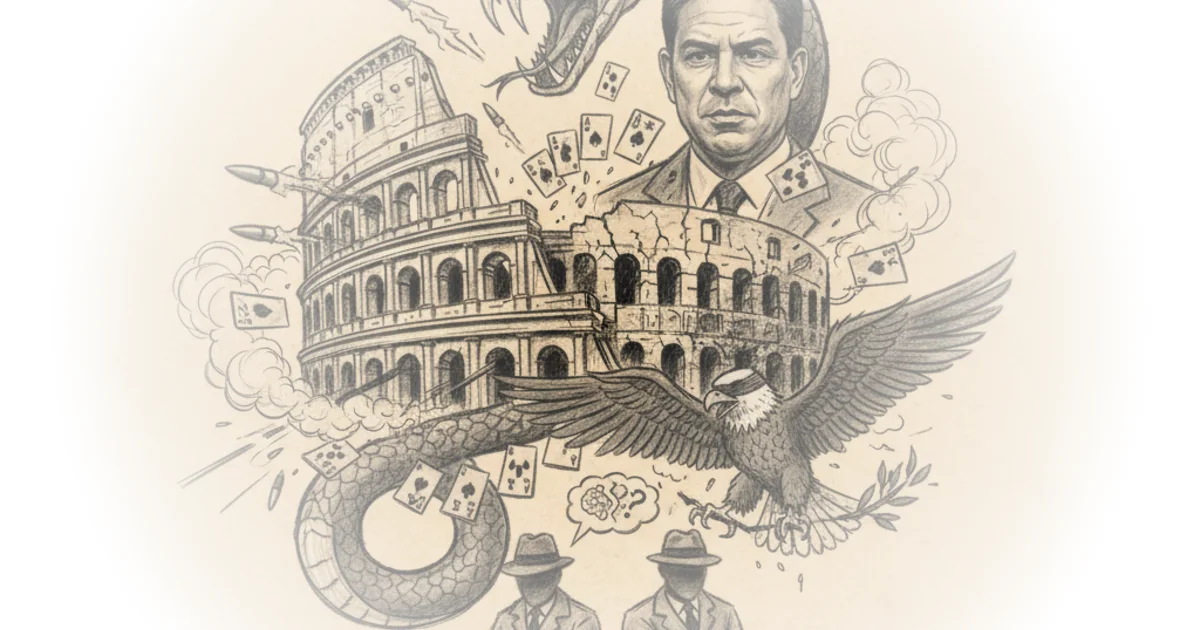
This framing is effective because it shifts the debate from "strength" to "competence." Stein notes that former National Counterterrorism Center Director Joe Kent has called for an investigation into why the administration proceeded with war despite these warnings. The stakes are incredibly high; as Stein reminds us, the Strait of Hormuz is a choke point that, if blocked, would send global energy markets into chaos. The administration's insistence on a narrative of inevitable victory seems to be at odds with the strategic reality that the region is on a knife's edge.
"Before the war began the U.S. Intel Community, including CIA, was in agreement that Iran wasn't developing a nuclear weapon & that Iran would target U.S. bases in the region & shut down the Strait of Hormuz if they were attacked by Israel & the U.S."
Critics might argue that intelligence is often wrong and that leaders must sometimes act on incomplete information. However, Stein's reliance on specific, contemporaneous warnings from multiple agencies suggests this is not a case of bad luck, but of willful ignorance. The administration appears to be operating on a different set of facts than the professionals tasked with gathering them.
Operational Blunders and Regional Spillover
The article then pivots to the operational consequences of this disconnect, detailing a "deadly desert flap" where Israel established a clandestine outpost in Iraq only to strike Iraqi troops investigating it. Stein writes that this incident, confirmed by U.S. officials, illustrates the chaotic nature of the current campaign. The lack of coordination is staggering; allies are firing on each other's forces in the very theater where they claim to be fighting a common enemy.
Furthermore, Stein brings in a disturbing report from DisinfoWatch regarding the fracturing of North American unity. The piece details how the U.S. and Russia are fanning separatist flames in Alberta, a high-tech and energy-rich Canadian province. Stein quotes the report stating, "Russia's engagement with Alberta separatism is covert... In contrast, U.S. engagement is overt, escalating, and in some environments, converging with Russia." This convergence is a profound shift in geopolitical alignment, where American influencers and officials are amplifying narratives that threaten the sovereignty of a close ally.
This section of Stein's coverage is particularly chilling because it suggests a deliberate strategy of destabilization that extends far beyond traditional battlefields. The mention of figures like Tucker Carlson and Steve Bannon amplifying these narratives adds a domestic dimension to the foreign policy failure. Stein draws a parallel to the pressure campaign on Greenland, noting how the administration's infowar tactics are being exported to destabilize neighbors. The human cost here is the erosion of trust among allies, turning the Western hemisphere into a patchwork of suspicion.
The Erosion of Norms at Home
Stein does not limit his critique to foreign policy; he turns his lens inward to the FBI and the White House National Security Council. The piece details a "highly unusual" criminal leak investigation launched by the FBI against reporters, rather than officials, following a story about FBI Director Kash Patel's behavior. Stein quotes sources who describe the situation as a "damned if you do, damned if you don't" scenario for the agents involved. "They know they are not supposed to do this," one source told the journalists, highlighting the internal resistance to what appears to be a politically motivated crackdown.
The article also scrutinizes a new counterterrorism strategy drafted by Sebastian Gorka, which labels domestic political groups as priority targets. Stein notes the strategy aims to "use law enforcement tools to cripple them operationally before they can maim or kill the innocent," targeting "violent, secular political groups whose ideology is anti-American." Stein likens this to the "pre-crime" police in the film Minority Report, a powerful metaphor for the dangers of preemptive policing based on ideology rather than action.
"The so-called insider threat investigation is highly unusual because it did not stem from a disclosure of classified information and because it is focused on leaks to a reporter."
This domestic overreach is perhaps the most alarming aspect of the piece. By targeting political dissent and journalists, the administration is blurring the lines between national security and political survival. Stein's inclusion of the Minority Report comparison effectively communicates the dystopian nature of "pre-crime" logic. Critics might argue that the government has a duty to stop violence before it happens, but the lack of specificity in defining "anti-American" groups leaves the door open for abuse against legitimate opposition.
Global Instability and the Human Cost
The final section of Stein's report weaves together a tapestry of global instability, from Putin's paranoia in Russia to espionage cases in China and the Arctic. Stein notes that Putin has shut off internet access nationwide, suspecting Ukrainian intelligence is using cell phones to guide strikes. This move, while a tactical defense, underscores the desperation of a leadership that fears its own population more than the enemy.
Stein also highlights the human toll of the ongoing conflicts, noting the defectors from the Russian government who cite corruption and the forcing of officers to comply with operations they do not support. "When stating their reasons for defecting, officers consistently repeated perceptions that the Russian government is corrupt, holding back the truth about the war," Stein writes. This detail adds a layer of moral complexity to the conflict, showing that the war is not just a strategic failure but a human tragedy that is fracturing the very institutions meant to protect the state.
The piece concludes with the tragic end of Kendall Myers, a State Department officer who spied for Cuba for decades. Stein notes that Myers died in prison, claiming he meant "no harm to the U.S." but wanted to help "defend the Cuban revolution." This serves as a somber reminder that espionage is a human endeavor, driven by ideology and personal conviction, often with devastating consequences for the individuals involved.
"The analysis... also found that Tehran retains significant ballistic missile capabilities despite weeks of intense U.S. and Israeli bombardment."
Bottom Line
Jeff Stein's commentary delivers a sobering verdict: the administration's foreign policy is being driven by political theater rather than intelligence, leading to operational blunders, regional destabilization, and the erosion of democratic norms at home. The strongest part of the argument is the clear evidence of a disconnect between the White House's public confidence and the intelligence community's warnings, a gap that could have catastrophic consequences. The biggest vulnerability of the current strategy is its reliance on "pre-crime" logic and the weaponization of law enforcement against political opponents, which threatens to undermine the very security it claims to protect. Readers should watch for the next escalation in the Strait of Hormuz and the potential for further domestic legal overreach as the administration doubles down on its narrative.