This lecture from Yale University reframes Dante's Inferno not as a static religious map, but as a dynamic, terrifying critique of how language can be weaponized to justify transgression. While most readers view the journey of Ulysses as a heroic quest for knowledge, Yale University argues that the poet deliberately exposes the "mad flight" of intellect when it is untethered from moral responsibility. For the busy professional navigating a world of grandiose rhetoric and strategic ambiguity, this analysis offers a startling mirror: the most dangerous counselors are not those who lie, but those who speak such beautiful truths that they convince others to leap off the cliff.
The Paradox of the Counselor
Yale University opens by dismantling the romanticized view of Ulysses as a Renaissance hero ahead of his time. Instead, the lecture positions him as the archetype of the "evil counselor," a figure whose sin is not ignorance, but the manipulation of others through high-minded speech. "For Dante there is no figure which is more interesting, more important, more full of... questions than the figure of the counselor," the lecture notes, highlighting how the administration of language is as dangerous as the administration of power. The argument suggests that Ulysses represents a specific kind of intellectual hubris where the pursuit of knowledge becomes a justification for breaking boundaries.
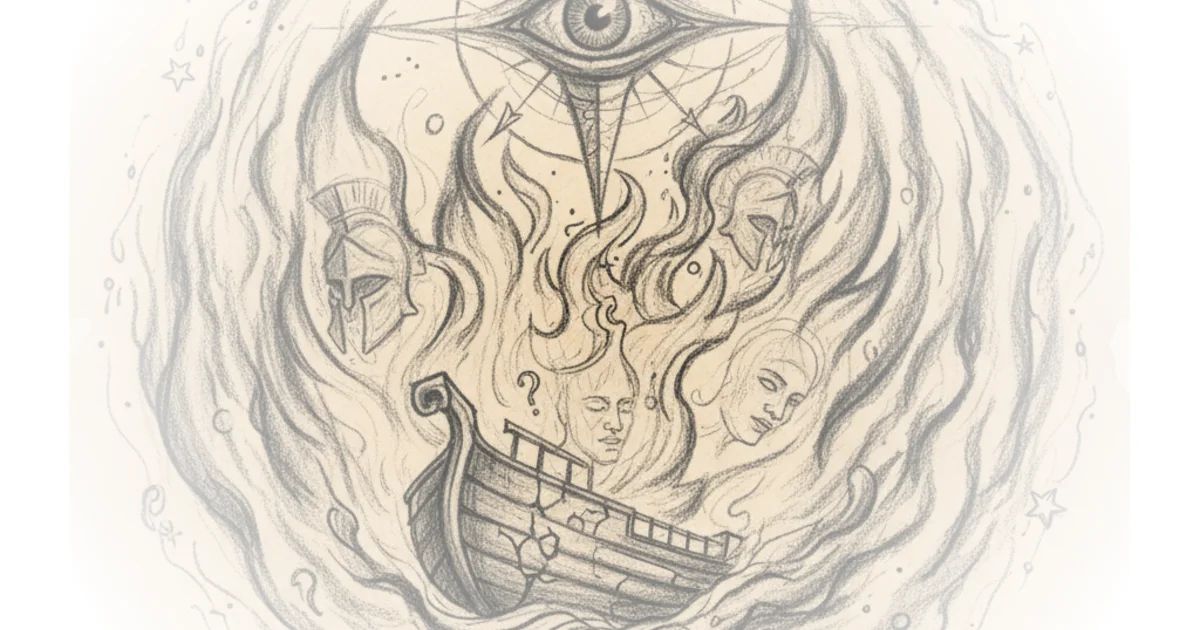
The core of the analysis rests on the speech Ulysses delivers to his crew. Yale University paraphrases the moment where Ulysses tells his companions, "You were not made to live as beasts... but to pursue to follow virtue and knowledge." On the surface, this sounds like a call to human excellence. However, the commentary points out the fatal flaw: Ulysses knows he cannot keep the promise of a safe return. "He makes rhetorical promises which he knows he cannot quite keep," Yale University observes, noting that the tragedy lies in the gap between the grandeur of the words and the reality of the outcome. This framing is particularly potent for modern readers who often encounter leaders who use noble abstractions to mask reckless strategies.
"It is the tragedy of language: a language that contains with itself all the most incredible mirages and yet falls short of reality."
Critics might argue that Dante's condemnation of Ulysses is too harsh, given that the pursuit of knowledge is often framed as a virtue in other literary traditions. Yet, Yale University counters this by emphasizing the political consequences of such counsel. The lecture draws a direct line from Ulysses' "grandiose advice" to the "falling cities" of Florence and Troy, suggesting that when rhetoric is divorced from responsibility, it leads to societal collapse. The argument holds up because it shifts the focus from the individual's ambition to the collective destruction that follows.
The Counter-Myth of Guido da Montefeltro
If Ulysses represents the philosopher who gets lost in his own abstractions, the lecture moves to Canto 27 to introduce Guido da Montefeltro, a figure who represents the cynic who knows exactly what he is doing. Yale University describes this section as a "counter myth" where the scale contracts from the cosmic journey to the gritty reality of local politics. Here, the Pope, Boniface VIII, seeks advice on how to conquer a small town, and Guido, now a Franciscan friar, provides the strategy. "You have to teach me... what are the strategies I should pursue in order to conquer," the Pope asks, turning the sacred office into a mere transaction for military advantage.
The lecture highlights the chilling pragmatism of Guido's response. He admits that his past works were those of "not of a lion but of a fox," a direct nod to the cunning required in Machiavellian politics. Yale University notes the irony: "The language of Machiavelli uses the language... that you will deploy for himself at one point." The connection is made explicit: the perfect prince, and by extension the perfect counselor, must know when to be violent and when to be crafty. This section of the lecture is crucial because it shows that the sin of the counselor is not just about lying, but about the calculated use of deception for political gain.
The most striking moment in this analysis is the description of the Sicilian bull, a metaphor for the counselor trapped by his own rhetoric. Yale University explains that the bull "bellowed with the voice of the victim," meaning the artist or counselor becomes the first victim of their own creation. "It is the story of the artist who becomes a captive of that which he himself has constructed," the lecture argues. This insight reframes the entire punishment in Hell: the flames are not just a penalty, but a manifestation of the internal logic of their own deceit.
"The tragedy of language... is that the counselor is literally placed in the empty ocean, away from all responsibilities and all locations."
A counterargument worth considering is whether Dante is being too cynical about the role of political counsel. One could argue that in complex political environments, some degree of "fox-like" strategy is necessary for survival. However, Yale University's framing suggests that the moment counsel becomes a tool for personal or institutional aggrandizement without regard for truth, it becomes a path to hell. The lecture effectively argues that the danger lies in the "gratuitousness" of the quest, where the end justifies any means, including the corruption of language itself.
Bottom Line
Yale University delivers a compelling case that Dante's Inferno is a timeless warning against the seduction of high-minded rhetoric used to justify transgression. The strongest part of this argument is the connection drawn between the "mad flight" of Ulysses and the cynical pragmatism of Guido da Montefeltro, showing that both the idealist and the cynic can become evil counselors when they prioritize their own vision over human responsibility. The biggest vulnerability for modern readers is the realization that we are constantly surrounded by figures who, like Ulysses, promise that we were "not made to live as beasts" while steering us toward our own destruction. Watch for how this dynamic plays out in current political discourse, where the language of virtue is increasingly used to mask the mechanics of power.