Nate Silver cuts through the noise of early presidential speculation to deliver a sobering diagnosis: Gavin Newsom's decline isn't an accident, but a predictable correction driven by a strategic misalignment with the very voters he needs most. While the political world obsesses over polling fluctuations, Silver argues that the California governor is doubling down on a fading legacy rather than forging a new path, a move that exposes deep fractures within the Democratic coalition.
The Illusion of Momentum
Silver begins by dismantling the narrative that Newsom's early frontrunner status was built on policy substance. He points out that despite a "successful passage" of his redistricting referendum in California last November, support among prospective Democratic voters has plummeted from 25 percent to just 15 percent. The author suggests this isn't a reaction to specific failures but rather a natural correction. "If you ask me, though, the reason for Newsom's decline is simple: this is reversion to the mean," Silver writes. He argues that Newsom lacks a persuasive case beyond name recognition, a vulnerability that prediction markets have already priced in as his odds drop from 35.5 percent to 23.3 percent.
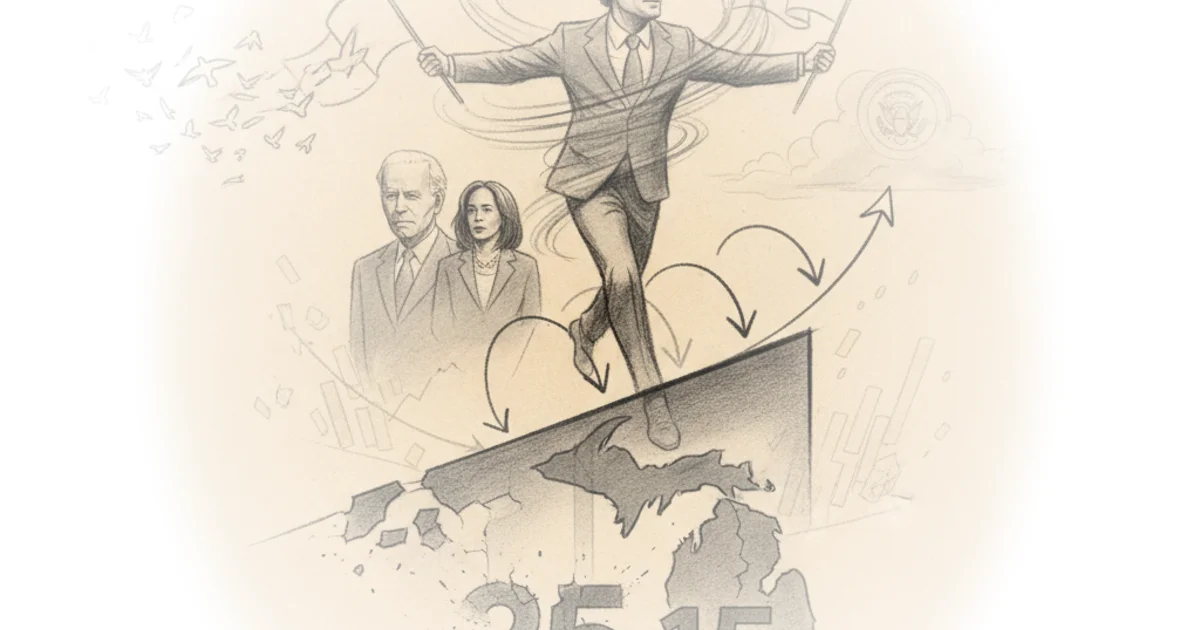
This analysis holds weight because it challenges the assumption that high-profile governors automatically translate into national viability. The primary field is wide open, with no single opponent emerging as the obvious alternative, yet Silver notes that "Bettors see the field as wide open, with the top six candidates having less than a 60 percent combined probability of winning the nomination." This fragmentation suggests that Newsom's slump isn't just about him; it reflects a party struggling to coalesce around any specific vision.
Newsom is never going to be the favorite candidate of the Left or the Abundance Libs, but if he can hold the #Resistance Libs, he'll have a high floor in the Democrats' highly proportional primary system.
Critics might argue that early polling is notoriously volatile and that a "messy" local primary doesn't dictate national destiny. However, Silver's integration of prediction markets adds a layer of rigor often missing from standard punditry, suggesting that the market sees something the casual observer misses: a candidate whose ceiling is lower than his current floor implies.
The Establishment Trap
The core of Silver's argument lies in Newsom's positioning as the "logical 'next-in-line' candidate for the establishment faction," a role that has become increasingly toxic within the party. Silver observes that while Newsom has attempted to pivot toward a more centrist or "heterodox" image—inviting figures like Charlie Kirk onto his podcast and opposing a wealth tax—he remains tethered to a legacy that voters are actively rejecting.
Silver highlights a striking contradiction in Newsom's strategy: he praises the current administration while running a shadow campaign against it just two years prior. "Last October, Newsom described Biden as 'one of the most successful presidents in the last century,'" Silver notes, pointing out the irony given that "voters are not warming to Biden's legacy." The data supports this skepticism; a recent CNN poll shows only 30 percent of voters hold a favorable impression of the former president, significantly lower than the approval ratings he left office with.
This framing is particularly sharp because it connects Newsom's personal political calculus to broader institutional fatigue. Silver writes, "As you might imagine, voters who do hold a favorable view of Biden are nearly all partisan Democrats," with favorability dropping to just 20 percent among independents. By anchoring his candidacy to a figure with such low general appeal, Newsom risks importing that unpopularity rather than transcending it.
It's hard to see why you'd embrace an 83-year-old whose legacy voters just rejected in 2024 when his vice president went head-to-head against Trump.
A counterargument worth considering is that the "establishment" label may be a strategic asset if the party fears another chaotic primary. However, Silver's evidence suggests that in a "change election," clinging to the past is a liability. The comparison to Barack Obama is telling: while Obama retains a 57 percent favorability rating and unifies factions, Biden does not. Silver notes that "Obama is basically the only Democrat who still unifies the various factions of the party," making Newsom's choice to emulate the current administration rather than the previous one seem like a strategic error.
The #Resistance Libs and the Fight for 2028
Silver identifies a specific demographic driving Newsom's support: the "#Resistance Libs." He describes this group as "older, college-educated and female-leaning," who are "less ideological than they are partisan" and believe Democrats lost recently because they didn't fight hard enough or because of bias against Kamala Harris. Silver argues that Newsom is specifically courting this group by positioning himself as a "fighter" who tweets in all caps, mirroring the aggressive style of his opponent.
The author suggests this is a "costly signal" designed to reassure these voters that their 2024 narrative was correct. However, Silver questions the efficacy of this approach, noting that "Newsom's electability argument is weak." While Democratic primary voters see him as highly electable, his actual performance in California has been underwhelming, and the state is not a swing state. In contrast, candidates like Jon Ossoff have "stronger arguments in the electability department by virtue of over-performing in swing states."
Newsom resolves each of these concerns [of the #Resistance Libs], although the white guy part is left unstated. He's a fighter who tweets in all caps like Trump. And he's a winner.
This observation cuts to the heart of the tension between primary appeal and general election viability. Silver implies that Newsom is willing to trade broad appeal for a loyal, albeit narrow, base. The reference to the 2010 California Proposition 20 context adds depth here; just as that measure reshaped the state's political landscape by empowering voters over legislators, Newsom's current strategy relies on energizing a specific voter bloc rather than building a universal coalition.
Bottom Line
Silver's most compelling insight is that Newsom's decline is not a failure of execution but a failure of vision; he is running as an establishment candidate in an anti-establishment moment. The argument's strength lies in its data-driven deconstruction of Newsom's "electability" myth, exposing the gap between primary enthusiasm and general election reality. However, the piece leaves open whether Newsom can pivot before it's too late or if his strategy will indeed result in a "thoroughly mediocre" candidate who unites the party only by default.