This piece cuts through the noise of trade wars to reveal a far more unsettling reality: the global economy is fracturing not because markets are fighting, but because they are being forcibly disconnected. Adam Tooze argues that while the world fixates on tariffs and supply chains, a deeper structural rift is forming where China's vast wealth is walled off from the very AI boom driving American prosperity. This is not just about trade balances; it is about a political economy so rigid that it prevents its own richest citizens from participating in history's greatest asset run-up.
The Great Disconnection
Tooze begins by framing the current global moment as a paradox of simultaneous but separated forces. He writes, "In the world economy right now there are two powerful forces at work. The AI boom is driving a K-shaped expansion in the US... Meanwhile, China's on-going supply-driven expansion, delivers abundance, but also deflationary pressure." This framing is crucial because it moves the conversation away from the simplistic narrative of a direct collision between Washington and Beijing. Instead, Tooze suggests we are witnessing a "strange combination" where the two giants operate in parallel universes.
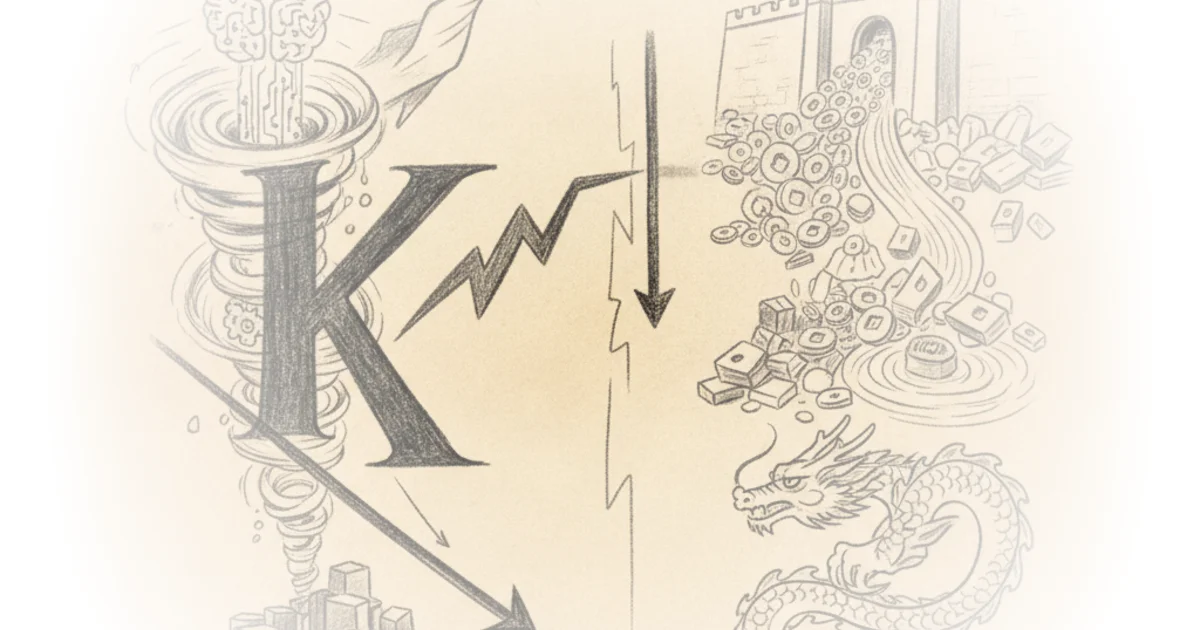
The evidence for this separation lies in the flow of goods versus the flow of capital. While the US is importing furiously to fuel its artificial intelligence infrastructure, those imports are coming from Taiwan and Mexico, not China. Tooze notes that "the bilateral, Sino-US relationship is oddly calm" despite the rhetoric, with trade deficits narrowing dramatically. This calmness, however, masks a deeper tension. The administration's protectionism has effectively insulated the US market from Chinese goods like electric vehicles, shifting the pain of the "China shock" to Europe instead. As Tooze observes, "That is painful for the Europeans, but less explosive for the world economy, so far at least."
China has achieved its growth targets via one of the largest monetary expansions the world has ever seen: at $60 trillion, China's domestic banking assets have reached ~50% of global GDP. If China fully opened its capital account, possible outflows could crush the RMB and trigger a collapse in Chinese equity/real estate markets.
This statistic from JP Morgan analyst Michael Cembalest, highlighted by Tooze, underscores the fragility beneath the surface. The sheer scale of China's domestic money supply creates a scenario where opening the floodgates for capital flight would be catastrophic. Critics might argue that such controls are merely temporary measures to stabilize a transition, but Tooze posits they are structural features of a system designed to prioritize state control over market freedom.
The Wall Around Wealth
The most striking aspect of Tooze's analysis is his focus on the Chinese bourgeoisie—the wealthy elite who are barred from the global party. He describes a situation where "China's wealthiest investors are barred from participating in one of the greatest run-ups in asset prices in history." This is not an accident; it is a deliberate policy outcome. The administration in Beijing maintains strict capital controls that "wall-in tens of trillions in Chinese wealth," preventing them from diversifying into the booming US tech sector.
The crackdown on offshore accounts illustrates the severity of this restriction. Tooze points out that brokerages like Longbridge Securities and Tiger Brokers were fined hundreds of millions for serving mainland clients without proper licenses. The government is actively dismantling the "five-step playbook" wealthy Chinese used to move money abroad: building a business, listing it globally, paying dividends, setting up family offices, and buying foreign real estate. Now, as Tooze writes, "Beijing has not just been issuing fines. It has given 'several Hong Kong and Singaporean-based brokerages with significant mainland clientele two years to wind down those accounts.'"
This move is driven by a mix of political anxiety and fiscal necessity. The government fears that capital outflows are "unpatriotic and damaging to the Communist Party's prestige," especially when citizens are eager to bet on foreign tech narratives like SpaceX that compete with China's own vision. But there is also a pragmatic need for revenue. Tooze notes, "It started with a tax bill," as officials aggressively target individuals with offshore structures to extract up to 20% in levies on investment gains.
Financial repression - in the extended sense - is a core component of China's political economy.
This phrase captures the essence of the situation: the system relies on keeping money trapped within domestic borders where it can be managed, taxed, and directed by the state. The alternative—a fully floating currency and open capital account—poses an existential threat to the regime's stability. As Tooze puts it, "The limitation of capital flows is not just technically reminiscent of Bretton Woods, it also has about it the flavor of mid-century political economy."
The Trap of Revaluation
Tooze challenges the conventional wisdom in Western policy circles that China should simply revalue its currency to fix trade imbalances. He argues that such a proposal ignores the underlying mechanics of how the yuan is managed. "Those calling for a revaluation of the yuan to redress China shock 2.0 do not, for obvious reasons, suggest that China should liberalize its balance of payments," Tooze writes. The reality is that without strict capital controls, a stronger currency would lead to massive outflows and a market crash, not a smooth adjustment.
The author draws a parallel to the "gilded cage" in which other advanced economies find themselves, benefiting from US growth through asset ownership while accepting the imbalances. He notes that over the last decade, non-US investors have benefited from "$13tn in profits from their US assets." It is no surprise that Chinese elites want in on this game. But if they were allowed to move freely, "that would drive the yuan down, not up and would maintain the imbalance on the basis of a new political economy."
This analysis reframes the debate from one of unfair trade practices to one of incompatible political systems. The West can demand a stronger yuan only because Beijing has the power to enforce it through repression. As Tooze concludes, "You can only seriously talk about currency policy if you have the PRC's system of controls." Without that control, the entire edifice could collapse into a scenario reminiscent of 2015-2016, when over a trillion dollars in reserves drained from the country, forcing even stricter regulations.
The political economy of that proposal is worth spelling out: A revaluation would, first and foremost, improve the terms of trade for Chinese consumers... And, under the current circumstances, to make it work will also require robust exchange controls. Under current conditions, more financial repression is the unmistakeable implication of calling for revaluation.
This insight is the piece's most powerful contribution: it exposes that the solution proposed by many Western economists would actually deepen the very repression they claim to oppose. A stronger currency in China today would not mean freer markets; it would mean tighter handcuffs on the wealthy to prevent capital flight.
Bottom Line
Tooze delivers a sobering verdict: the global economic disconnect is not a temporary glitch but a structural feature of a world where political control trumps market logic. The strongest part of his argument is the demonstration that Western calls for currency revaluation are naive without acknowledging the draconian capital controls required to make them work. The biggest vulnerability lies in the assumption that this "walled-in" model can sustain itself indefinitely as the AI boom widens the wealth gap between those inside and outside China's borders. Readers should watch for how Beijing balances its need for revenue against the growing desperation of its elite to access global assets, a tension that could eventually crack the dam.