Heather Cox Richardson delivers a startling diagnosis of American democracy in her May 27, 2026, dispatch: the Republican Party has not just shifted right, it has been surgically replaced by a dominance-driven movement that treats governance as a combat sport. The piece is notable not for the election results themselves, but for how Richardson connects a primary upset in Texas to the physical transformation of the White House and the historical collapse of the Whig Party in the 1850s. She argues that the current political chaos is not an anomaly, but a deliberate strategy of purging loyalty in favor of extremism, a move that mirrors the fatal rigidity of the pre-Civil War South.
The Dominance Game
Richardson frames the recent Texas primary, where the administration-backed Ken Paxton defeated incumbent John Cornyn by 27 points, as a rejection of institutional stability. She notes that despite Cornyn voting with the administration 99.2% of the time, he was discarded for not being "loyal enough." Richardson writes, "Trump appears to see politics as a dominance sport, much like the mixed martial arts fighting promoted by Ultimate Fighting Championship, whose arena is currently going up on the lawn of the White House for the fights Trump will host on his birthday, June 14." This comparison is jarring but effective; it reframes political maneuvering not as policy disagreement but as a ritual of power assertion. The construction of a 90-foot structure called "The Claw" to loom over the Rose Garden is presented not as an event, but as a symbolic erasure of the People's House.
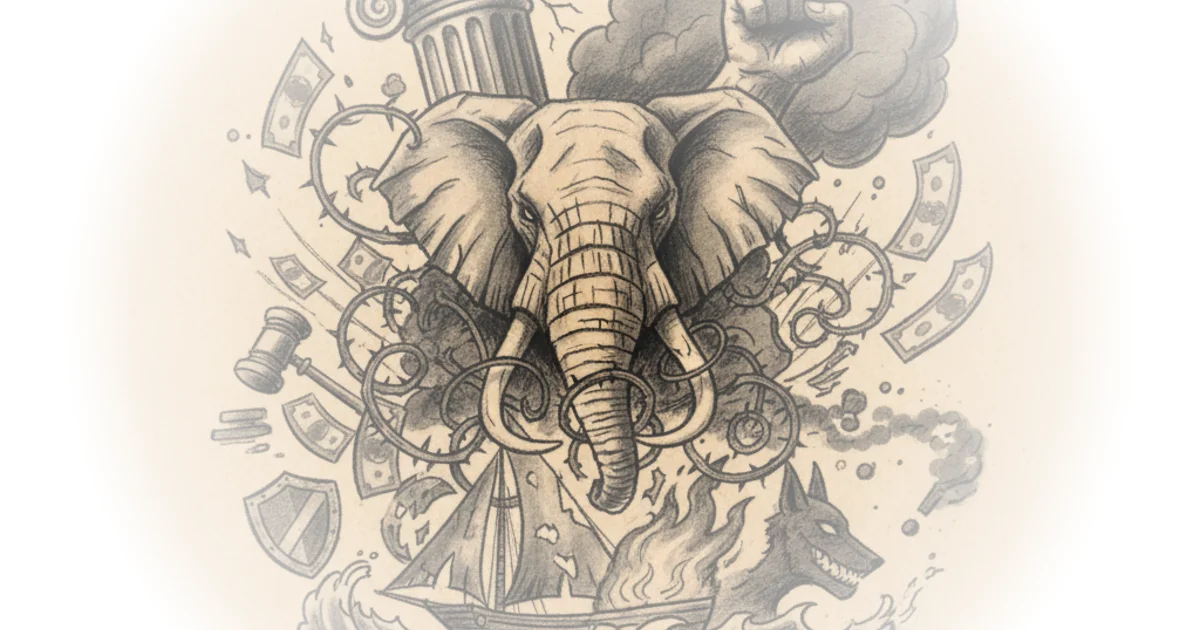
The author details Paxton's resume to show why this victory matters. She notes that in 2015, Paxton was indicted on felony securities fraud, and in 2020, his own aides reported him to the FBI for abusing his office, only to be fired and later awarded $6.6 million by a judge. Richardson points out that the Texas House impeached Paxton in 2023, yet he was acquitted under pressure from the White House. As Richardson puts it, "Trump preferred Paxton's attacks on Democrats and his flaunting of his MAGA identity despite—or perhaps because of—Paxton's many scandals." This suggests a party that no longer values competence or legality, but rather the ability to project aggression. Critics might argue that focusing solely on the candidate's scandals ignores the genuine policy disagreements that drove voters away from Cornyn, yet the sheer volume of legal and ethical breaches makes the "policy" argument difficult to sustain.
"Trump has asserted his dominance over the People's House. Similarly, with his purging even of loyalists in favor of extremists, he is asserting his dominance over the Republican Party, turning it fully into the MAGA Party."
Echoes of the 1850s
Richardson's most compelling argument lies in her historical parallel to the Kansas-Nebraska Act of 1854. She draws a direct line between the elite enslavers who forced the expansion of slavery and the current administration's demand for ideological purity. She writes, "In a similar moment in the 1850s, elite enslavers who dominated the Democratic Party demanded party members line up behind their determination to spread human enslavement to the West." Just as the Kansas-Nebraska Act shattered the existing political order, the current "purity test" is fracturing the Republican coalition. Richardson observes that "those opposed to the Kansas-Nebraska Act and the spread of slavery abandoned their old political allegiances and came together," forming a new coalition that would eventually elect Abraham Lincoln.
The author highlights how the current administration uses the same tactics as the "Slave Power" of the 1850s: appealing to racism and fear to maintain control. She notes that the administration has falsely claimed that ethnic Somalis in Minnesota are "all crooks," a tactic designed to rally the base through exclusion. Richardson writes, "The echoes of that tactic today are blaring as Trump and MAGA Republicans try to cement their power through racism and culture war issues." This historical framing is powerful because it moves the conversation from personality to systemic collapse. It suggests that the current turmoil is not a temporary glitch but a fundamental realignment of the American political landscape, much like the birth of the Republican Party itself in opposition to the spread of slavery.
The Cost of Secrecy and Violence
The piece does not shy away from the human cost of this dominance strategy. Richardson details the administration's use of a $1.776 billion slush fund to support January 6 insurrectionists, noting that Proud Boy Enrique Tarrio expects these funds to be used to "spread 'conservative culture' and to run for office to take over the system." She also exposes the financial corruption, citing reports that a contractor was paid $13.1 million to repair the Lincoln Memorial Reflecting Pool—seven times the initial estimate—using fees collected from national park visitors. Richardson argues that the administration is actively hiding these actions, proposing sweeping nondisclosure agreements for federal employees to prevent exposure. As Don Moynihan is cited, this secrecy would make it "impossible for the American people to know what government officials are doing."
Perhaps most disturbing is the administration's military conduct. Richardson reports that the U.S. military has struck fifty-eight small boats in the eastern Pacific and Caribbean, killing at least 194 individuals, with no evidence produced to support the claim that they were trafficking drugs. She quotes Eric Schmitt of the New York Times, who notes that "military experts say the strikes are illegal, extrajudicial killings." The author also highlights the administration's threat to "blow up" the ally Oman if it does not comply with demands regarding the Strait of Hormuz. This section of the commentary is vital because it grounds the political analysis in the reality of violence and death. The human toll of 194 dead individuals is not a footnote; it is the direct result of a policy driven by dominance rather than diplomacy.
"Unlike anti-Nebraska candidates in 1854, Talarico and other Democratic candidates this year have the advantage of running against a party whose leader is openly corrupt."
The Path Forward
Despite the grim landscape, Richardson finds a glimmer of hope in the response of Democratic candidate James Talarico. While the administration attacks Talarico with absurd claims that he is a "transgender vegan," Talarico refuses to take the bait. Richardson quotes him saying, "I'm an eighth-generation Texan. I've been eating barbecue since before Ken Paxton's first indictment." Talarico's strategy is to speak directly to disillusioned voters who feel the system works only for billionaires. Richardson writes, "If 'we can bring those Texans together across all these divisions in our politics, if we can see past the distractions and the culture war tactics, I think we can do something extraordinary.'" This mirrors the anti-Nebraska coalition of 1854, which swept Democrats out of state legislatures and eventually formed a new party. The author suggests that the current moment, like the 1850s, could be a turning point where voters reject a party consumed by extremism and corruption.
The piece concludes by noting that while the Texas Senate race is a toss-up, the historical precedent is clear. In 1854, voters put "anti-Nebraska" congressmen in 120 of 142 northern seats. Richardson argues that the current political realignment is underway, driven by a rejection of a party that has become a vehicle for corruption and violence. The strongest part of her argument is the seamless integration of historical context with current events, showing that the patterns of American political collapse are repeating. However, a counterargument worth considering is whether the current electorate is as polarized and ready for a realignment as the 1850s voters were, or if the current chaos will simply lead to further gridlock.
Bottom Line
Richardson's piece is a masterful synthesis of history and current events, arguing that the current political crisis is a deliberate strategy of dominance that mirrors the fatal rigidity of the pre-Civil War era. Its greatest strength is the unflinching connection between the administration's rhetoric, its corruption, and the human cost of its policies. The biggest vulnerability is the assumption that the electorate will follow the historical precedent of 1854 and reject extremism, a hope that remains unproven in a deeply polarized modern landscape.