This analysis cuts through the noise of ideological posturing to reveal a stark reality: Taiwan's energy strategy has evolved from a political slogan into an existential vulnerability. Jordan Schneider and his co-hosts on ChinaTalk present a chilling case study where the pursuit of "Non-Nuclear Homeland" branding has left the island with only 11 days of liquefied natural gas reserves, creating a fragile grid ripe for disruption without a single missile being fired.
The Architecture of Vulnerability
Schneider frames Taiwan's energy crisis not as an accident of nature, but as the direct result of decades of political maneuvering that prioritized ideology over engineering. The piece opens with a terrifying hypothetical: a scenario where Chinese warships encircle the island, cutting off the sea lanes that supply 97% of its energy needs. "Taiwan holds roughly 11 days of LNG reserves," the commentary notes, highlighting how this thin buffer turns global market fluctuations into immediate domestic emergencies.
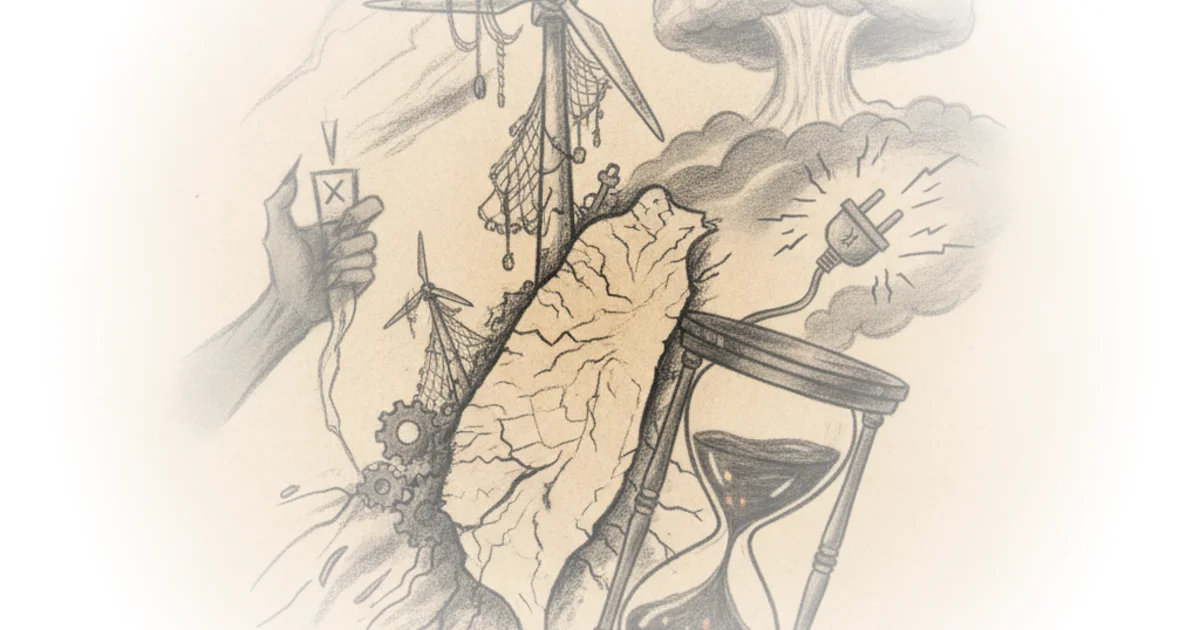
The argument gains traction by linking current geopolitical tensions to local policy failures. When the war in Iran disrupted gas supplies from Qatar, Taiwan's spot prices surged over 140%. Yet, as energy journalist Angelica Oung points out, the island survived only because of a specific geopolitical anomaly: "Taiwan should send a thank you note and a fruit basket to Beijing right now because the reason we're not having an energy crisis is because of China." She explains that China's own demand destruction has flooded the market with excess LNG cargoes, temporarily masking Taiwan's structural weakness. This insight is crucial; it suggests that Taiwan's current stability is borrowed time, dependent on a rival power's economic struggles rather than its own strategic planning.
"The more natural gas you have in your grid, naturally, the more vulnerable you are, both to a blockade scenario or to just stuff happening — like the Iran situation."
Critics might argue that transitioning away from nuclear power was a necessary democratic response to public fear following the Fukushima disaster and decades of opaque authoritarian rule. The article acknowledges this historical context, noting that the Democratic Progressive Party (DPP) was founded in opposition to the martial law era when nuclear plants were built without public consultation. However, Schneider's analysis suggests that the pendulum has swung too far, replacing one form of energy insecurity with another.
The Political Gridlock on Energy
The commentary excels at dissecting how Taiwan's polarized political landscape paralyzes practical solutions. The ruling DPP is wedded to its "Non-Nuclear Homeland" brand, while the opposition parties, including the Kuomintang (KMT) and the Taiwan People's Party (TPP), have become increasingly anti-renewable in their reaction to the government's failures. Schneider observes that this dynamic has created a toxic environment where energy policy is treated as a partisan weapon rather than a national security imperative.
Ricky Huang captures this absurdity perfectly: "Multiple forces have united against renewables in Taiwan, each with different motivations. This reminds me of cross-strait relations, where we say 'one China, multiple interpretations.' Here it's one anti-renewable sentiment with countless different rationales." The result is a gridlock where no single party can implement an "all-of-the-above" strategy. The DPP, described by Oung as the "party of lawyers and activists," lacks the technocratic capacity to manage complex infrastructure projects, while the KMT, the "party of engineers," has been sidelined politically despite having the expertise to execute the grid modernization Taiwan desperately needs.
The historical weight of this failure is underscored by references to the Lungmen Nuclear Power Plant, a project that was mothballed in 2014 and permanently halted by referendum in 2021. This decision removed a massive source of baseload power just as renewable deployment stalled due to corruption scandals and local opposition. The article highlights how "green energy cockroaches" — a term used to describe the corrupt networks surrounding renewable projects — have tainted public trust, making it nearly impossible for any party to advance a coherent energy agenda without being accused of selling out or incompetence.
"Political polarization has been a huge problem in all aspects... Because this has been part of their branding, they don't find it attractive to work with the other side since they have already attacked the other side on this issue so much."
The piece also touches on the economic stakes, noting that TSMC alone consumes 8 to 10 percent of Taiwan's electricity. Any disruption to the grid is not just a matter of comfort; it is a direct threat to the global semiconductor supply chain. Yet, the political will to address this remains fractured. The absence of a dealmaker like the late Wang Jin-pyng, who once facilitated cross-party cooperation on nuclear issues, leaves the current divided government without a mechanism to break the deadlock.
The Path Forward or Downward?
Schneider's narrative concludes with a cautious optimism that feels more like a warning. He suggests that the severity of Taiwan's energy poverty might eventually force a political realignment, potentially resurrecting the electoral fortunes of the KMT despite their controversial ties to Beijing. "If things don't improve... well… Taiwan's energy poverty might just be able to resurrect the electoral chances of the Kuomintang," he posits. This is a sobering prediction: the very party that many Taiwanese voters distrust for its proximity to China could become the default choice simply because it represents stability and technical competence in an era of green chaos.
The administration's recent U-turn, with President Lai Ching-te walking back forty years of anti-nuclear orthodoxy to consider restarting reactors, signals a recognition of this reality. However, reversing decades of policy is slow and fraught with legal and social hurdles. The article implies that without a fundamental shift in how energy is debated—moving from identity politics to pragmatic engineering—the island remains on a collision course with its own vulnerabilities.
"This isn't a hypothetical war game... China wouldn't even need to shoot missiles into the Taiwan Strait. They have the vessels, they have the means to say, 'We have a new renewable energy mandate. Any energy vessels coming into our territorial waters have to get this permit.'"
Bottom Line
Schneider's analysis is at its strongest when it strips away the ideological rhetoric to reveal the hard engineering and security math: an island with 11 days of fuel reserves cannot sustain a modern economy under blockade or global supply shock. The piece's greatest vulnerability lies in its reliance on political speculation regarding future elections, which may distract from the immediate need for infrastructure investment regardless of who wins the next vote. Readers should watch closely to see if the current administration can translate its nuclear U-turn into actual power generation before the next geopolitical storm hits.