In a cultural landscape where secularism often equates to rigid materialism, Alex O'Connor's interview with Sam Harris challenges the very vocabulary of the modern atheist. The most striking claim here is not that spirituality exists, but that the secular world has lost a crucial tool for understanding the mind by rejecting the word entirely. O'Connor and Harris argue that the dismissal of introspection as "spooky" or "dogmatic" blinds science to the most immediate data we possess: the first-person experience of consciousness itself.
The Rehabilitation of a Dirty Word
The conversation begins by addressing the stigma surrounding the term "spirituality" within secular circles. Harris admits that even he struggles with the word, noting that he has "burnt a fair number of words trying to... take the shades of at least Abrahamic religion off of it." O'Connor probes whether the last decade has shifted this sentiment, given Harris's earlier efforts to frame his work as "spirituality without religion." Harris concedes that while he attempted to rehabilitate the term, he "don't think I was exceptional even for myself," and many in the scientific community still view the contemplative life with suspicion.
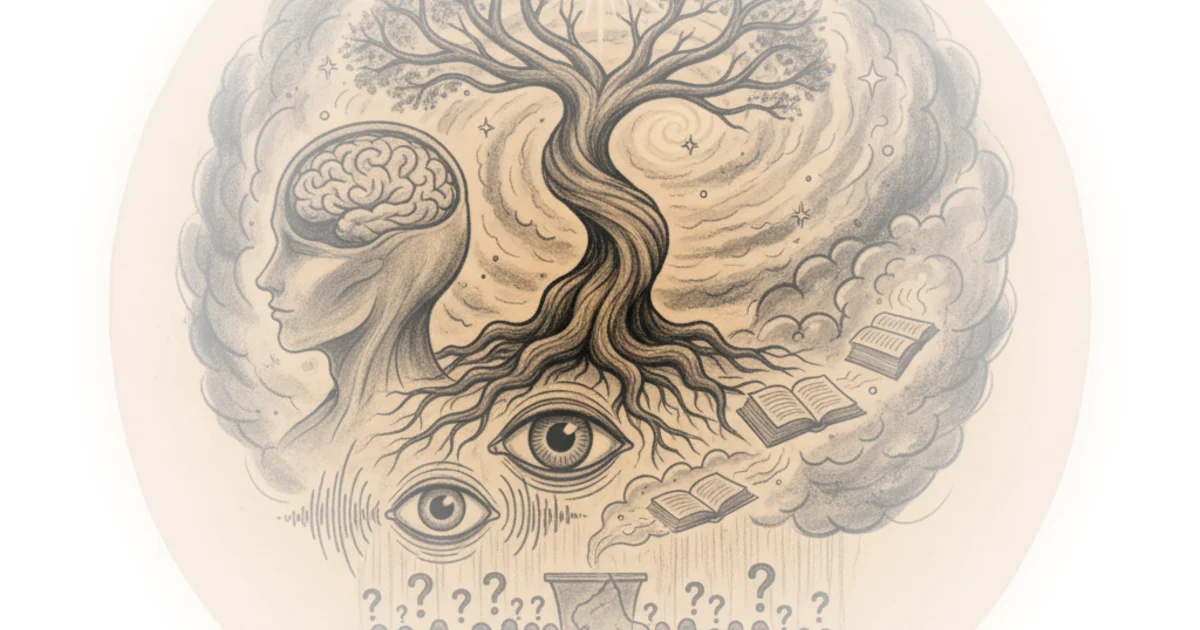
This hesitation is not merely semantic; it reflects a deeper epistemological divide. The authors suggest that science has historically prioritized third-person observation, often dismissing the first-person perspective as unscientific. Yet, as Harris points out, "the first person's perspective is really the only one we can ever fully adopt." By clinging to external metrics alone, the materialist worldview risks ignoring the very phenomenon it seeks to explain: the nature of experience.
"There is a primacy of experience, right? That the first person's perspective is really the only one we can ever fully adopt."
Critics might argue that relying on subjective experience invites solipsism or unverifiable claims. However, the dialogue reframes this not as a rejection of science, but as an expansion of it to include phenomenology—the study of structures of consciousness as experienced from the first-person point of view. This connects to the broader philosophical tradition, echoing the work of Edmund Husserl in the early 20th century, who argued that philosophy must return "to the things themselves" by bracketing out theoretical assumptions to examine pure experience.
The Talent Gap in Introspection
A central pillar of the argument is the idea that introspection, much like music, is a skill with a wide variance in aptitude. Harris uses a compelling analogy: just as some people are tone-deaf and cannot access the depth of music, many are "closed by sheer... lack of talent" to the depths of their own minds. He describes a bell curve of aptitude where the highly talented can, with simple instructions to focus on the breath, "plunge into a drug-like experience where you're kind of find yourself in the well of pure mind very very quickly."
For those on the other end of the spectrum, the exercise feels futile. Harris describes the experience of the "hard case" as a "painful collision with your own capacity for restlessness and doubt." Instead of finding silence, they find a "prison of thought," where the mind cycles through the same repetitive stories without relief. This observation is crucial because it explains why skepticism persists: if one cannot access the state, the instruction seems nonsensical.
"If you stick an untrained mind in a room, you know, all by itself for days or weeks or months or years at a time, people can just go nuts."
The authors suggest that the scientific community's resistance often stems from this inability to access the phenomenon. If a researcher has never experienced the cessation of the "subject-object split," they are unlikely to take reports of it seriously. This mirrors the historical tension in philosophy of mind, where the "hard problem" of consciousness remains unsolved precisely because objective data cannot fully capture the subjective "what it is like" to be a thinker. The argument here is that the failure to recognize the legitimacy of reflective knowledge is a failure of imagination and practice, not necessarily a failure of the method itself.
The Prison of the Thinking Mind
The most visceral part of the commentary is the description of the untrained mind as a form of solitary confinement. Harris notes that for the average person, the mind is a place where they "tell yourself the same story, you know, 20 times and for some reason you have no capacity to be bored by it." This repetitive loop creates a sense of imprisonment that only becomes apparent when one attempts to step outside of it.
The implication is profound: the default state of human consciousness is not a neutral baseline but a specific, often limiting, mode of operation. By failing to investigate this state, we accept a constrained version of reality. As Harris puts it, "most people in science have never found that there was anything else to do with the mind but to think." This oversight limits the potential for understanding human potential, suggesting that the "self" is not a fixed entity but a construct that can be deconstructed through disciplined attention.
"The mind is a prison, and for most of us, we don't even know we are locked inside until we try the key."
While the argument is powerful, it relies heavily on the assumption that these states of consciousness are universal and accessible to all with sufficient training. Skeptics might question whether the "pure consciousness" described is a genuine discovery or a culturally conditioned hallucination. Yet, the sheer consistency of these reports across millennia and cultures, from Buddhist sages to modern neuroscientists, lends weight to the idea that there is a shared, underlying structure to human experience waiting to be uncovered.
Bottom Line
O'Connor and Harris successfully reframe the debate on spirituality, moving it from a theological dispute to a practical inquiry into the nature of consciousness. The strongest part of their argument is the analogy of musical talent, which effectively explains the resistance of the secular world to introspective practices without resorting to mysticism. However, the piece's vulnerability lies in its reliance on personal aptitude; if the experience is inaccessible to the majority without extensive, difficult training, its utility as a broad secular framework remains limited. The reader should watch for how this "contemplative science" evolves as neuroscience begins to map these subjective states with increasing precision.
"Most people in science have never found that there was anything else to do with the mind but to think."
The ultimate takeaway is that the dismissal of the inner life is not a sign of intellectual rigor, but a failure to explore the full spectrum of human data. By reclaiming the tools of introspection, the secular world may find it has more to discover about the mind than it ever imagined.