This piece cuts through the noise of Chinese social media to expose a dangerous feedback loop where simplification wins over truth, and where the "elite" and the "masses" are far more aligned than they admit. Zichen Wang, writing for Pekingnology, argues that the recent suspension of mega-influencer Lu Kewen is not a victory for accuracy, but a temporary glitch in a system that rewards "second-hand certainty" over first-hand knowledge. The coverage is notable because it refuses to treat this as a simple case of bad actors; instead, it frames the phenomenon as a structural failure of the information ecosystem itself, one that is actively shaping how a billion people understand global conflict.
The Architecture of Simplification
Zichen Wang opens by describing the unique constraints of the Chinese information environment, noting that "red lines are sensed more often than spelt out, nudging participants towards euphemism and hint." This observation is crucial because it explains why the discourse doesn't just drift toward conspiracy; it is structurally engineered to do so. When direct analysis is risky, speculation becomes the safest path, creating a "peculiarly domestic version of 'the world'" that circulates behind the Great Firewall. This dynamic mirrors the historical function of the "50 Cent Party," where state-sponsored commenters once flooded forums to drown out dissent, but here the mechanism is more organic: the audience itself polices the boundaries, rewarding those who speak in confident, simplified slogans.
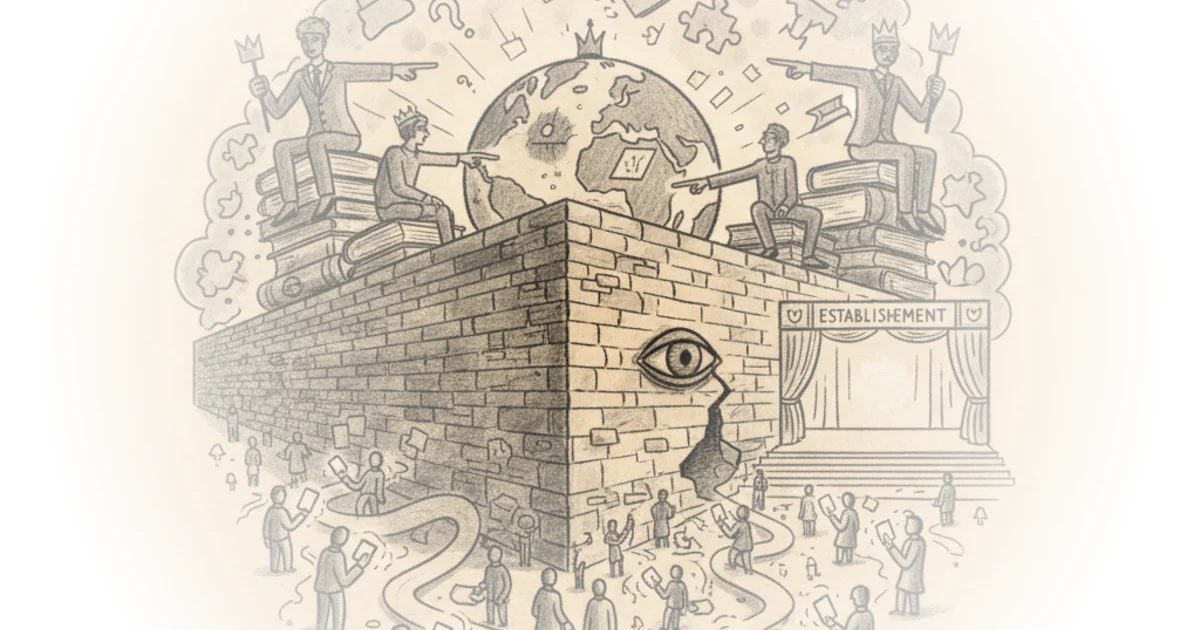
The author identifies a hierarchy of voices, from the shouting "street strategists" to the polished pundits in lecture halls, arguing that "the job is the same: boil the world down into something brutally simple and eerily conspiratorial." This is a sharp critique of the entire media landscape, suggesting that the distinction between a factory worker and a white-collar executive is merely one of vocabulary, not worldview. As Zichen Wang puts it, "In that setting, moderation tends to be a liability. The loudest voices are not merely amplified by algorithms; they are often spared the swift correction that greets less convenient kinds of speech."
"In-jokes become catchphrases; catchphrases harden into doctrine; doctrine turns into badges of belonging, and then into habits of feeling."
This progression from humor to dogma is the piece's most chilling insight. It suggests that the closed loop of these online communities is self-sustaining, creating a reality where "outrage is recycled, intensified, and taken as evidence." Critics might argue that this analysis underestimates the genuine anger or frustration that fuels these movements, but the evidence of self-referentiality is hard to ignore. The ecosystem doesn't just reflect the world; it replaces it.
The Illusion of Class Divide
The commentary then turns to the recent ban of Lu Kewen, a figure who epitomizes the "street strategist" model. Song Xi, one of the voices analyzed, claims that Lu's audience is limited to the "less educated" in factory dorms, implying that the "white-collar set in Beijing, Shanghai and Guangzhou would never fall for it." Zichen Wang dismantles this comforting narrative immediately. The author argues that the "premium" version of this rhetoric, often found in high-end venues, is "not an antidote—it just speaks more softly and dresses itself up with a preamble: Anglo-Saxon blocs, Jewish conspiracy, Freemasons as a kind of intellectual foreplay, sold as sophistication."
This reframing is essential. It challenges the reader to see that the "Anglo-Saxon bloc" rhetoric isn't a sign of sophistication, but merely a more expensive packaging of the same conspiracy theories. The text notes that "different tiers, same closed loop," meaning the underlying logic remains unchanged regardless of the speaker's credentials. The influence of these figures is "widely underestimated," and Zichen Wang warns that "something dangerous happens" as this style of commentary occupies more of the opinion market.
"As the trend continues and intensifies, it is only a matter of time before what the 'elite' once mocked as obvious nonsense becomes the mainstream's working vocabulary for understanding the world."
This is the core of the argument: the erosion of shared reality. When complex geopolitical structures are replaced by "wuxia novel" tropes where the U.S. is an "evil cult" and Japan is a "traitor," the ability to engage in genuine diplomacy or policy-making is compromised. The author points out that Lu Kewen's success is a "triumph of knowledge simplified and weaponised to overpower everything else."
The Human Cost of "Knowledge"
The piece does not shy away from the human element, noting that Lu Kewen's content often trivializes real violence. His "Taliban Story," for instance, portrayed a group responsible for bloodshed in Xinjiang as having a "sense of saving the country and the nation." This is not just misinformation; it is a moral distortion that treats real-world suffering as "artistic flair." Zichen Wang writes that "the sad truth is that in this age of the attention economy, it is often the slop flavoured with 'the deep sentiment of Osama bin Laden' that brings in the big bucks."
This section highlights the ethical vacuum of the "attention economy." The author argues that Lu Kewen's followers are not stupid; they are "hungry for world knowledge but lacking the ability to critically assess it." They are "devouring" instant noodles of information because legitimate knowledge is either too high up in the "ivory tower" or restricted by "special reasons."
"When legitimate knowledge remains high up in its ivory tower or can't be spoken for 'special reasons,' there will always be 'knowledge peddlers' opening fast-food stands in the corners, selling instant noodles spiced up with sensational seasoning."
The counterargument here is that the "street strategists" are simply filling a void left by the state and academia. If the government restricts certain topics and universities are too abstract, why shouldn't influencers provide a "user manual for the world"? However, the cost of this "user manual" is a distorted view of reality that can lead to real-world consequences, from public pressure on foreign policy to the dehumanization of foreign populations.
Bottom Line
Zichen Wang's analysis is a powerful indictment of an information ecosystem where truth is secondary to engagement and where the "elite" and the "masses" are united by a shared, simplified worldview. The strongest part of the argument is its refusal to let the "white-collar" class off the hook, revealing that their sophisticated rhetoric is often just a veneer over the same conspiracy theories. The biggest vulnerability is the assumption that this loop can ever be broken without a fundamental shift in how information is regulated and consumed. As the piece concludes, mocking the "street strategist" is easy, but the mirror they hold up reflects a society that has lost its way in understanding the world.