In an era where artificial intelligence promises to automate every facet of business, Emily Kramer makes a counterintuitive claim: the most effective tool for B2B growth is not a new algorithm, but a dinner plate. While the industry chases the next generative model, Kramer argues that the highest-leverage strategy for closing high-value deals is the deliberate, human-centric executive dinner. This is not merely a nostalgic nod to old-school relationship building; it is a tactical pivot born from the collapse of the traditional trade show model and the saturation of AI-generated content.
The Death of the Booth and the Rise of the Table
Kramer identifies a seismic shift in how companies allocate event budgets. For decades, the trade show booth was the default, but the post-pandemic landscape has rendered it inefficient. Sheena Badani, an expert in executive events whom Kramer interviewed, notes the stark change in attendee behavior. "Events used to be more trade show-oriented, taking advantage of other people's events to leverage for lead generation. Now attendance at those just looks different. People are less inclined to travel to those large trade shows. So the new event model is using your own hosted events for deal acceleration," Badani explains. This observation cuts through the noise of marketing vanity metrics. The old model relied on hope—hoping the right decision-maker wandered by a booth. The new model relies on precision.
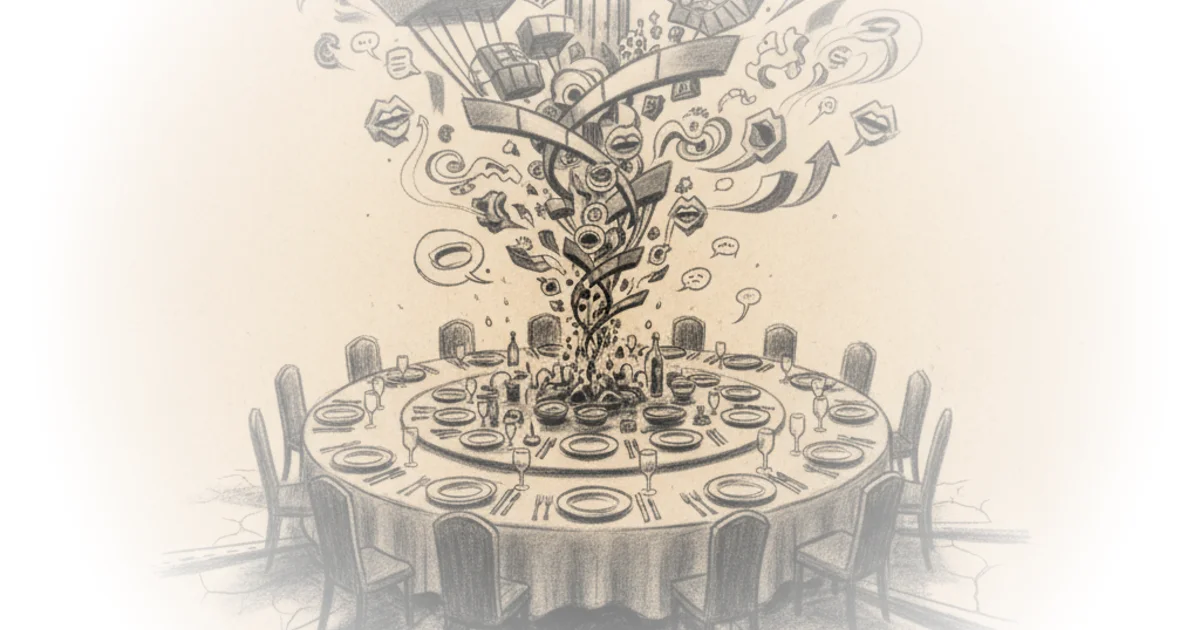
The argument here is compelling because it reframes the dinner not as a perk, but as a controlled environment for deal acceleration. Kramer writes, "You're not trying to collect 500 badge scans from people who will never respond to follow-up emails. You're connecting directly with ~12 people who are actually in your pipeline, actually evaluating you, and giving them a reason to move forward." This distinction is vital. It moves the conversation from volume to velocity. In a world where digital inboxes are flooded with AI-slop, the scarcity of genuine, unscripted human interaction has become a premium asset.
"In the age of AI-generated everything, this kind of authentic human connection is a strong differentiator. A dinner forces real conversation. You can't automate your way through it."
Critics might argue that scaling intimacy is impossible for large enterprises, or that the ROI of a single dinner is too hard to track compared to digital campaigns. However, the piece suggests that the return isn't just in the immediate sale, but in the intelligence gathered and the relationships forged that digital channels cannot replicate.
The 3 Ps: People, Place, and Programming
Kramer does not simply advocate for throwing money at a restaurant; she insists on a rigorous framework. The core of her argument rests on Badani's formula for a successful event: the "3 Ps"—people, place, and programming. The most critical element, by far, is the guest list. "Rather than going out with an empty invite list, seed a few people to build interest in the dinner," Badani advises. This is a subtle but powerful psychological lever. Social proof drives attendance more effectively than a generic invitation.
The author emphasizes that the composition of the group matters more than the venue. "You could show up at McDonald's with the right people or co-hosts, get people to show up, and still have a good time. The inverse is also true: If you have the wrong people, even the best restaurant and most compelling topic won't save the dinner," Kramer writes. This reframing challenges the common tendency to over-invest in logistics while under-investing in curation. It requires a level of strategic discipline that many marketing teams lack, treating the guest list with the same rigor as a product launch.
Furthermore, the dinner serves a dual purpose: closing deals and gathering market intelligence. "People who go to these dinners tell me they want to either meet their peers, somebody interesting, or they want to learn something new that they can take back to their business," Badani notes. This aligns with the historical function of executive search and networking, where the value often lies in the exchange of unfiltered insights rather than a formal pitch. Just as the evolution of trade shows from simple exhibitions to complex ecosystems required a shift in strategy, the dinner model requires a shift from vendor-centric pitching to peer-centric convening.
"You're showing up as a peer, not a vendor. That perception shift is worth more than most companies realize, especially in crowded markets where everyone's product looks the same."
Beyond the Transaction: Community and Intelligence
The commentary extends beyond immediate revenue to the long-term value of community building. Kramer highlights that these dinners can uncover market gaps and test new messaging in real-time. "There's no substitute for talking to your ICP in person, and people get really unfiltered at dinner," she observes. This intelligence is often the hidden dividend of the strategy. When executives hear directly from their ideal customer profile about what keeps them up at night, it informs product roadmaps and positioning in ways that survey data never could.
The piece also touches on the importance of follow-through. A dinner is not a one-off event but a campaign. "You need fuel (the content and experience) and engine (how you get people there and follow up)," Kramer argues. This systems-thinking approach prevents the "random acts of marketing" that plague many organizations. By treating the dinner as a repeatable, scalable process, companies can build a network of advocates. As Badani illustrates with a case study involving Glean, the goal is often to create a self-sustaining community: "We set up a WhatsApp group for them to stay in touch afterwards." This transforms a transactional meeting into a lasting ecosystem.
However, the strategy is not without its pitfalls. The reliance on high-touch, high-cost events means that the barrier to entry is significant. For startups with limited resources, the cost of executing a "perfect" dinner might outweigh the potential returns if the target account list is not meticulously curated. The article acknowledges this, warning against "reckless abandon," but the execution requires a level of operational maturity that not all teams possess.
Bottom Line
Emily Kramer's analysis successfully reframes the executive dinner from a luxury perk to a strategic necessity in the AI era. The strongest part of the argument is the pivot from volume-based lead generation to high-intent, relationship-driven acceleration. The biggest vulnerability lies in the execution: without rigorous curation of the guest list and a clear post-event strategy, the model collapses into expensive socializing. For leaders navigating a saturated market, the verdict is clear: if you cannot automate the human connection, you must master it.