This piece from More Perfect Union cuts through the spectacle of Sunday football to expose a century-long corporate strategy of medical denial. It argues that the league's billion-dollar revenue model is not merely built on entertainment, but on the systematic concealment of brain damage and the active recruitment of children to sustain a fan pipeline. The most startling claim is not that injuries happen, but that the league's leadership, composed of billionaires from hedge funds and private equity, has knowingly prioritized profit over the cognitive survival of their workforce for generations.
The Architecture of Denial
More Perfect Union anchors its argument in the stark contrast between medical consensus and league protocol. They highlight the tragic case of Junior Seau, whose suicide revealed a brain aged decades beyond his years, noting that "postmortem the National Institutes of Health concluded that he had CTE." The author uses this to illustrate a broader pattern of institutional negligence. "Since the first major studies linking CTE to professional football were released in 2005, the NFL has made 180 billion dollars," they write, "they've barely changed anything about their protocol and continue to sacrifice players brains in the pursuit of profit."
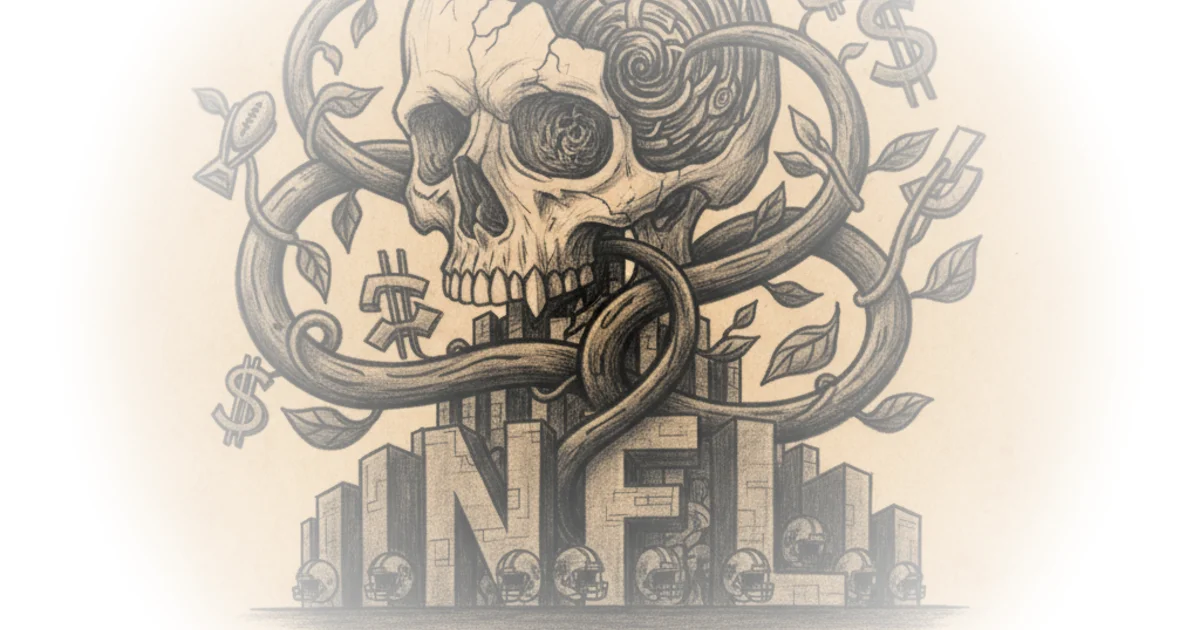
This framing is effective because it shifts the narrative from accidental injury to calculated risk management. The piece details how the league appointed a rheumatologist, rather than a neurologist, to lead their concussion committee, a move that signaled a lack of scientific seriousness. More Perfect Union describes the resulting research as "big tobacco-like studies where they designed them in a way that would only benefit the NFL's position." This comparison to the tobacco industry is potent; it suggests a deliberate strategy of sowing doubt rather than a genuine misunderstanding of the science. Critics might argue that the league has since updated safety protocols, but the author counters that these changes are cosmetic when the fundamental economic incentives remain unchanged.
The NFL is an unstoppable force with a monopoly on a pastime physically linked with American culture and economy, a story of deep corporate greed prioritizing profit for billionaires over all else.
The Media and Union Complicity
The commentary expands to examine how the NFL's monopoly power extends beyond the field, silencing critics through economic leverage. More Perfect Union points out that major media conglomerates like Comcast, Disney, and Amazon pay billions for broadcasting rights, creating a conflict of interest for journalists. "If you did a bad story about the NFL you got a phone call from the NFL offices saying how unfair you were being," the author explains, noting that media companies fear retaliation during contract negotiations. This dynamic has historically stifled investigative reporting, allowing the cover-up to persist.
Similarly, the piece argues that the players' union is often powerless to protect its members. The author notes that players who speak out or lead union resistance often find their careers cut short. "If you are in a leadership role in the NFL players association and you fight back against the NFL or say bad things in the media you're much less likely to get signed later on in your career," they observe. This creates a chilling effect where workers are afraid to demand safer conditions. The argument here is that the union's bargaining power is structurally weakened by the league's ability to blacklist dissenters, a point that resonates with broader labor struggles in other industries.
The Pipeline of Youth
Perhaps the most disturbing section of the coverage is the analysis of youth football. More Perfect Union challenges the notion that players are fully informed adults making a choice, arguing instead that the sport recruits children before they can comprehend the risks. "The idea that we are recruiting five-year-olds for a sport that will give them a brain disease when they have 25 other options that will not give them that brain disease has to change," they assert. The author suggests the league's interest in youth sports is not to develop talent, but to cultivate lifelong fans who will consume the product for decades.
This reframing of youth football as a marketing funnel rather than a developmental pathway is a bold move. It forces the reader to reconsider the cultural acceptance of children playing a dangerous contact sport. The piece notes that the league actively discourages flag football, preferring the full-contact version because it creates a "sticky relationship" with the game. "You have to put the same costume on as your hero and if you go play football yourself your entire family turns into a football watching family," the author writes. This insight into the league's business model strips away the romanticism of the sport, revealing a cynical calculation that trades long-term health for short-term engagement.
The Billionaire Owners
The final thrust of the argument targets the ownership structure itself. More Perfect Union emphasizes that the league is jointly owned by 32 teams, 30 of whose owners are billionaires. They highlight the disparity between the owners' wealth and the players' long-term health outcomes. "These are men and women who made their billions in hedge funds, real estate, oil, private equity, and we've put them in charge of a monopoly overseeing something seen as a necessity to many Americans," the author writes. The piece argues that these owners use their immense wealth and political influence to escape accountability for the damage they have inflicted.
The settlement reached in 2016 is dismissed as insufficient. More Perfect Union notes that while the NFL agreed to payouts, they refused to admit wrongdoing, and the compensation is "a drop in the bucket" compared to the lifetime of cognitive impairment players face. "If you can't think straight, if you have cognitive disorders in your 40s and 50s, it's almost impossible to earn a living afterwards," they point out. This economic reality underscores the moral failure of the league: it extracts value from players' bodies and discards them when they can no longer perform, leaving them with no safety net.
The billionaires who own the NFL need to be held accountable for the damage they've wreaked on their players' brains; players who make football great are, just like the rest of us, workers too.
Bottom Line
More Perfect Union's strongest asset is its ability to connect the dots between medical denial, media complicity, and the economic incentives of billionaire ownership, presenting the concussion crisis not as an accident but as a feature of the business model. The piece's vulnerability lies in its lack of specific policy prescriptions beyond holding owners accountable, leaving the reader with a clear diagnosis but no clear cure. However, the argument succeeds in making it impossible to view the NFL's profitability without acknowledging the human cost it obscures.