The Humean Theory Under Fire
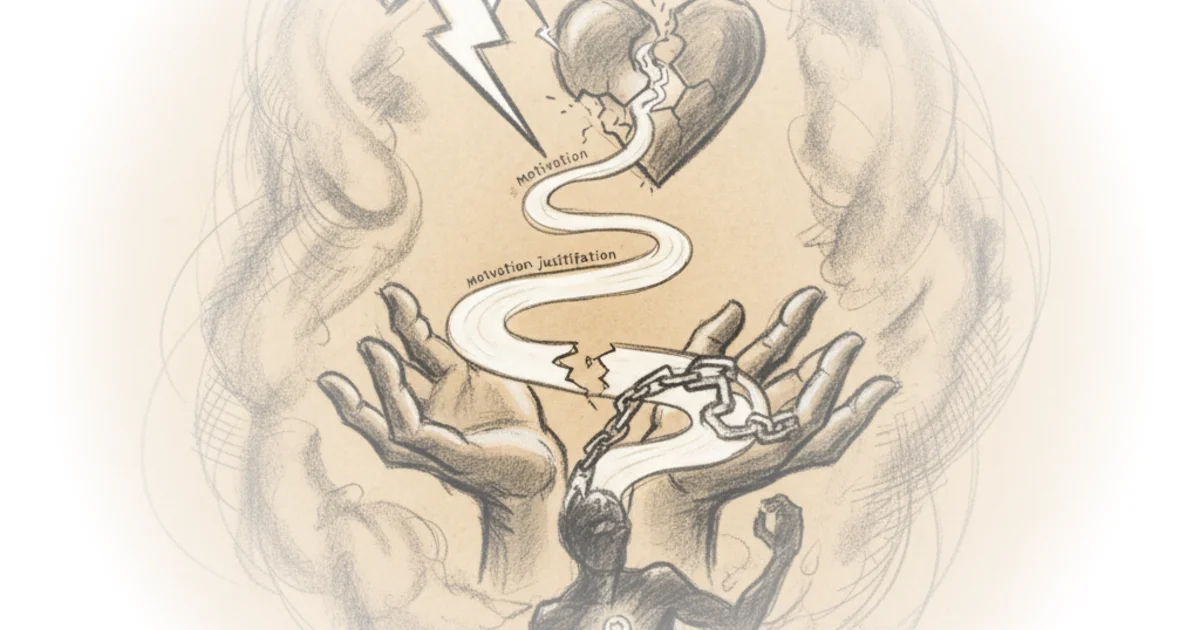
Michael Huemer, a philosophy professor at the University of Colorado Boulder and author of Ethical Intuitionism, takes aim at one of the most influential ideas in moral philosophy: the Humean theory of motivation. The theory, attributed to the eighteenth-century Scottish philosopher David Hume, holds that reason alone can never move a person to act. Only desires can do that. Beliefs just help you figure out how to get what you already want.
Huemer argues this gets things exactly backwards when it comes to moral judgments.
What the Humean Argument Actually Claims
The piece lays out a four-step argument that has dominated ethics for centuries. It runs like this: all reasons for action come from desires; beliefs about objective facts do not entail desires; moral attitudes entail reasons for action; therefore, moral attitudes cannot be beliefs about objective facts. This argument has been used to prop up both subjectivism and non-cognitivism, the view that moral statements do not express beliefs at all but rather emotions or preferences.
Maybe the most popular argument in all of the ethics literature is the Humean argument against moral realism.
Huemer notes an important distinction that often gets muddled in these debates. "Reasons for action" can mean two very different things. There are motivating reasons, the psychological forces that actually cause someone to act, and normative reasons, the considerations that make an action rational. The Humean argument trades on conflating these, or at least on assuming they must always travel together.
Four Kinds of Motivation
Rather than accept the Humean framework, Huemer proposes a richer taxonomy of what moves people to act. He identifies four categories: appetites (hunger, thirst, lust), emotions (fear, anger, love), prudence (concern for long-term self-interest), and impartial reasons (motivation to do what one judges to be overall good or right).
The critical move comes next.
You could just define "desire" to cover (1)-(4) (and anything else I've missed). In that case, it's trivial that all intentional action stems from desire. But this trivial truth would not rebut moral realism, nor would it show anything else interesting.
This is a sharp observation. If "desire" is stretched to include every possible motivation, including the calm judgment that one ought to donate to charity, then the Humean theory becomes true by definition but loses all its bite. It no longer tells us anything about the nature of morality. But if "desire" is restricted to appetites and emotions, then the theory is substantive but plainly false. People regularly override what they want in favor of what they judge to be right.
Why the Theory Seems Plausible
Huemer offers a deft explanation for why so many philosophers have found the Humean view compelling. Most ordinary beliefs are descriptively neutral. Knowing that a train is about to leave tells you nothing about whether you should board it.
The intuitive plausibility of the Humean theory stems from just looking at examples of descriptive beliefs. Then you hastily extend what's true of descriptive beliefs to evaluative beliefs.
Evaluative beliefs are different. The belief that going to the airport is good does, by its very nature, point toward a course of action. It is not neutral in the way that believing the train schedule is neutral. Huemer argues that philosophers who find the Humean theory obvious have simply failed to notice this asymmetry.
Dismantling the Moderate Position
The strongest section of the piece targets what Huemer calls "moderate Humeanism," the attempt by most contemporary Humeans to rescue some notion of rational and irrational behavior without abandoning the desire-based framework. Hume himself was more radical, holding that actions themselves can never be reasonable or unreasonable:
Actions may be laudable or blamable, but they cannot be reasonable or unreasonable.
Most modern Humeans find that too extreme. They try to patch the theory with conditions: you should give weight to your future desires, you should act on the desires you would have if you vividly imagined the consequences, you should make your desires coherent, you should act on what you would want after full deliberation.
Huemer dismantles each patch in turn. The foresight condition fails because sometimes it is rational to frustrate a future desire, as in the Odysseus and the Sirens case, and sometimes it is not. The difference depends on objective value, not the strength of the desire. The imagination condition fails for the same reason: vividly imagining surgery might make you squeamish enough to refuse it, but that does not mean refusing is rational.
The coherence condition gets an especially pointed critique:
The reason why consistency matters for beliefs is that beliefs aim at truth, and inconsistent beliefs are guaranteed to be false. Similarly, coherence matters only because coherent sets of beliefs are more likely to be true. But desires don't aim at truth, and there is nothing defective about a desire that is unsatisfied.
And the deliberation condition collapses into circularity. If someone deliberated briefly and acted, their action was rational given their actual beliefs and desires at the time. You cannot criticize them for not deliberating longer, because on Humean grounds, the decision to stop deliberating was itself produced by their existing motivational states.
The moderate Humean view is unstable. Humeans will have to move to an extreme position, e.g., that no actual behavior is irrational.
Free Will and Weakness of Will
The final section connects the motivation debate to two perennial problems in philosophy. If the Humean theory is correct and people always act on their strongest desire, then free will looks impossible. You simply do whatever the strongest desire compels. Weakness of will becomes equally mysterious: if you act on your strongest desire, how can that action be "weak"?
In a conflict between reason and inclination, there is no such thing as "the strongest desire" or "the strongest motive" because the motives are of qualitatively different kinds. One is an evaluative judgment, while the other is a desire.
Huemer's rationalist alternative avoids both problems. Because moral judgments and brute desires are qualitatively different, there is no single scale on which to rank them. A person choosing between appetite and moral conviction is not simply comparing two forces of the same kind. This preserves conceptual room for genuine choice, and it explains why acting against one's moral judgment feels distinctly like a failure of will rather than merely following a different preference.
Where the Argument Is Thinnest
The piece is strongest as a demolition project and somewhat less convincing as reconstruction. Huemer's four-category taxonomy of motivation, while intuitive, does not come with an independent argument for why categories three and four (prudence and impartial reasons) are fundamentally different in kind from categories one and two (appetites and emotions) rather than merely different in complexity. A determined Humean could argue that prudential motivation is simply a more sophisticated form of desire, one that aggregates across time, and that moral motivation is an emotion shaped by social conditioning. Huemer asserts the qualitative difference but does not fully defend it here, referring readers instead to his book Ethical Intuitionism for the deeper case.
Additionally, the claim that evaluative beliefs inherently motivate action faces a well-known challenge from cases of clinical depression, where people may sincerely judge that they ought to act but feel no motivation whatsoever. If moral beliefs can exist without producing motivation, the tight connection Huemer needs between moral cognition and action becomes harder to maintain.
Bottom Line
Huemer delivers a compact and forceful case against the Humean orthodoxy in moral psychology. The argument that moderate Humeanism is unstable, forced to collapse into the absurd position that no behavior is truly irrational, is the highlight. His four counterexamples (foresight, imagination, coherence, deliberation) work in concert to show that every attempt to rescue desire-based rationality smuggles in objective value through the back door. Whether his positive alternative, the rationalist view that objective evaluative facts directly motivate action, can withstand its own set of challenges is a question he leaves largely for another day. But as an exercise in pulling apart one of philosophy's most entrenched assumptions, this piece earns its author's complaint that the argument has been "unjustly ignored."