Sam Dalrymple uncovers a chilling, cinematic moment where the fate of a nation was whispered in the dark of a Dacca Christmas morning, revealing that the birth of Bangladesh was not an inevitable historical tide, but a desperate gamble made by a man who once passionately fought for the very state he would later dismantle. This piece forces a reckoning with the human cost of partition, moving beyond dry diplomatic timelines to expose the visceral violence and linguistic alienation that turned a unified dream into a bloody reality.
The Architect of a Dream Turned Nightmare
Dalrymple begins by dismantling the myth that Mujibur Rahman was born a separatist. Instead, the author paints a portrait of a young man deeply embedded in the Pakistani nationalist movement, a teenager who "spent the week attaching loudspeakers to cars to blare out the League's demands across the streets." This framing is crucial; it establishes that the drive for independence was not a premeditated ideological stance but a reaction to systemic betrayal. The author details how the 1946 Direct Action Day, intended to secure Pakistan, descended into ethnic cleansing, leaving Mujib to witness friends covered in blood and a mob drowning a boy while an engineer "noting the time he took to die on his Rolex wristwatch."
"Of the many calls we had received … many were from Hindus. They had stowed away their Muslim friends and acquaintances and had called for them to be rescued."
This quote serves as a stark reminder that the violence was not a monolithic religious war but a chaotic collapse of social order where humanity often transcended the very lines being drawn. Dalrymple argues that the disillusionment began not with a desire for a new country, but with the realization that the new state was failing its own people. The central government's refusal to recognize Bengali as a state language, despite Bengalis comprising 55 percent of the population, was the first crack in the foundation. When Muhammad Ali Jinnah declared that "Urdu, and no other language" would be the state tongue, he effectively told the majority of his citizens they were second-class in their own land.
The Language of Martyrdom and the Silence of the State
The commentary shifts to the cultural erasure that fueled the fire. Dalrymple highlights the 1952 language movement, where students marched against the ban on Bengali speech and were met with police bullets. The author notes that this event, now celebrated as International Mother Language Day, was viewed by locals as more significant than the 1947 partition itself. "1952 is far more important to us than 1947," one source tells the oral historian Anam Zakaria, a line that underscores how the struggle for identity superseded the struggle for borders.
However, the author does not shy away from the darker undercurrents of this nationalism. As the movement coalesced around language, Urdu-speaking refugees were pejoratively labeled 'Bihari' and became symbols of 'Pakistan's internal colonialism.' Dalrymple draws a parallel to India, where a similar language movement for Telugu speakers was unfolding, suggesting that the fragmentation of South Asia was a regional crisis of identity, not just a Pakistani failure. Yet, the Pakistani state's response was uniquely brutal. The author describes how the military coup further alienated the East, where Bengalis constituted a mere 1 percent of the armed forces, leaving the region's 55 percent of the population politically voiceless.
"The country had become independent: why wasn't anything being done to alleviate [our suffering]."
This diary entry from Mujib captures the essence of the betrayal. It was not just about language; it was about food, jobs, and dignity. The author cites the 1954 Khulna famine, which killed twenty thousand, and the grotesque contrast of a crossword puzzle in Karachi pairing "Plentiful in East Pakistan" with the answer "Lice." This juxtaposition of bureaucratic indifference and human starvation is the piece's most damning evidence of why the union became unsustainable.
The Christmas Plot and the Path to War
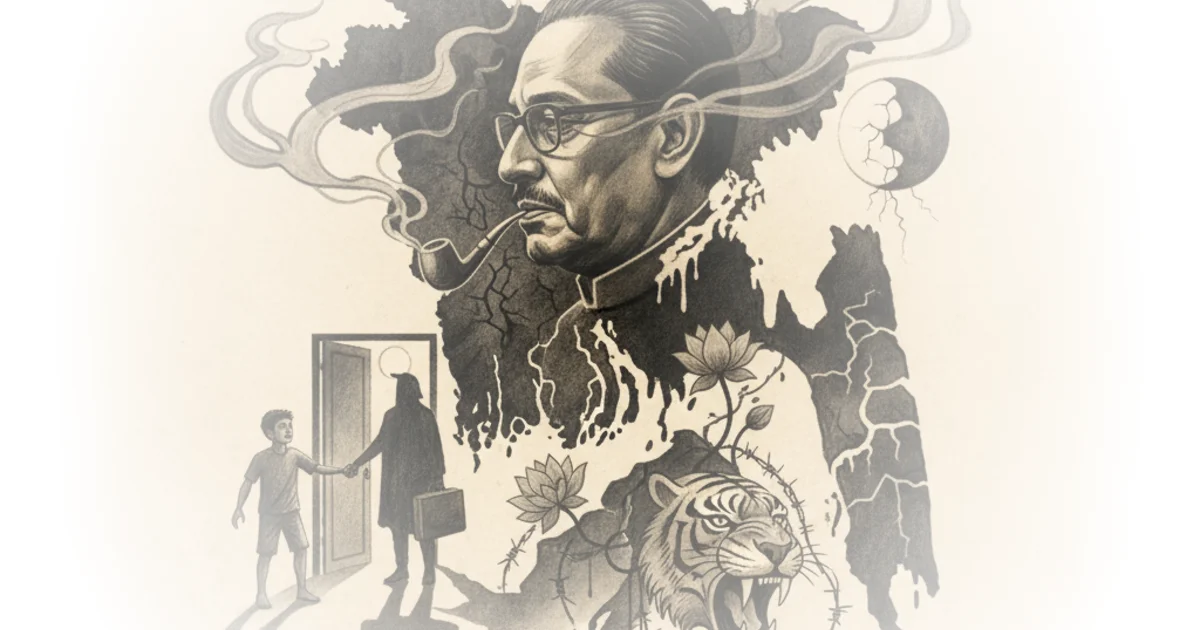
The narrative culminates in the dramatic, if partially unverified, account of the 1962 Christmas meeting. Dalrymple recounts how Indian diplomat S.S. Banerjee was summoned by a young boy to meet Mujib, who handed over a plan for a "sovereign independent homeland." The author notes the cinematic nature of the story, admitting it lacks documentary verification, but uses it to illustrate Mujib's radicalization. By this point, Mujib had moved from seeking autonomy to planning secession, even joking that he could end the "bondage between the two wings" with "a canful of kerosene and a matchbox."
"Pakistan was split in two, and South Asia underwent its fifth partition in five decades."
Dalrymple emphasizes the scale of the tragedy that followed. The 1971 conflict resulted in a disputed death toll ranging from 300,000 to three million, with ten million refugees flooding into India. The author points out that the vocabulary of the war remains contested: Bangladeshis call it a 'Liberation War,' Pakistanis a 'Civil War,' and India the 'Third Indo-Pakistan War.' This linguistic dispute reflects the ongoing trauma that the region has never fully processed. Critics might note that the article's reliance on Mujib's memoirs and the Banerjee anecdote risks romanticizing the leader's agency, potentially downplaying the broader grassroots mobilization that made independence possible. Yet, the focus on individual agency serves to humanize a conflict often reduced to geopolitical chess moves.
"The twenty-first of February would retrospectively be considered the foundational moment of Bangladeshi nationalism and is hailed as International Mother Language Day; proof that Pakistan was doomed from the start."
Bottom Line
Dalrymple's most powerful contribution is reframing the birth of Bangladesh not as a sudden geopolitical event, but as the inevitable result of decades of cultural erasure and state-sponsored neglect. The piece's greatest vulnerability lies in its heavy reliance on the perspective of the Awami League's founder, which, while compelling, occasionally glosses over the complex internal dynamics of the Bengali resistance. Ultimately, this is a necessary reminder that the maps we see today were drawn in blood, and the human cost of those lines is still being paid by the descendants of those who fled, fought, and died.
"The country had become independent: why wasn't anything being done to alleviate [our suffering]."