In a genre defined by gothic excess and impossible technology, Rohin Francis asks a question that cuts through the noise: if we stripped away the sorcery, would the planets of Warhammer 40k actually hold up to the laws of physics? This isn't just a fan's fantasy; it is a rigorous stress test of astrophysics and atmospheric science against one of fiction's most detailed settings, revealing where the lore accidentally mirrors reality and where it demands impossible miracles.
The Physics of a Dying World
Francis begins by dismantling the concept of Terra, the human homeworld, which the source material describes as a desiccated husk where all water has vanished. "If you were to remove all water from Earth's hydrosphere things would go very badly," Francis notes, explaining that water is not just a resource but a critical climate regulator. The author argues that without the oceans to store thermal energy and the atmosphere's water vapor to trap heat, the planet would swing between scorching days and freezing nights, eventually becoming a dust-choked desert. This is a crucial distinction: the article separates the narrative horror of a dead world from the physical impossibility of a planet simply "using up" its water without a catastrophic atmospheric collapse.
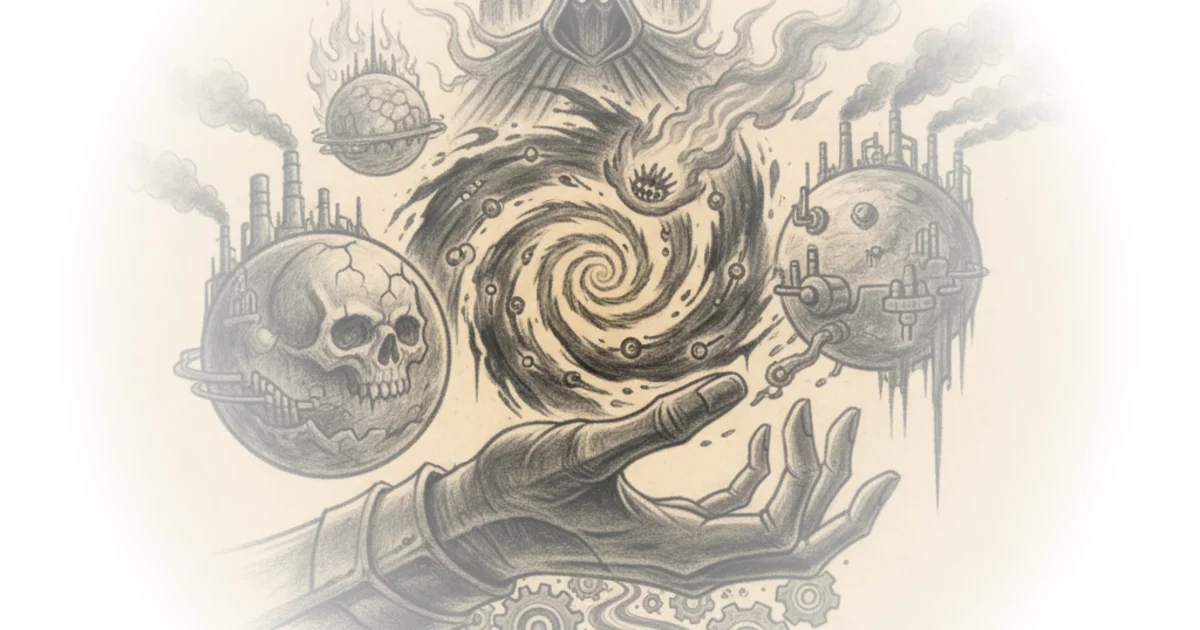
The commentary suggests that for Terra to exist as described, it would require "huge amounts of arcane technology reshaping the atmosphere," effectively admitting that the setting relies on magic disguised as engineering. Francis writes, "Terra is a nightmare world kept alive by huge amounts of arcane technology reshaping the atmosphere but it seemed as possible in this setting." This reframing is vital; it shifts the reader's focus from the grim narrative to the sheer scale of the geoengineering required to maintain a biosphere in such hostile conditions.
Terra is a nightmare world kept alive by huge amounts of arcane technology reshaping the atmosphere but it seemed as possible in this setting.
Darkness and Tidal Locking
Moving to the planet Nostramo, Francis tackles the physics of a world plunged into eternal darkness. The source text describes an atmosphere clogged with toxic smog that blocks all sunlight, orbiting a dying red giant. Francis breaks down the radiative transfer, noting that while water clouds trap heat, pollutants like sulfur dioxide can reflect sunlight without trapping long-wave radiation, leading to significant cooling. "If Nastramo had for example a low stratosphere and so could keep a large density of pollutants in the atmosphere at all times then it can definitely largely block out the Sun and cause very dark cold world," Francis concludes. This analysis validates the setting's gloominess with real-world volcanic analogs, proving that a planet can indeed freeze over due to atmospheric composition alone.
The piece then pivots to Moredaun, a tidally locked world where one side faces the sun and the other faces eternal night. Francis corrects a common misconception in the lore, pointing out that the source material incorrectly claims such a planet has no Coriolis force and therefore no wind. "That's just plain wrong for a planet to be tightly locked it needs to rotate and tidally locked planets have really interesting atmospheric dynamics," Francis asserts. The author explains that while the planet rotates once per orbit, the temperature differential would drive massive convection currents, creating a habitable band between the extremes. This is a rare moment where the commentary finds the fiction "spot-on" regarding cloud formation, even if the mechanics of wind were botched by the original writers.
The Impossibility of Orbital Shifts
Perhaps the most damning analysis comes when Francis examines Valhalla, a frozen world supposedly knocked out of its habitable zone by a comet impact. The lore claims a massive impact shifted the planet's orbit, freezing the oceans. Francis runs the numbers and finds the scenario physically impossible. "In order to knock earth specifically to that new orbit you would need to transfer some 1.3 million billion billion billion joules of energy," Francis calculates. The author points out that an object capable of delivering such momentum would need to be larger than Earth itself, making the event a collision of two planets rather than a comet strike.
Francis writes, "It would actually be about the same size as the earth but pure iron see yeah that's not gonna happen." This section highlights a fundamental flaw in the source material's approach to scale; the lore treats planetary orbits as fragile things easily tossed by a single rock, whereas the reality of orbital mechanics requires energies that dwarf human comprehension. Critics might note that in a universe with faster-than-light travel, the rules of classical mechanics might be suspended, but Francis's point stands: within the internal logic of "hard" physics, the backstory is a non-starter.
It would actually be about the same size as the earth but pure iron see yeah that's not gonna happen.
Geographic Nonsense
Finally, the commentary dissects the climate map of Armageddon, which features a jungle running north-south along the equator rather than east-west. Francis identifies this as a "baffling" error, noting that jungles require consistent solar heating found in latitudinal bands, not longitudinal ones. "If the jungle is anything like what we have on earth it should extend from west to east not north to south as we see on the map," Francis argues. The author suggests that while bizarre orographic factors could theoretically create such a climate, the map looks more like a tidally locked world with a hot hemisphere and a cold one, rather than a rotating planet with standard seasons. This critique underscores how easily visual storytelling can clash with physical reality when the creators prioritize aesthetic drama over scientific consistency.
Bottom Line
Francis's analysis succeeds because it treats the source material with respect while refusing to let it slide on the hard science, proving that even in a universe of gothic horror, the laws of physics are the ultimate gatekeepers. The strongest part of the argument is the detailed breakdown of tidal locking and atmospheric dynamics, which offers a genuine educational value beyond the fandom. However, the piece's biggest vulnerability is its reliance on the assumption that the setting's "arcane technology" operates within known physical limits, a premise the lore itself often explicitly rejects. For the busy reader, the takeaway is clear: the Warhammer 40k universe is a fascinating thought experiment, but it remains a work of fiction where the only thing more powerful than the Emperor is the writer's need for drama.