Then & Now delivers a startlingly simple yet scientifically robust argument: that the human brain is not designed for the sterile, linear confines of modern office life, but rather requires the chaotic, sensory richness of the natural world to function optimally. While the piece leans on familiar tropes like "touch grass," it distinguishes itself by grounding the metaphor in neurobiology and evolutionary history, arguing that our stress isn't just psychological—it's a physiological mismatch between our ancient bodies and our current environments.
The Architecture of Stress
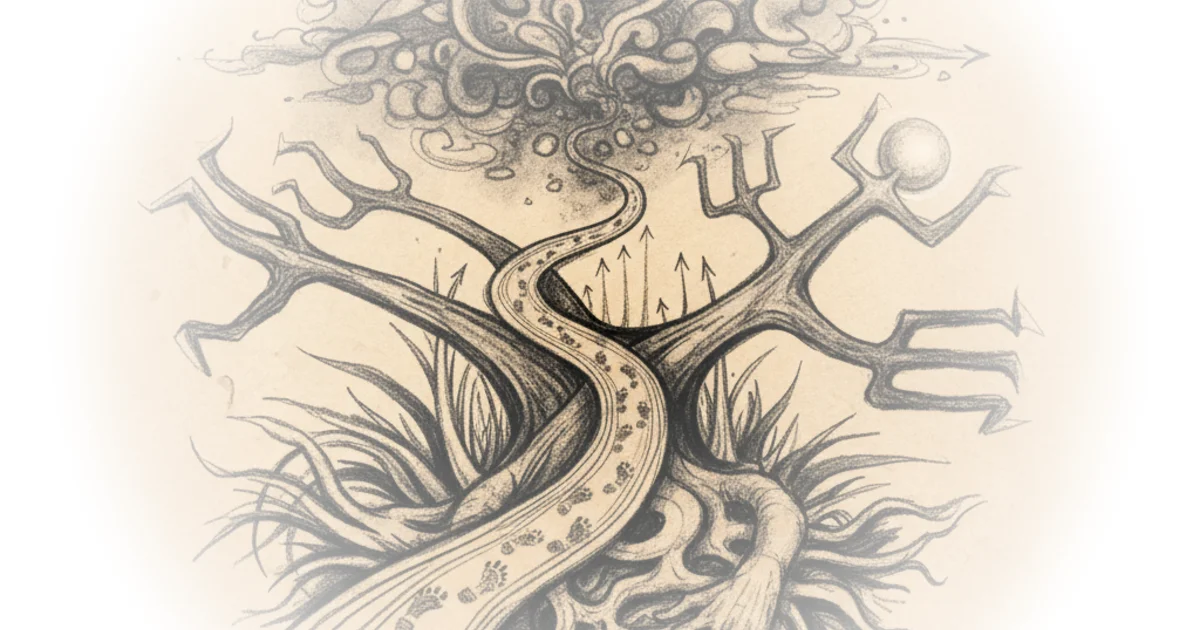
The commentary begins by dismantling the modern obsession with linear progress. Then & Now writes, "humans think in lines we are a line making species," noting how we use lines to navigate, weave, and plan. However, the author quickly pivots to the danger of this mindset when applied exclusively to life. "The singular mode of thought is totalitarian but paths are multiplicitous," they argue, suggesting that our rigid focus on a single destination blinds us to the complexity of reality. This framing is effective because it reframes "distraction" not as a failure of discipline, but as a necessary biological function.
The piece marshals a formidable array of data to prove that our indoor existence is actively toxic. Then & Now cites studies showing that "life satisfaction fell by 0.5 percent for every extra 10 milligrams of pollution" and that "environmental noises like traffic... led to a 20 increase in hypertension." The argument is compelling: sound triggers an autonomic fight-or-flight response, releasing cortisol and tensing muscles. As the author notes, "it's micro stressors that can build up over time into chronic stress." Critics might note that correlation does not always equal causation in these broad epidemiological studies, but the sheer volume of consistent data across different populations makes the case for environmental toxicity undeniable.
"Despite spending 99 of our evolutionary history Outdoors we now spend 93 percent of our time either indoors or in vehicles."
The Two Modes of the Brain
Moving beyond stress, Then & Now explores the cognitive mechanics of nature, introducing the distinction between the "executive mode" and the "default mode." The executive mode is described as "office mode," characterized by "intense concentration resisting compulsion reasoning logic." It is narrow, methodical, and exhausting. In contrast, the default mode is where "Meandering daydreaming sometimes random and chaotic takes us down surprising interesting and different and creative paths." The author quotes William James beautifully to describe this state: "the attention is dispersed so that the whole body is felt as it were at once."
This section is the intellectual core of the piece. Then & Now argues that nature facilitates a shift into this default mode through "soft Fascination," where gentle stimuli like "rolling clouds the sound of a stream the green of the hills" allow the brain to rest without shutting down. The evidence presented is striking: walking in nature was found to "decrease cortisol levels by 12 blood pressure by 1.3 percent and heart rate by six percent for days." Furthermore, a study of businessmen hiking showed that "immunity boosting white blood cells were 40 percent higher after the war can still 15 percent higher a month later." This suggests that the benefits of nature are not fleeting moods but sustained physiological changes.
The Philosophy of the Sublime
The commentary then elevates the discussion from health to philosophy, invoking the concept of the "sublime." Then & Now references Edmund Burke's observation that the sublime causes "astonishment and astonishment is the state of the soul in which all its motions are suspended with some degree of Horror." This feeling of insignificance in the face of vastness is not negative; it is liberating. As Ralph Waldo Emerson is quoted, "all mean egotism vanishes I become a transparent eyeball."
The author connects this ancient philosophical concept to modern psychology, noting that experiencing the sublime makes people "more likely to then help them pick up pens that they pretended to drop." In other words, awe breeds kindness. The piece concludes by tying this back to the body, citing neuroscientist Antonio Damasio: "we think with our bodies as much as with our minds." The argument posits that "feelings point us in the proper direction" and that "thought comes through feeling through the moving of legs and the beating of the heart." This is a powerful rebuttal to the Cartesian separation of mind and body, suggesting that to solve complex problems, we must physically move and engage our senses.
"If you have a block a frustration even if you don't switch up on as many Pathways as possible physically mentally neurally sensory feel touch smell move and then the corresponding neural Pathways will switch over."
Bottom Line
Then & Now successfully argues that "touching grass" is not a cliché but a biological imperative for cognitive restoration and creative breakthrough. The piece's greatest strength is its synthesis of hard neuroscience with high philosophy, proving that the "default mode" is not a bug in our system but a feature we have suppressed. The only vulnerability lies in the practicality of the solution for those trapped in high-stress, low-mobility urban environments, but the evidence presented makes the cost of inaction clear: a brain that is chronically stressed, creatively stunted, and physiologically degraded.