Most music histories treat rock and roll as a genre that simply emerged from the American South, but Kahlil Greene argues that what we call 'rock' is actually a Black invention that was systematically reclassified out of existence. This piece does not merely list forgotten pioneers; it dissects the bureaucratic machinery—radio formats, chart categories, and copyright laws—that erased Black ownership of the sound. In an era where algorithms dictate taste, understanding how human gatekeepers once engineered these same exclusions is essential for anyone trying to make sense of today's cultural landscape.
The Architecture of Erasure
Greene opens with a contemporary case study that feels like a bookend to a century of history: the Detroit-based sibling group Infinity Song. Despite being trained in classical, gospel, and jazz, and releasing a self-titled album in 2026 that reviewers describe as "soft rock built on close vocal harmony and guitar," the industry files them under "alternative." Greene writes, "The people who created rock and roll did not lose the genre because their music changed. They lost it because other people controlled the charts, the copyrights, and the formats, and those people decided which chart a Black musician belonged on." This framing is crucial because it shifts the blame from artistic evolution to institutional gatekeeping. It forces the reader to see that genre is not a natural category but a constructed one.
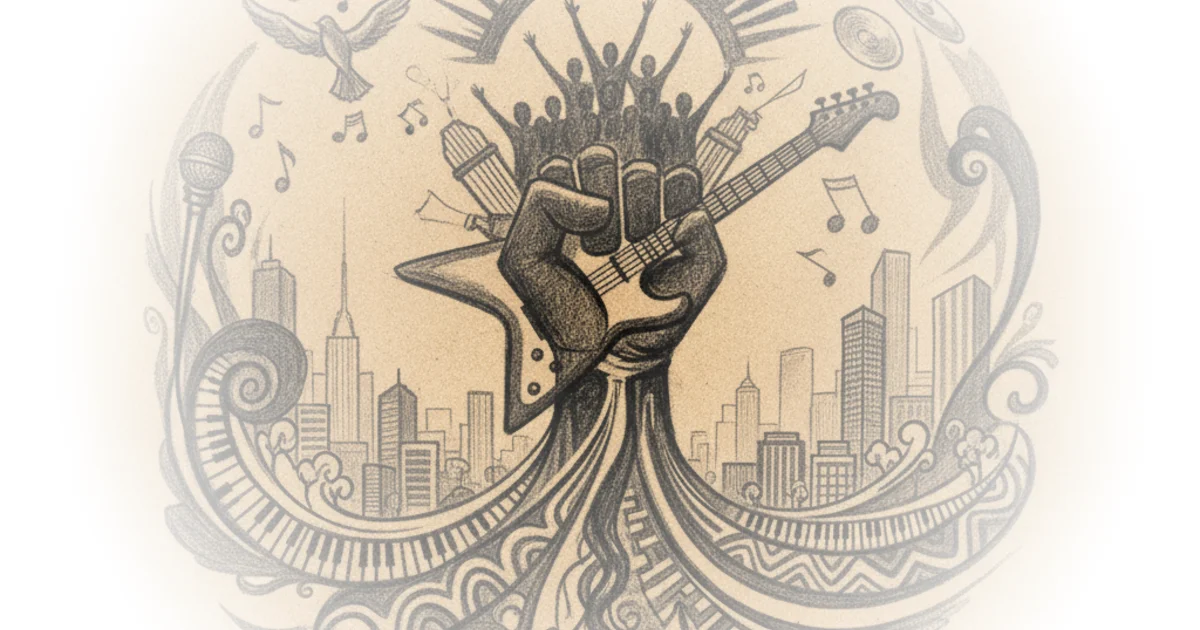
The argument gains historical weight when Greene traces the lineage back to Sister Rosetta Tharpe. He notes that in 1938, she recorded "Rock Me" and became a national star, playing an electric guitar loudly in front of gospel audiences. "Chuck Berry later said his career amounted to one long Sister Rosetta Tharpe impersonation," Greene observes, highlighting the direct lineage often omitted from standard rock histories. The inclusion of the Moog synthesizer's development context here is subtle but vital; just as Black innovators like Tharpe and Berry defined the electric sound, later Black engineers and musicians would drive the electronic revolution that underpins modern production, yet the narrative of "rock" remains stubbornly white-washed. Greene points out that the very term "rock and roll" was borrowed from Black vernacular, noting that Cleveland disc jockey Alan Freed adopted the phrase for his rhythm and blues program in 1951, a term already used by Trixie Smith in 1922.
"Industry gatekeepers worked with charts, formats, contracts, and marketing categories rather than with sound, and the sorting they set up still decides where a Black band with guitars gets filed."
The Economics of Appropriation
The piece moves beyond cultural credit to the hard economics of ownership, specifically examining the case of Willie Mae "Big Mama" Thornton and her song "Hound Dog." Greene details how Thornton's 1952 recording topped the rhythm and blues charts, only for Elvis Presley's version to dominate the pop charts years later. While Greene acknowledges that Presley took his arrangement from a Las Vegas lounge act rather than directly stealing Thornton's recording, the financial outcome remains stark. "Thornton lost ownership and the profits that were rightfully hers," Greene writes, explaining that her label retained the copyright for "Ball and Chain," meaning she collected nothing when Janis Joplin later turned it into a hit.
This section is particularly effective because it avoids the simplistic "theft" narrative that often plagues these discussions. Greene cites music expert Eric Alper, who noted that Thornton "had no lawyers and no distribution network she could use to pressure record stores." This lack of infrastructure, rather than a lack of talent, was the primary driver of her financial erasure. A counterargument worth considering is that the music industry in the 1950s was notoriously exploitative toward all artists, not just Black ones. However, Greene's focus on the racialized sorting of charts—where "race records" were segregated from the pop charts—demonstrates that Black artists faced a unique structural barrier that white artists did not.
The Modern Sorting Machine
Greene connects these historical patterns to the present day, arguing that the sorting mechanisms have evolved but not disappeared. He points to the 2019 controversy where country radio refused to play Lil Nas X's "Old Town Road," leading to its removal from the country charts. "Black artists still get moved when they cross a genre line," Greene asserts, citing how country singer Mickey Guyton is often told her songs are "too pop." The author also highlights the 2025 Grammy win for Beyoncé's Cowboy Carter, noting that despite the award, online backlash labeled her an "intruder."
The commentary here is sharp, suggesting that streaming has not democratized listening but rather narrowed it. Bill Stephney, the first president of Def Jam Recordings, is quoted worrying that "streaming has narrowed what young listeners hear rather than widening it." This challenges the optimistic narrative that the internet has dissolved genre boundaries. Instead, Greene suggests that algorithms reinforce the same racialized categories established by radio programmers in the 1970s. While some critics might argue that artists like Brittany Howard and Gary Clark Jr. are finding more success in blues-based rock, Greene maintains that the structural resistance remains for Black artists attempting to claim the rock mantle.
"The people who created rock and roll did not lose the genre because their music changed. They lost it because other people controlled the charts, the copyrights, and the formats, and those people decided which chart a Black musician belonged on."
Bottom Line
Kahlil Greene's most compelling contribution is the shift from asking "Who played it first?" to "Who decided what it was called?" The piece successfully demonstrates that the erasure of Black rock is not an accident of history but a result of deliberate industrial sorting. Its greatest vulnerability lies in its heavy reliance on historical precedent to explain modern algorithmic behavior, which operates on different, less transparent logic than 1950s radio programmers. However, the core thesis remains unassailable: until the industry stops sorting Black musicians out of the genres they invented, the history of rock will remain incomplete.