In an era obsessed with supply chain fragility, Asianometry uncovers a forgotten industrial catastrophe where a missing chemical additive caused billions of computer components to literally explode. This piece distinguishes itself by refusing to accept the convenient narrative of a single industrial spy, instead dissecting the messy, overlapping timeline of failures that plagued everything from motherboards to game consoles. For the busy professional, the lesson is stark: even the smallest, cheapest component can bring down a global technology ecosystem when quality control is compromised by espionage or corner-cutting.
The Anatomy of a Plague
Asianometry begins by grounding the reader in the physics of the failure, explaining that electrolytic capacitors are essentially rolled-up sandwiches of aluminum foil and liquid electrolyte designed to smooth out power surges. The author notes that while these components are cheap, they are critical: "a PC motherboard might have about 60 ecaps on it," serving as the "drainage ponds" for electrical floods. When these fail, the result is catastrophic; as Asianometry describes, a bulging capacitor can cause a short circuit, while an exploded one might even "cause the thing to catch on fire."
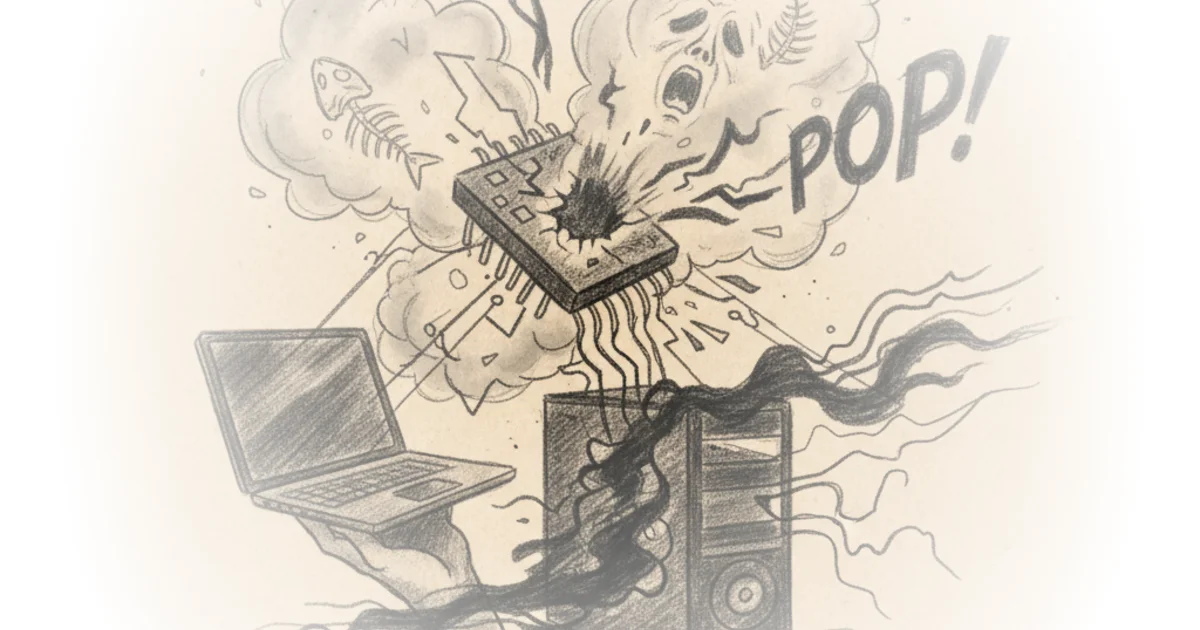
The piece effectively frames the scale of the disaster by citing a Utah repairman who, starting in the summer of 2002, was replacing "over 10 a day" of these faulty units, totaling 40,000 in a single year. This anecdotal evidence anchors the technical explanation in human reality, showing that the problem wasn't theoretical but a daily nightmare for technicians. The author argues that the industry's reliance on specific chemical formulations makes it uniquely vulnerable, noting that the electrolyte is not a simple mix but a "critical trade secret that sits at the core of the whole product."
The electrolyte is not just a simple mix that you pump into the capacitor at the last second rather the electrolyte is a critical trade secret that sits at the core of the whole product.
The Spy Story and Its Flaws
The core of the coverage revolves around a compelling industrial espionage narrative involving a Japanese firm, Rubicon, and a Taiwanese competitor. Asianometry details how a scientist allegedly defected, replicating a water-based electrolyte formula but failing to include a crucial additive called a "depolarizer." Without this chemical, the electrolyte becomes too alkaline, dissolving the internal layers and generating hydrogen gas until the capacitor bursts. The author cites industry reports suggesting that "missing additives caused the ecaps to suffer hydrogen gas buildup until they rupture or break."
However, Asianometry immediately pivots to skepticism, questioning whether a single defector could explain a plague that lasted for years and affected diverse manufacturers. The author points out that the timeline doesn't quite add up; if the bad capacitors were produced in mid-2002, they should have failed within a year, yet reports of failures continued well into 2007. Asianometry writes, "how can such sleeper ecaps keep blowing up into 2007?" This observation is the piece's most valuable contribution, challenging the popular myth that a single act of theft caused a decade-long crisis.
Critics might note that the author's skepticism relies heavily on the assumption that all failures were identical, whereas in reality, different manufacturers likely had different quality control issues. Yet, the author's insistence on separating the Rubicon story from the broader phenomenon is a necessary correction to the historical record. The piece highlights that while industrial espionage is real, "we will never really know the truth" if we accept a single story as the sole explanation for a complex systemic failure.
We will never really know the truth of course there's nothing about it that makes me think it can't be true in fact I'm pretty sure something like it actually happened industrial Espionage is a real thing however I am skeptical that the whole plague can be blamed on a single Defector from Rubicon.
The Real Culprits: Timing and Corporate Negligence
The commentary shifts to the broader implications of the timeline, noting that failures were reported as early as 1999 and as late as 2005, affecting major players like Dell and Apple. Asianometry uses the case of the original Xbox to illustrate how unrelated failures get lumped into the "plague" narrative simply because of timing. The author clarifies that the Xbox capacitor was an American-made super-capacitor, not an aluminum electrolytic, proving that "people are apt to blame this bad capacitor used for a clock on the plague" despite it being a completely different technology.
The piece delivers a stinging critique of corporate accountability, revealing that Dell knew about the faulty capacitors in their Optiplex PCs from 2003 to 2005 and shipped 11.8 million units with parts that were "10 times more likely to bulge." Asianometry notes that Dell "apparently knew of this and tried to hide the issue from customers," leading to lawsuits. This section moves the story from a technical curiosity to a lesson in corporate governance, showing how the drive to cut costs on tiny components can lead to massive reputational and financial damage.
Bottom Line
Asianometry's most significant achievement is dismantling the romanticized "one bad apple" theory of the capacitor plague, replacing it with a more nuanced view of systemic industry-wide vulnerabilities and corporate negligence. While the industrial espionage story is a gripping hook, the author correctly identifies that the real story lies in the failure of quality assurance across a global supply chain. The reader is left with a clear warning: in complex manufacturing, the cheapest component often carries the highest risk, and hiding defects is a strategy that inevitably leads to disaster.