Most automotive analysis fixates on who sells the most cars today, but this piece from Chipstrat makes a far more provocative claim: the real battle for the future of transportation isn't about battery chemistry or factory output, but about who owns the silicon and the code beneath the hood. It argues that Rivian has quietly built the only American platform capable of scaling true autonomy without the crushing legacy baggage that paralyzes its competitors, turning a $23 billion cash burn into a strategic asset rather than a liability.
The Silicon Strategy
The article's most distinctive insight reframes Rivian not as a car company, but as a hardware-agnostic technology firm that happens to build vehicles. Chipstrat draws a sharp parallel to the tech giant that redefined consumer electronics, noting that "Rivian is analogous: a consumer product company that realized it could only deliver its world-class transportation experience by owning the entire hardware and software stack." This vertical integration is presented not as a vanity project, but as a technical necessity for the era of physical AI.
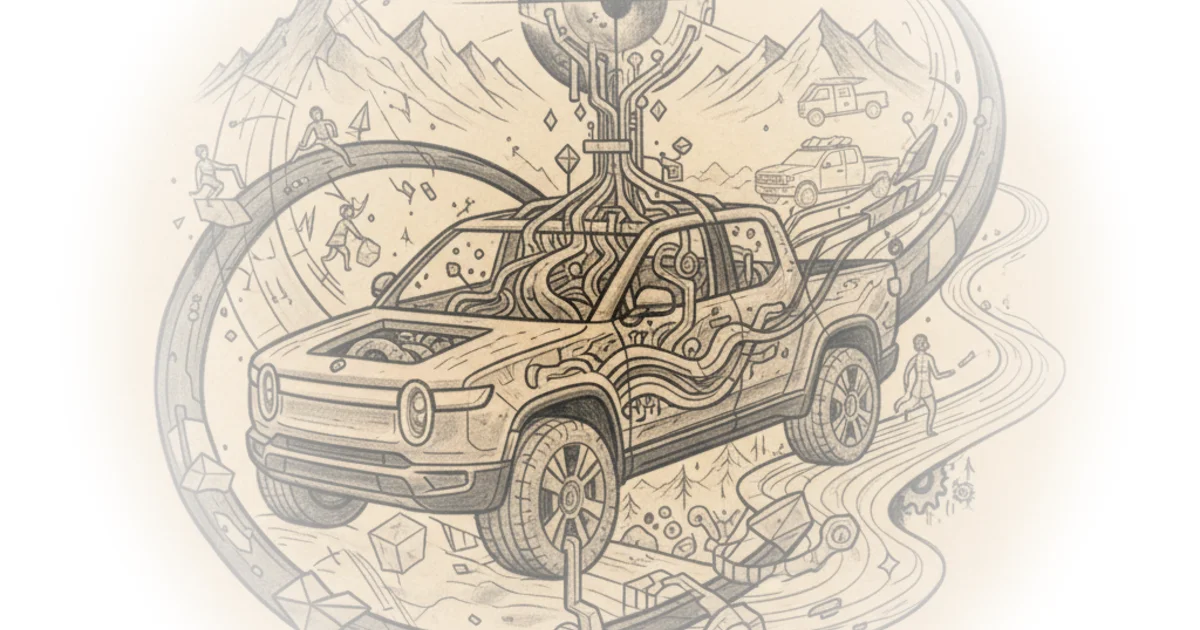
The piece contrasts this clean-sheet approach with the fragmented reality of legacy automakers. It cites the company's CEO, RJ Scaringe, who explains the inefficiency of the old model: "If you put twenty great computer scientists and electronics engineers together, you wouldn't say, 'Let's build a system of 120 islands of software... that communicate through a CAN network, but it's very hard to make updates to.'" The reference to the Controller Area Network (CAN) is crucial here; it recalls the decades-old bus architecture that has long limited how quickly vehicles can receive software updates, a bottleneck that doomed early autonomous projects like GM's Cruise when they tried to retrofit these archaic systems with modern AI.
Instead of patching old systems, Rivian is betting on a zonal architecture where "the smallest number of computers in the car... do all the decisioning." This shift from distributed microcontrollers to centralized high-performance compute is the bedrock of the company's autonomy ambitions. The argument lands because it identifies a structural flaw in the entire industry: you cannot simply bolt artificial intelligence onto a vehicle designed for a human driver. The legacy of mechanical engineering and outsourced electronics creates a "twofold, often three or four layers" of abstraction that slows down innovation.
"Autonomy demands vertical integration. Rivian made the right early vertical integration EV choices to set it up for an autonomous future."
Critics might note that owning the stack is incredibly capital intensive, a risk that has already bankrupted other startups who tried to do too much too soon. However, the piece suggests that for the specific goal of scaling autonomy, there is no middle ground.
The Culture of Uncertainty
Moving beyond hardware, the article tackles the profound cultural shift required to build driverless vehicles. It argues that traditional automotive safety models, which assume deterministic systems operated by unpredictable humans, are fundamentally broken for the age of neural networks. The piece highlights that "Neural networks make the decisions, and their behavior is probabilistic," a reality that "Engineers who spent their careers validating deterministic logic often struggle with that shift."
This cultural friction explains why the industry's acquisition strategy has largely failed. The editors point to the struggles of GM/Cruise and Ford/Argo as evidence that "The OEMs can't just acquire their way out of it either." A century of institutional muscle memory simply cannot be bought; it must be built from the ground up. The article suggests that "culture will be the strongest predictor of future AV winners," a bold claim that places Rivian's young, unencumbered workforce ahead of established giants.
The piece also touches on the unique challenges of safety in dynamic environments, drawing a parallel to the author's experience with autonomous tractors at John Deere. Just as a tractor must navigate dust clouds that blind human drivers, autonomous cars must handle the chaos of construction zones and unpredictable human motion. The argument is that only a system designed with sensors like radar, which can penetrate visual obstructions, and a software stack built for uncertainty, can solve this problem.
The Economics of Scale
Perhaps the most compelling section addresses the elephant in the room: the staggering $23 billion in cumulative cash burn. While bears see a broken business model, Chipstrat argues this capital funded a "first-principles EV and autonomy platform and a complete US manufacturing footprint." The piece contrasts Rivian with firms like Fisker or Canoo, which rely on Tier-1 electronics suppliers and cannot consolidate their computing power, leaving them with high costs even as they scale.
The article details how Rivian is now leveraging its scale to fix its cost structure. CEO RJ Scaringe is quoted explaining the shift in supplier dynamics: "Those same suppliers are highly engaged... they now see us as a large customer... and that gives us a really meaningful negotiating leverage." This is a critical turning point. The "new entrant tax" that inflated the Bill of Materials (BOM) for the initial R1 and R1T models is being stripped away through renegotiated contracts and the introduction of the Gen2 platform.
The strategy hinges on the upcoming R2 vehicle, which promises a BOM "roughly half that of R1." This is not just about lowering prices; it's about unlocking a multi-million-unit market that the premium R1 could never reach. The piece notes that while the R1 was a "handshake with the world," the R2 is designed to "land in the center of the US market where the average new vehicle now sits."
"The $23B funded a completed factory, a cost-optimized platform, and an autonomy-ready compute and electronics stack. R2 and R3 unlock mass-market volume on top of that foundation."
A counterargument worth considering is that the timeline for achieving profitability in the mass market is incredibly tight, and the competitive pressure from Chinese EV makers and Tesla's price cuts is intensifying. Yet, the piece maintains that Rivian's clean architecture gives it a cost-reduction runway that legacy players simply do not have.
Bottom Line
The strongest part of this argument is its rejection of the "cash burn equals failure" narrative, reframing Rivian's spending as the necessary cost of building a vertically integrated autonomy stack that legacy competitors cannot replicate. Its biggest vulnerability lies in the execution risk of the R2 launch and the sheer difficulty of achieving mass-market scale in a hyper-competitive environment. Readers should watch closely for the R2's pricing and production ramp, as these will be the first real tests of whether the Gen2 platform can truly deliver the promised cost efficiencies.