Brian Beutler's Vanity Fair deep dive on Chief of Staff Susie Wiles does something rare in political journalism: it treats the inner workings of the White House not as a theater of personality, but as a case study in institutional collapse. By dissecting Wiles's own admissions, Beutler constructs a narrative where the administration's most powerful operator effectively confesses to enabling a presidency that operates on falsehoods, ignores legal boundaries, and treats national security as a personal playground. This is not just gossip; it is a forensic audit of how the executive branch is being hollowed out from the inside.
The Architecture of the Pardon
Beutler begins by dismantling the defense surrounding the mass pardons of January 6 insurrectionists. The sheer scale of the clemency—releasing nearly 1,500 individuals convicted of attacking the Capitol—is framed not as a policy choice, but as a factual impossibility defended by Wiles. Beutler writes, "Basically nobody who tried to overthrow the government was sentenced to serve more time than the guidelines recommended. Her claim is thus factually impossible, and inconsistent with Trump's decision to pardon all of the rioters." The author's point is sharp: Wiles's justification relies on a lie that even a cursory check of court records would expose. This suggests either a profound incompetence or a deliberate effort to sanitize a historic jailbreak for the benefit of history.
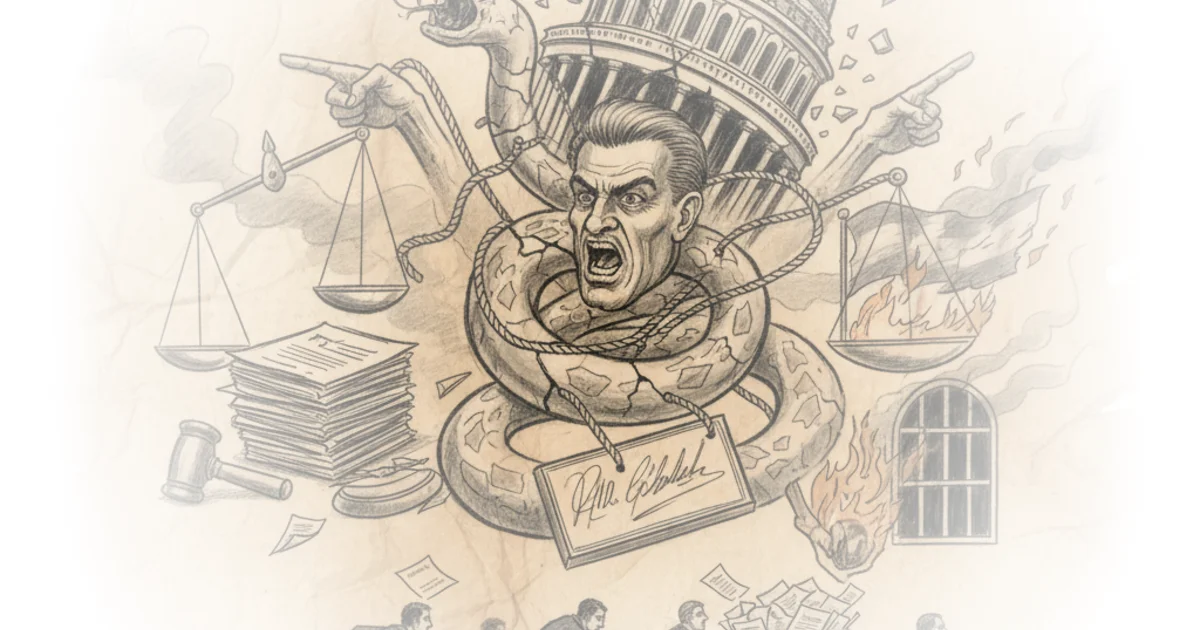
Critics might argue that the President has broad constitutional discretion over pardons, regardless of the sentencing guidelines. However, Beutler's focus is not on the legality of the pardon itself, but on the integrity of the advisor who claims to have vetted it. If the Chief of Staff cannot or will not verify the basic facts of a decision that frees violent rioters, the mechanism of accountability within the White House has already failed.
"The president doesn't know and never will. He doesn't know the details of these smallish agencies."
The Vacuum of Authority
The commentary shifts to the administration's handling of USAID, where the author highlights a terrifying dynamic: the President's disinterest in governance has created a power vacuum filled by self-interested courtiers. Beutler notes that when Elon Musk moved to dismantle the agency, Wiles admitted the President was unaware of the specifics. The author argues, "A literal interpretation here places us more squarely in 25th amendment territory. What does it say if the president is simply incapable of understanding how the agencies he oversees function?" This is a crucial distinction. The Twenty-fifth Amendment, ratified in 1967 after the assassination of John F. Kennedy, was designed to address presidential incapacity. Beutler suggests that while the President's stubbornness isn't a medical ailment, the result is the same: a leader who cannot govern, leaving the machinery of state to be hijacked by those with their own agendas.
The risk here is that the Chief of Staff becomes a "failsafe" for a leader who is effectively absent. Beutler warns that in a "Weekend At Bernie's situation," where the inner circle props up a mummified president, you would ideally want an ethical Chief of Staff. Instead, the author observes, "You definitely would not want an industrialist (who happened to be the president's top donor) to slide into that role." The admission that the President is unaware of his own government's actions transforms the crisis from a policy dispute into a constitutional emergency.
The Economics of Chaos
On the issue of tariffs, Beutler exposes the administration's strategy of governing through manufactured panic. Wiles admits that the President was treated like a "toddler shrieking in the aisles of a grocery store," with aides trying to delay his decisions until they could manage the fallout. The result was a market sell-off and a 90-day pause that the author calls "inconsistent with the concept of a national emergency." Beutler writes, "Making bad faith arguments in court in order to justify an abuse of power is certainly frowned upon, though arguably not impeachable." Yet, the broader implication is that the administration is willing to destabilize the global economy to satisfy a personal impulse, knowing full well the policy lacks a legitimate emergency basis.
The Epstein Shadow and the Culture of Denial
Perhaps the most damning section of Beutler's analysis concerns the administration's relationship with the Jeffrey Epstein files. Wiles admits Trump is in the files but claims he was "not doing anything awful," a statement Beutler dismantles by pointing out the factual errors in her timeline and the casual nature of her dismissal. The author notes, "A president who engages in casual slander should probably be impeached and removed... A president who hallucinates uncontrollably should be deposed by his vice president and cabinet." The admission that the President is spreading defamatory lies about political rivals, while simultaneously being unable to recall his own association with a convicted sex offender, paints a picture of a leader detached from reality.
Furthermore, Beutler scrutinizes Wiles's denial of knowledge regarding the transfer of Ghislaine Maxwell to a less restrictive facility. "There's no sense in playing dumb," Beutler asserts, arguing that Wiles is either lying or exposing the administration's use of frivolous lawsuits to intimidate the press. This pattern of behavior—denying knowledge of scandals while simultaneously launching legal attacks on those who reveal them—suggests a systemic commitment to obfuscation.
The Pretext of War
The piece concludes with a chilling revelation regarding the administration's military actions in the Caribbean. Wiles admits that the campaign of blowing up boats is not about drug interdiction, as officially stated, but is a pretext for regime change against Venezuela. Beutler writes, "Wiles here confesses that Trump's campaign of bombing fisher boats in the Caribbean is purely pretextual, and the real goal is regime change in Venezuela." This is a profound admission. It suggests that the executive branch is willing to engage in unauthorized acts of war, risking civilian lives and international stability, to achieve a political objective that has not been debated or authorized by Congress. The human cost of these "pretextual" strikes is not mentioned in the administration's rhetoric, but the reality of blowing up fishing boats in the Caribbean cannot be ignored.
"The burden's on us to make sure that [national security] conversations are preserved. In this case, Jeff Goldberg did it for us."
Bottom Line
Brian Beutler's analysis is a masterclass in reading between the lines of a political interview to reveal a system in freefall. The strongest part of the argument is the cumulative weight of Wiles's admissions: they collectively paint a picture of a Chief of Staff who is either complicit in or powerless against a presidency that operates on lies, ignores the law, and treats national security as a personal vendetta. The biggest vulnerability in the piece is its reliance on the assumption that the administration's internal logic is coherent enough to be analyzed as a unified strategy; in reality, it may simply be a chaotic drift. The reader should watch for whether the institutional checks Beutler describes—Congress, the courts, the public—will act before the administration's internal contradictions cause a total collapse.