Then & Now delivers a striking correction to the modern Stoic revival, arguing that the philosophy's most popular interpretation strips away the very worldview that made it coherent. While self-help gurus sell a sanitized version of emotional detachment, the author contends that ancient Stoicism was a complete system of logic, physics, and ethics that has become dangerously incoherent when severed from its historical context. This is not just a history lesson; it is a challenge to the very foundation of how millions of people today navigate uncertainty and control.
The Illusion of Control
The piece begins by dismantling the central tenet of modern Stoicism: the "dichotomy of control." Then & Now writes, "The problem with this neat line between what we can and can't control is that on closer inspection it becomes a little hazy." The author effectively demonstrates that the binary separation of "internals" (our judgments) and "externals" (our bodies, reputation, and outcomes) is a false dichotomy in the modern world. By paraphrasing the author's critique, we see that human agency is rarely so absolute; we often influence external outcomes through sustained effort, learning, and engagement, blurring the line the ancients tried to draw.
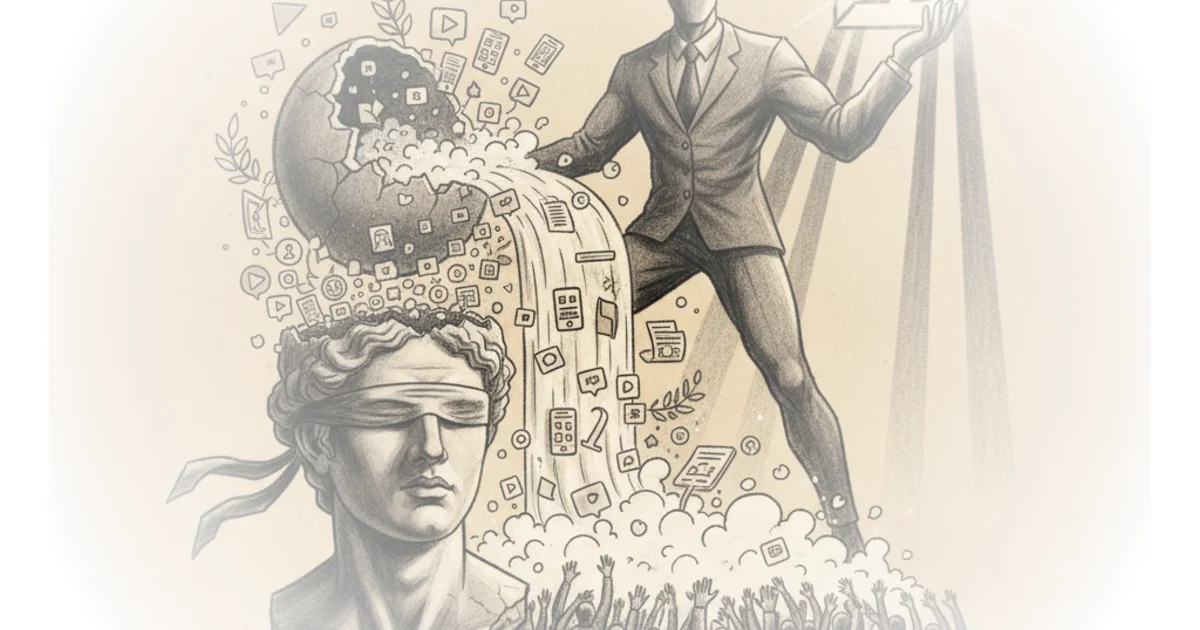
This analysis holds up well against the reality of complex systems. The author notes that Epictetus might claim we have no control over how many people like a video, only our effort. Then & Now counters, "Actually that means I do have some control over how many people like it if I put more effort into it... if I learn in the right ways." The commentary rightly points out that treating external factors as entirely out of reach can lead to passivity rather than resilience. Critics might argue that the dichotomy is a useful psychological heuristic rather than a literal truth, but the author's insistence on the interconnectedness of action and outcome feels more aligned with contemporary understandings of agency.
The Cost of Indifference
Moving deeper into the ethical framework, the text exposes the tension in Zeno's concept of "preferred indifferents." Then & Now observes, "The philosophy has no way of truly valuing some things rather than others; it cuts the world off with a stoic guillotine." The author argues that by categorizing essential needs like food, shelter, and relationships as "externals" to be met with indifference, Stoicism risks alienating the individual from the very world they inhabit. The text suggests that "without a value system we have no basis for acting, for choosing, for thinking," and that true philosophy requires attachment, not detachment.
This is a powerful reframing of the Stoic goal of tranquility. The author writes, "Hope, need, want, desire, movement, life — all of these are the result of value systems of connecting us to the world around us." By highlighting this, Then & Now challenges the notion that emotional numbness is the pinnacle of wisdom. The argument is compelling because it identifies a fundamental flaw in applying ancient logic to modern life: we cannot be indifferent to the things that sustain us without ceasing to be fully human.
Stoicism is not a philosophy of life; it's a philosophy of despair.
A Philosophy Born of Despair
The commentary then pivots to the historical context, asking why the ancients felt the need to divide themselves from the world. Then & Now provides a visceral tour of Roman brutality, noting that "life was capricious, dangerous, and short; hunger, pestilence, warfare and tragedy were commonplace." The author details the gruesome fates of figures like Seneca, who was forced to commit suicide by Nero, and the general atmosphere of terror where "wives, bodyguards, friends, colleagues, slaves — all at different times — murdered their Emperors."
This historical grounding is the piece's strongest asset. It reframes Stoic detachment not as a universal truth, but as a survival mechanism for a specific, violent era. As Then & Now puts it, "Focusing on what was in his control might have been a good way to put the hazards of elite Roman life out of his mind." The author suggests that the philosophy was a reaction to a world where no one could be trusted and where the state could destroy you at a whim. In this light, the modern application of Stoicism to minor inconveniences like traffic or social media likes seems trivial, even absurd.
The Missing Physics
Finally, the text addresses the structural incompleteness of the modern interpretation. Then & Now writes, "Cicero for example wrote that the stoic system is so well constructed... that if you alter a single letter you shake the whole structure." The author emphasizes that ancient Stoicism was not just about ethics; it was inextricably linked to their physics and theology—the belief that the universe was ordered by a divine reason. "To live a good virtuous life we should act in accordance with nature," the author notes, quoting Marcus Aurelius. Without this belief in a rational, ordered cosmos, the ethical imperative to accept one's fate loses its logical foundation.
The commentary effectively argues that removing the "physics" leaves only the "ethics," which then becomes a hollow shell. Then & Now concludes that the modern version is an "emptied out interpretation" that reduces a complex worldview to "therapeutic self-help cliches." This is a crucial distinction for busy readers who want a robust framework for living, not just a quick fix for anxiety. A counterargument worth considering is that the core ethical insights can stand on their own, but the author's insistence on the systemic nature of the philosophy makes a strong case that the modern adaptation is fundamentally broken.
Bottom Line
Then & Now's critique is a necessary corrective to the commercialization of ancient wisdom, successfully arguing that Stoicism's modern popularity rests on a selective and historically inaccurate reading of the text. The strongest part of the argument is the historical contextualization, which reveals the philosophy as a desperate response to tyranny rather than a universal guide for emotional regulation. The biggest vulnerability, however, is the potential dismissal of the psychological utility of the dichotomy of control, even if it is philosophically imperfect. Readers should watch for how this critique reshapes the conversation around resilience, moving away from individual detachment toward a more engaged, value-driven approach to the world.