Dave Amos doesn't just recount the history of Rome; he decodes its physical DNA, arguing that the city's geography is not merely a backdrop but the primary architect of its political and social evolution. While most narratives focus on emperors and battles, Amos posits that the Tyber Island's role as a natural crossing point and the strategic placement of the Seven Hills were the true catalysts for Rome's rise from a settlement to an empire. This approach transforms a standard history lesson into a masterclass in urban planning, revealing how the landscape dictated the flow of power for three millennia.
The Geography of Power
Amos begins by dismantling the myth of a singular founding moment, grounding the city's origins in hard geography rather than legend. "The reality is that humans occupied the place where Rome now exists far before its official founding date of 753 BCE," he writes, immediately pivoting to the Tyber Island as the critical junction that made trade and expansion possible. This reframing is crucial; it suggests that Rome's dominance was inevitable not because of superior character, but because of superior location. The author effectively uses the comparison to Paris to make this abstract concept concrete for a modern audience, yet he quickly returns to the unique Roman context.
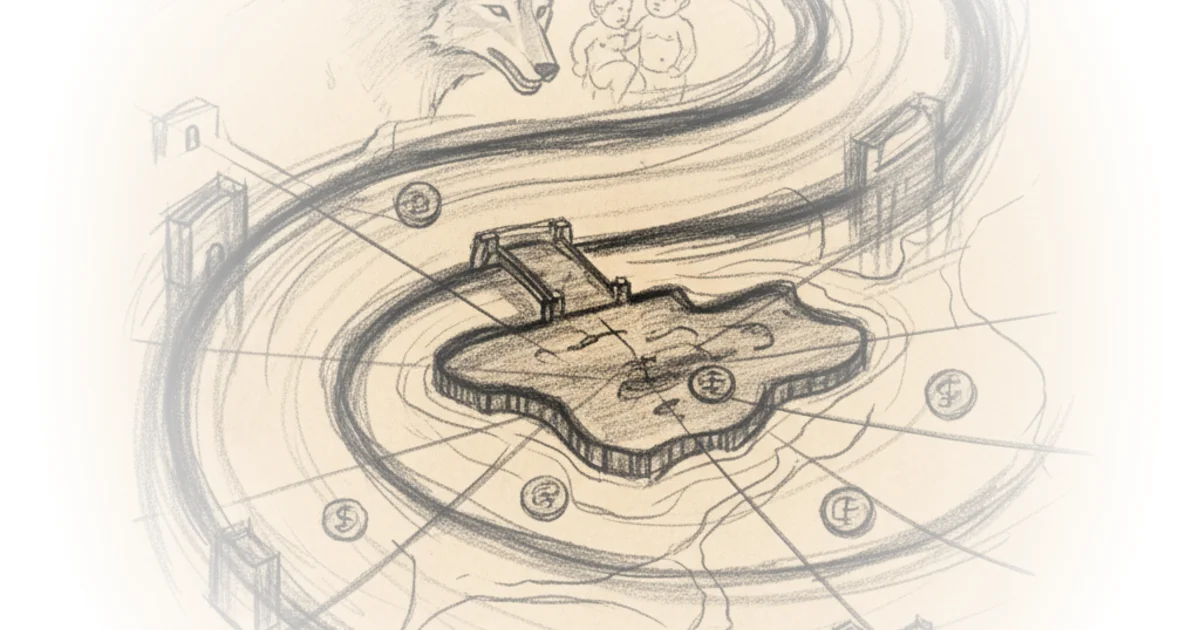
The commentary then moves to the Servian Wall, a structure so ancient it predates the Republic itself. Amos notes that this wall "protected the Seven Hills of Rome," specifically highlighting the Palatine and Capitoline as the engines of political and religious life. He points out that the Palatine was "packed with houses for the rich until Augustus built his Palace on the hill," illustrating how geography was quickly co-opted by the elite to signal status. This observation lands powerfully because it connects the physical elevation of the hills to the social hierarchy of the era. Critics might argue that focusing on the hills overlooks the importance of the valleys and the river, but Amos counters this by dedicating significant space to the spaces between the hills.
The Palatine Hill was packed with houses for the rich until Augustus built his Palace on the hill and the Emperors tiberias and demisha did the same thing.
From Republic to Monumental Empire
As the narrative shifts from the Republic to the Empire, Amos offers a sharp, if brief, political critique embedded in the architectural history. "Emperors are really bad for democracy but really good if you want a Monumental City," he writes, a line that perfectly encapsulates the trade-off between liberty and grandeur. He traces how the Coliseum was built on land previously occupied by Nero's private lake, a detail that underscores the sheer scale of imperial ambition and the willingness to erase private spaces for public spectacle. The author's ability to condense centuries of construction into a coherent spatial narrative is impressive, turning a list of ruins into a story of urban transformation.
The discussion of the Aurelian Walls marks a turning point in the city's defensive posture. Amos explains that while the earlier walls were built against immediate neighbors, the Aurelian Walls were a reaction to a crumbling sense of invincibility. "By the late 200s ad Rome wasn't looking so Invincible anymore," he observes, noting that the wall was completed in just five years. This rapid mobilization highlights the urgency of the threat, yet Amos also notes that the wall didn't contain the entire city, leaving the Campus Martius outside. This exclusion is significant, as it forced the development of new urban centers outside the traditional defensive perimeter, a pattern that would repeat throughout history.
The Layers of Faith and State
Amos then navigates the complex religious landscape, distinguishing between the four major papal basilicas with a clarity that often eludes tourists. He clarifies a common misconception: "St John in Lateran is technically the Pope's home church not St Peter's," explaining that the latter is a cathedral while the former is the Pope's actual seat as Bishop of Rome. This distinction is not merely semantic; it reflects the dual nature of papal authority—spiritual and temporal. The author's explanation of the Vatican's status as a sovereign nation is particularly compelling. He details how the "uneasy peace" following the capture of Rome in 1870 was only resolved with the Lateran Treaty in 1929, which formally established the Vatican's boundaries.
The physical connection between the Vatican and the Castel Sant'Angelo serves as a potent metaphor for the fragility of this power. Amos describes the passageway as a route that "carries scared popes," allowing them to flee to safety. This vivid imagery humanizes the abstract concept of sovereignty, reminding the reader that even the head of the Catholic Church was once a refugee within his own city. The inclusion of the Piazza del Popolo and the Via del Corso further illustrates how the city's layout was designed to funnel visitors and power toward specific centers of authority.
The Vatican is the smallest country in the world by both land area and population.
Beyond the Walls: Modern Expansion
The piece concludes by looking outward, beyond the ancient walls to the modern metropolitan area. Amos highlights the EUR district, built in the 1930s for a World's Fair that never happened, as a precursor to modern business districts like La Défense in Paris. He also notes Cinecittà, the massive film studio complex, as a testament to Italy's cultural export power. These examples serve to bridge the gap between the ancient city and the modern metropolis, showing how the same forces of politics, economy, and culture continue to shape the urban landscape. The author's admission that he doesn't know everything about current events adds a layer of humility, grounding his historical expertise in a recognition of the present's complexity.
Bottom Line
Dave Amos's commentary succeeds by treating Rome not as a static museum but as a living, breathing organism shaped by its geography. The strongest part of the argument is the seamless integration of physical space with political history, demonstrating how the landscape dictated the flow of power. However, the piece's greatest vulnerability lies in its necessary simplification of complex historical transitions, particularly the shift from Republic to Empire, which risks glossing over the violent realities of that transformation. Readers should watch for how these ancient patterns of urban development continue to influence modern Italian politics and urban planning.