Cory Doctorow does something rare in political commentary: he refuses to treat the rise of authoritarianism as a personality cult or a temporary glitch, instead framing it as a fundamental shift in the operating system of society. By applying Donella Meadows' systems theory to modern fascism, Doctorow argues that the real battle isn't over tax rates or specific regulations, but over the deep-seated belief that the average citizen is too foolish to govern themselves. This is a vital distinction for anyone trying to understand why standard political pushback often fails against movements that seem to grow stronger with every crisis.
The Leverage Point of Belief
Doctorow anchors his analysis in the work of Donella Meadows, specifically her hierarchy of leverage points for changing complex systems. He notes that while most political fights focus on "constants, numbers, parameters," these are merely the fine-tuning knobs of a system. When a system is fundamentally broken, tweaking the knobs won't fix it. Doctorow writes, "But when you're confronted with a system that is significantly, persistently dysfunctional, you will likely have to work at sites that are further up the hierarchy, such as 'the distribution of power over the rules of the system' or 'the goals of the system'; or the most profound of all, 'the paradigm out of which the system — its goals, power structure, rules, its culture — arises.'" This reframing is powerful because it explains why policy debates often feel futile; the opposition isn't arguing about the policy, they are arguing about the paradigm that makes the policy possible.
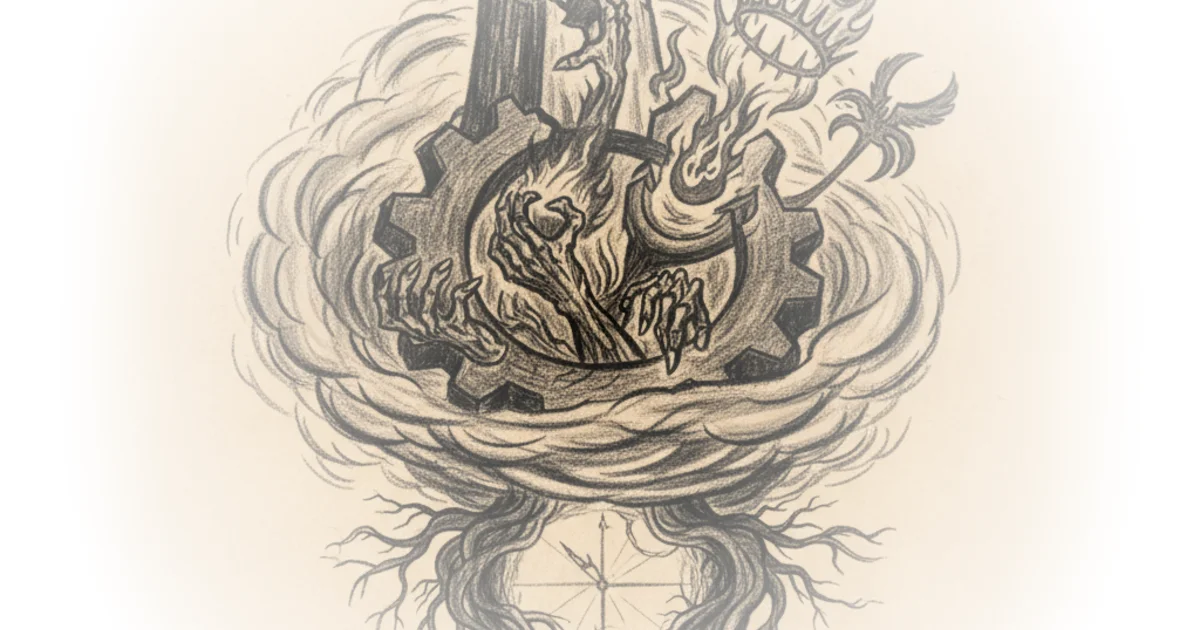
The author suggests that the current surge of anti-democratic movements is effective precisely because they have successfully shifted the paradigm. As Doctorow puts it, "Fascists like Farage and Trump are, at their root, anti-democratic. Their pitch is that the people are incapable of self-determination." He connects this to the work of Peter Thiel, noting the belief that "democracy is incompatible with freedom." This is not just rhetoric; it is a systemic intervention. By convincing the public that they are irrational and that only a select few are born to rule, the movement bypasses the need to win arguments on specific issues. They win by changing the rules of engagement entirely.
The paradigm of democracy is that all of us are capable of both wise self-governance and self-rationalized misgovernance, and each of us has a useful perspective to contribute.
Doctorow illustrates this paradigm shift by examining how modern fascists interpret disaster. He argues that whenever a crisis occurs, the movement immediately demands to know the identity of the person in charge, looking for evidence that a "lesser" person has been elevated to power. "If the person who crashed the cargo ship into the bridge has brown skin, we can add another line to the ledger of costs associated with the doomed project to put people who were born to be bossed around in the boss's seat," Doctorow writes. This logic, which he links to the revival of eugenics under the guise of "race realism," serves to reinforce the idea that competence is hereditary and exclusive. Critics might argue that focusing on the ideological roots of fascism distracts from the immediate, tangible policy harms, but Doctorow's point is that without addressing the root paradigm, policy fixes will always be temporary.
The Fight for Self-Rule
If the problem is a paradigm shift, the solution must be a counter-shift. Doctorow argues that the only way to dismantle this authoritarian framework is to relentlessly affirm the capacity of ordinary people to govern themselves. He writes, "We have to convince our neighbors that they are smart enough to rule themselves, and so are we, and so is everyone else." This is a call for a new form of meta-cognition, a collective realization that checks and balances are not obstacles to efficiency but necessary safeguards against human folly.
The author targets the concept of the "unitary executive" as a primary battleground, describing it as an ideology that is not just unconstitutional but "ideologically catastrophic." He insists that the fight must be framed around the idea that "No kings," because even a benevolent leader cannot be omniscient. "No kings, because even an omnibenevolent king isn't omniscient, and that means that omnipotence is always omnidestructive in the long run," Doctorow states. This echoes the systems thinking principle that complex systems require distributed intelligence to remain stable; concentrating power in a single node creates a single point of failure that can collapse the entire system.
This approach moves beyond the usual debates about specific laws or appointments. It demands a cultural reset where the assumption of human fallibility is embraced rather than feared. Doctorow suggests that the resilience of the fascist movement comes from its ability to exploit the fear of chaos, offering a strongman as the only solution. The counter-strategy, therefore, is to demonstrate that chaos is the natural result of unchecked power, while order is the result of shared responsibility.
We need to attack the theory of the "unitary executive" and every other autocratic ideology head on. We have to insist that these aren't just unconstitutional, but that they are ideologically catastrophic.
Bottom Line
Doctorow's strongest contribution is identifying the "fascist paradigm" not as a political party platform, but as a systemic intervention at the deepest level of societal belief. His argument holds up because it explains the resilience of authoritarian movements that survive policy defeats. The biggest vulnerability in this approach is the sheer difficulty of shifting a paradigm; it requires a level of sustained cultural engagement that is far more demanding than passing legislation. Readers should watch for how this theoretical framework translates into concrete organizing strategies that can actually reach the "leverage point" of the public mindset.