Two Churches, One Country, and the Kremlin's Playbook
Of Moldova's 2.41 million people counted in the 2024 census, 94.3 percent self-identify as Orthodox Christian. Yet that near-unanimous faith is split between two rival church structures whose jurisdictional quarrel now doubles as a frontline in Russia's information war against European integration. David Smith, writing for Moldova Matters in collaboration with the Moldovan investigative outlet WatchDog, sets out to explain how this ecclesiastical fracture became a vehicle for foreign influence operations during the 2024-2025 election cycle.
Smith frames the article as the first installment in a four-part series, and his ambition is clear from the outset:
Kremlin-aligned actors leveraged religious narratives, church structures, and faith-based media ecosystems to shape political messaging both inside Moldova and abroad.
That is a big claim, and Smith wisely spends most of this opening piece building the historical scaffolding needed to evaluate it. The payoff, he promises, will come in subsequent parts. Whether the scaffolding can bear the weight of the argument remains to be seen.
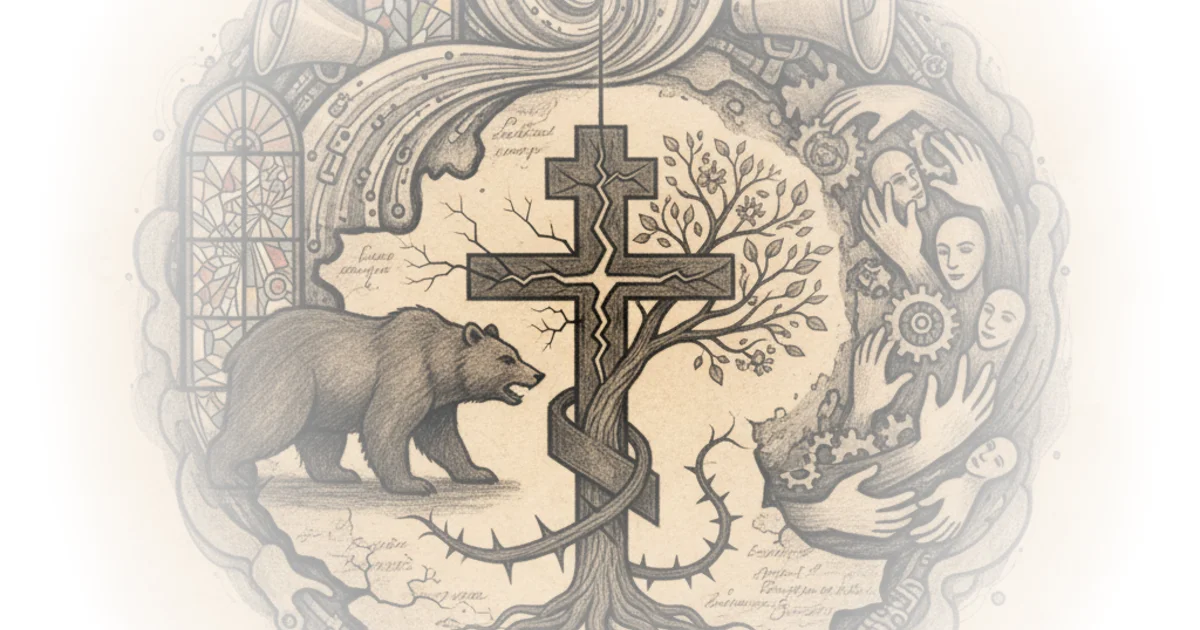
The Historical Roots of the Split
The two competing bodies are the Metropolis of Chișinău and All Moldova, commonly called the Moldovan Orthodox Church, which is canonically subordinate to the Moscow Patriarchate, and the Metropolis of Bessarabia, which falls directly under the Romanian Patriarchate. Smith estimates roughly 80 percent of believers belong to the Moscow-linked church, though he acknowledges these numbers predate the accelerating parish transfers of recent years.
Smith traces the fault line back to the Russian Empire's annexation of Bessarabia in 1812, when the Diocese of Chișinău was created under Russian Orthodox authority and a sustained program of Russification began. The Romanian-language church was restored between 1918 and 1940, only to be swallowed again by Soviet annexation. He captures the Soviet era in a single, evocative detail:
After initial waves of suppression, Stalin introduced limited toleration during the Second World War and following the war the church was allowed to function within strict state control, including KGB infiltration of the clergy.
The modern schism dates from Moldovan independence in 1991. Smith notes that the Moldovan Orthodox Church tried to suppress its Romanian rival with government backing in the 1990s but lost decisively in the European Court of Human Rights in the case Metropolitan Church of Bessarabia v. Moldova, which forced legal recognition in 2001. Both churches have operated on the same territory since.
What Russia's War Changed
The article's most compelling section details how Russia's full-scale invasion of Ukraine in February 2022 detonated the fragile coexistence. With Patriarch Kirill in Moscow publicly blessing the war as a civilizational struggle, the Moldovan Orthodox Church found itself institutionally chained to a campaign of aggression that many of its own parishioners abhor.
Smith's most striking piece of evidence is a leaked letter from Metropolitan Vladimir, head of the Moldovan Orthodox Church, to Patriarch Kirill himself:
Metropolitan Vladimir noted an increasing exodus towards the Metropolis of Bessarabia and how the actions of the church in Moscow are forcing people to decide between their "Latin roots" and the clear ambitions to reincorporate the country into the "Russian World."
The letter reportedly pleads for additional funding and resources, citing competition from the Romanian-backed church. Smith relays a claim that the Metropolis of Bessarabia pays priests 800 to 900 euros per month plus healthcare and a pension, though he later qualifies this through expert Andrei Curararu, who puts the figure closer to 300 euros and argues the real financial advantage lies in the direction money flows:
In the Metropolis of Bessarabia resources flow downward from the center through the bishoprics and to the parishes. In the Moldovan Orthodox Church funds flow upward with a portion of the "fees" gathered for church services being directed towards the upper echelons.
This is one of the most useful observations in the piece. It reframes the competition not as a simple salary comparison but as a structural question about which institution lets parish priests keep more of their earnings.
Factions Within the Moscow-Linked Church
Smith identifies two publicly visible factions within the Moldovan Orthodox Church. Metropolitan Vladimir is presented as a pragmatist trying to navigate between Moscow's demands and local political realities. More aggressive is Bishop Markell of Bălți and Fălești, whom Smith describes as someone who:
pushes aggressive Russian talking points and appears frequently in Kremlin organized Foreign Information Manipulation and Interference (FIMI) campaigns.
FIMI, or Foreign Information Manipulation and Interference, is the European Union's term for coordinated state-backed disinformation operations. Smith uses the acronym throughout, signaling that he views the church schism through the lens of information warfare rather than purely theological or cultural terms.
Critics might note that the article takes the existence of organized FIMI campaigns largely for granted in this first installment, promising evidence in later parts. Readers are asked to accept the framing before seeing the receipts.
What the Two Churches Share
One of Smith's most important interventions is his insistence that the schism is not about theology or social values. Both churches oppose LGBTQ+ rights, champion "traditional values," and share the same seminaries and elite networks. The difference is that the Romanian Patriarchate has lived through EU accession firsthand and knows it does not threaten church prerogatives:
The Romanian Orthodox Church has many of the same anxieties but has seen the process of EU integration firsthand and knows that it is not directly threatening to their church. They may pursue many of the same culture wars but they do so within the EU's infrastructure.
Smith also delivers a pointed observation about the churches' absence during Moldova's recent crises:
During the great crises of these past years - COVID lockdowns and the 2022 Ukraine Refugee Crisis - neither church played an organized role in providing supplies, donations or aid to those in need.
This is a quietly devastating line. It undermines any narrative that either church acts primarily as a community institution. Both are, in Smith's telling, primarily concerned with hierarchy, language, and geopolitical allegiance.
A counterargument is that the absence of organized, institutional relief does not preclude parish-level aid that went unrecorded by national media. Smith's sweeping claim here would benefit from more granular evidence or at least a qualifier acknowledging what he could not verify.
The Calendar as Cultural Barrier
A small but telling detail: the Moldovan Orthodox Church uses the Julian calendar while the Metropolis of Bessarabia uses the Gregorian calendar. Switching churches means moving Christmas, Easter, and the rhythms of family life. For a population Smith describes as largely "culturally orthodox," people who interact with the church mainly through baptisms, weddings, funerals, and holidays, this is not a trivial barrier. It helps explain why defections, while accelerating, have not become a flood.
Bottom Line
Smith's opening installment is strongest as a concise historical primer. He covers two centuries of ecclesiastical politics in accessible prose, and his sourcing, which draws on census data, the European Court of Human Rights, leaked correspondence, and expert interviews, is solid for a Substack piece. The structural comparison of how money flows in each church is genuinely illuminating.
The article is weakest where it previews conclusions it has not yet earned. The FIMI framing is asserted early and often, but the evidence for organized Kremlin manipulation through church networks is deferred entirely to Parts 2 through 4. The discussion of internal factions within the Moldovan Orthodox Church is thin, limited to two named figures with little on how the broader clergy or laity navigate the pressures. And the claim that neither church provided organized crisis relief deserves more support than a single sentence. Still, as the foundation for a four-part investigation, it sets out the stakes clearly and gives readers the historical literacy they will need to evaluate what comes next.