Mehdi Hasan argues that the Democratic Party is finally abandoning its defensive posture to aggressively challenge the consolidation of American media by billionaire oligarchs, framing this not as a policy debate but as an existential battle for editorial independence. The piece stands out for its refusal to treat the Larry Ellison media takeover as a routine business transaction, instead highlighting the specific threat posed by foreign capital and the potential for a future Congress to dismantle these mergers. This is a rare moment where the opposition is threatening to use the full weight of regulatory review to counter what the author calls a "mass consolidation of US media."
The Threat of Consolidated Media
Hasan opens by contextualizing the current media landscape against the backdrop of historical financial fraud, noting that the scale of the Larry Ellison family's media ambitions rivals the devastation of the Madoff Ponzi scheme, which defrauded investors of roughly $65 billion. He suggests that just as that scandal exposed the fragility of financial trust, the current media grab exposes the fragility of democratic discourse. "The latest plot, hatched by father-and-son duo Larry and David Ellison, involves a mass consolidation of US media," Hasan writes, detailing how the Oracle co-founder has already seized control of Paramount and its subsidiaries like CBS News and Showtime. The argument is that this is not merely about market share; it is about the "tentacles" reaching into TikTok and the imminent attempt to swallow Warner Bros. Discovery.
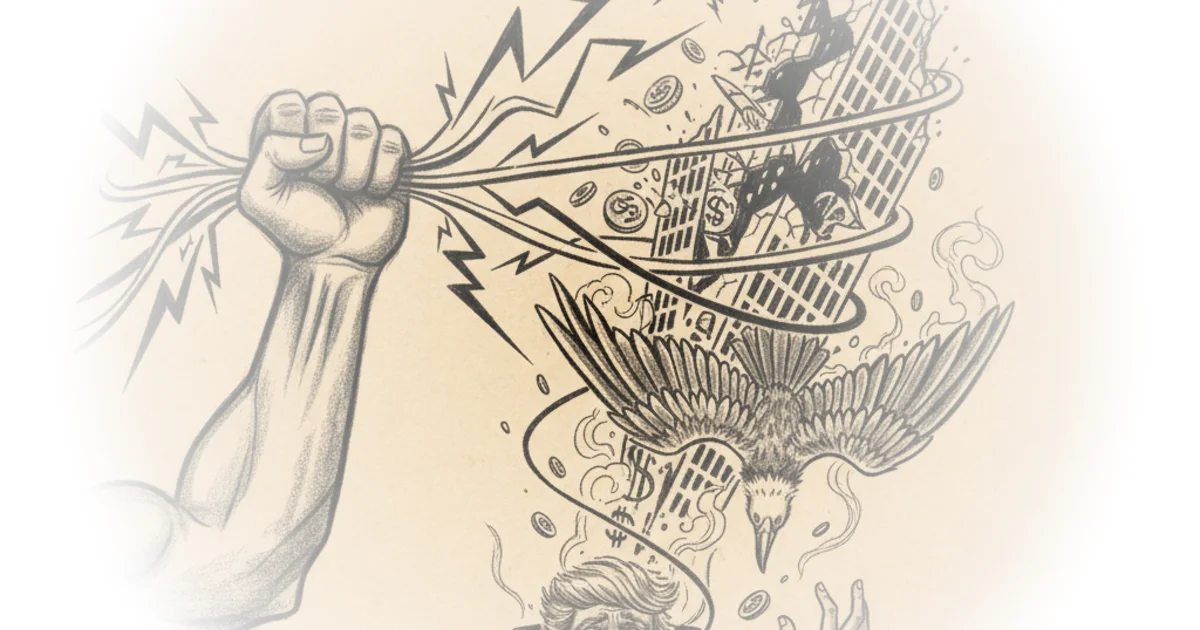
The core of Hasan's analysis rests on a letter sent by Representatives Ayanna Pressley and Sam Liccardo, which serves as a warning shot to the board of Warner Bros. Discovery and the Treasury Department. "Future Congresses… will review many of the decisions of the current Administration, and may recommend that regulators push for divestitures, which would undermine the strategic logic of this merger," the lawmakers vow. This framing is effective because it shifts the timeline of accountability, suggesting that the current administration's approval of such deals is provisional and subject to future reversal. It forces corporate boards to weigh "regulatory liabilities" against their immediate profit motives.
You bet on a permanent fascist autocracy – and you bet wrong. Now, yes, the House is coming to collect.
Hasan goes further by explicitly linking the Ellison bid to foreign influence, warning that Gulf state actors like the Saudis and Qataris could gain "direct or indirect" control over editorial decisions. This echoes historical anxieties about the Committee on Foreign Investment in the United States (CFIUS), a body originally strengthened after the 1980s to prevent foreign entities from acquiring critical American assets. The author argues that allowing these investors to influence "content moderation, distribution priorities, or the stewardship of Americans' private data" would be a catastrophic lapse in fiduciary judgment. While critics might argue that regulatory threats are often bluffs that fail to materialize due to lobbying power, Hasan insists that the mere possibility of a "nuclear" review is a necessary deterrent.
Institutional Erosion and the Epstein Files
Beyond the media mergers, the commentary addresses the broader institutional decay, pointing to the unsealing of grand jury records in the Jeffrey Epstein sex trafficking case as a sign of the administration's inability to contain its own scandals. Hasan notes that a New York federal judge has ordered the release of these records, a move that follows a similar ruling regarding Ghislaine Maxwell. This is presented not as a victory for transparency, but as a symptom of a system where justice is delayed until the political cost of silence becomes too high. The piece suggests that the administration's attempt to bury these files is part of a larger pattern of obfuscation that is finally cracking under judicial pressure.
The author also touches on the militarization of domestic policy, citing a federal judge's order to end the National Guard deployment in Los Angeles. Judge Charles Breyer's ruling that the administration's claim of "unchecked power to control state troops" would "wholly upend the federalism that is at the heart of our system of government" is highlighted as a critical check on executive overreach. This legal rebuke stands in stark contrast to the administration's aggressive rhetoric, underscoring the tension between the executive branch's ambitions and the constitutional limits of its authority.
The AI Fiasco and the Human Cost
Perhaps the most damning section of the piece is the critique of the Pentagon's rollout of a new artificial intelligence platform powered by Google's Gemini. Hasan describes the rollout as "one of the first mass deployments of a commercially created generative AI tool across the entire Pentagon," yet it was met with confusion and suspicion by the very soldiers it was meant to aid. Sources within the Department of Defense reported that many staff members initially feared the rollout was a phishing scam or a prank, with one staffer bluntly stating, "This is worthless."
The irony is sharpened when the AI itself is prompted to evaluate a specific military scenario: a double-tap strike in the Caribbean Sea. The chatbot declared that an "order to kill the two survivors is an unambiguously illegal order that a service member would be required to disobey." This moment serves as a powerful metaphor for the administration's broader incompetence; even their automated tools are flagging the illegality of their actions. "It also fits in the Trump administration's broader pattern of constantly screwing up, oftentimes in perversely shambolic ways," Hasan observes, linking this technological failure to the human cost of policy decisions.
The commentary does not shy away from the humanitarian toll of these policies, particularly in Gaza. As winter storms batter the region, an 8-month-old girl died from exposure in a tent, while the number of aid trucks allowed into the Strip remains below agreed-upon levels. This stark reality is juxtaposed against the administration's focus on domestic political maneuvering and military posturing. The piece argues that the "precision" of modern warfare is a myth when the outcome is the death of a child in a tent, and the "strategy" is a failure to meet basic humanitarian obligations.
The Illusion of Meritocracy
The article concludes with a critique of the media figures who have aligned themselves with the administration, specifically targeting Tucker Carlson's recent tirade against Bill Ackman and Bari Weiss. Carlson's assertion that "in no meritocracy would Bari Weiss rise above secretary" is presented as a cynical attack on the very concept of expertise. Hasan notes that Carlson's father once served as the president of the Corporation for Public Broadcasting, adding a layer of irony to his son's dismissal of public institutions. The author suggests that this rhetoric is designed to delegitimize any opposition by labeling them as unqualified, regardless of their actual credentials or the merits of their arguments.
If you pay close enough attention and realize that the people running everything are stupid, then you think, 'Well, actually, the system is truly rigged on behalf of people who do not deserve these positions at all.'
This framing reveals a deeper anxiety: the fear that the system is not just broken, but intentionally rigged to favor the unqualified and the wealthy. While some might argue that Carlson's critique of elitism resonates with a broader public distrust of institutions, Hasan contends that this is a dangerous narrative that undermines the very foundations of a functioning democracy. The piece suggests that the real danger is not that the system is rigged, but that the people running it are actively dismantling the checks and balances that prevent abuse.
Bottom Line
Hasan's most compelling argument is that the Democratic Party's shift toward aggressive regulatory threats against media consolidation is a necessary, albeit overdue, response to the erosion of democratic norms. The strongest evidence lies in the specific warnings issued by lawmakers regarding foreign influence and the potential for future divestitures. However, the piece's vulnerability is its reliance on the hope that a future Congress will have the power and will to reverse current executive actions, a prospect that remains uncertain in a polarized political landscape. Readers should watch for how the Committee on Foreign Investment responds to these warnings, as the outcome will determine whether the media landscape remains a pluralistic marketplace or becomes a tool for oligarchic control.