Brian Merchant doesn't just report on a hearing; he exposes the raw nerve of a cultural industry being hollowed out by its own tools. While the coverage focuses on a California bill, the real story is the audacious claim that the very companies building the future are actively dismantling the legal and economic foundations of the present. This isn't about technology moving too fast for the law; it's about a deliberate strategy of opacity and exploitation that Merchant documents with surgical precision.
The Heart of the Valley
Merchant sets the scene at Stanford's Paul Brest Hall, a space usually reserved for academic discourse, now packed with artists who feel their livelihoods are under existential threat. He writes, "The restless majority were artists, writers, and actors; they had come to this special hearing to offer public comment in favor of a proposed California law that promised a sliver of leverage against the AI companies headquartered mere miles away." This framing is crucial: it positions the legislation not as a bureaucratic hurdle, but as a desperate defense mechanism for human creativity.
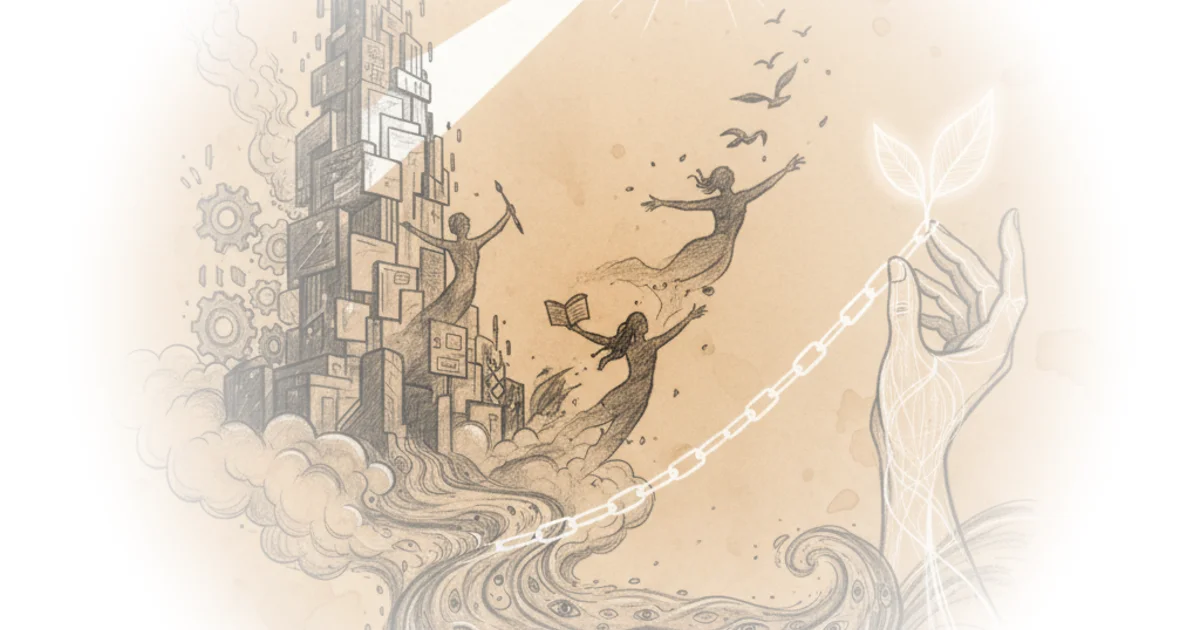
The author highlights the stark contrast between the artists' desperation and the corporate indifference. Danny Lin, president of the Animation Guild, delivers a devastating assessment of the industry's trajectory. "I don't know how many of you have come to LA recently," Lin says, "but it is bleeding out in front of my very eyes." Merchant uses this testimony to underscore that the issue isn't theoretical; it is a current, active hemorrhage of jobs and income. The author notes that while other sectors are stalled by the unreliability of large language models, creative fields are uniquely vulnerable because clients often accept "good enough" AI output over human work.
"AI has the potential to devastate not only California's creative workforce and our employment prospects but curtail intellectual property rights and the profits of related businesses."
This quote from actor Jason George, captured by Merchant, crystallizes the stakes. The argument here is that the threat extends beyond individual artists to the entire ecosystem of cultural production. Merchant's choice to focus on the "sea of jazz hands" that erupted in applause when artists spoke reveals the deep emotional resonance of the room, contrasting sharply with the cold, calculated responses from the tech sector.
The Corporate Playbook
The piece shifts to a critical analysis of the corporate response, specifically the testimony of Mark Gray from OpenAI. Merchant observes that Gray's arguments were less about the merits of the technology and more about political maneuvering. When Gray suggested that copyright wasn't the right tool and that industrial policy or labor law should be used instead, Merchant identifies this as a classic lobbying tactic. "This, it might be noted, is corporate lobbying 101; say this policy option isn't right but another one, maybe even a stronger but less politically feasible one, is."
The author draws a sharp parallel to historical environmental debates, noting how this mirrors the strategy used by oil giants years ago. "It reminded me of years ago when Exxon said it was against a cap and trade climate policy that would limit pollution, but was in favor of a more punitive carbon tax, knowing such a policy was politically impossible." This historical context, reminiscent of the complexities found in discussions about carbon emission trading, adds significant weight to the argument that the opposition to transparency is a calculated delay tactic, not a genuine policy preference.
Merchant also exposes the revolving door between regulators and the industry, pointing out that Gray previously worked for the US Copyright Office before joining OpenAI. The artist Karla Ortiz's reaction to this is telling: "I want to tell him to his face how much he broke my heart." This personalizes the institutional betrayal, showing how the very people tasked with protecting creators are now employed by the entities exploiting them. Critics might argue that industry experts are necessary to understand the technology, but Merchant effectively counters this by showing how that expertise is being weaponized to block accountability.
The Feasibility of Transparency
A significant portion of the commentary is dedicated to dismantling the myth that transparency is technically impossible. Merchant cites experts like Ben Zhao and the EU's Gerard de Graaf to prove that systems for tracking and compensating creators already exist. "Gerard de Graaf... detailed how the European Union had begun to instate one such system, showing it was possible both technically and politically."
The author expresses frustration with the tech industry's selective outrage regarding complexity. "I get very frustrated whenever I hear companies and tech advocates who love to celebrate innovation when it promises profits label an undertaking too complex or onerous the minute a technology threatens to be put in service of working class interests." This is a powerful reframing: the barrier isn't engineering; it's will. The argument is bolstered by the testimony of smaller AI company founders who agree that a database is feasible, suggesting that the opposition comes primarily from the giants who benefit most from opacity.
However, Merchant acknowledges the limitations of the proposed bill, AB 412. He questions whether a transparency law is enough to stop the "mass automation of the median of art." He writes, "AB 412 may push AI companies to be more intentional about what they include in their datasets... but what next?" This nuance prevents the piece from becoming a simple cheerleading exercise for a single bill. It recognizes that while transparency is a necessary step, it may not be a sufficient cure for the systemic shift toward automated content generation.
The Bottom Line
The piece concludes with a chilling update: Disney's $1 billion investment in OpenAI, effectively partnering to use its own protected intellectual property to train the very models that threaten its creators. Merchant stares at the notification, noting, "Not in disbelief, because we expect nothing less from an executive class that exults AI even when doing so appears to be against its own direct material interests." This final image drives home the central thesis: the drive for automation is so entrenched that it overrides even the most basic self-interest of the world's largest media conglomerates.
"There has to be a way."
The strongest part of Merchant's argument is his ability to connect the specific mechanics of a California bill to the broader, existential threat of devaluing human labor. His biggest vulnerability is the sheer scale of the capital flowing into AI, which makes the legislative victories of a single state feel like a drop in the ocean. Readers should watch for how the industry's narrative shifts from "fair use" to "partnership" as the legal battles intensify, a tactic already visible in the Disney deal. The question remains whether transparency can ever be enough to restore the balance of power between the creators and the algorithms consuming their work.