This piece makes an intriguing case: structure isn't just decoration — it's an experience. The lecturer argues that when we encounter a poem, "our first encounter with a poem before we even read it is the way it greets us on the page," positioning visual form as something that shapes how meaning lands before we even process the words. That's a bold claim, and the lecture backs it up by walking through three concrete examples: Herbert's shape poem, Spenser's narrative stanza, and Mary Sidney's Psalm translation.
The strongest moment comes with George Herbert's "Easter Wings." The lecturer shows how the meter itself enacts decay — lines descending from pentameter to trimeter as the subject becomes "most poor." This isn't just wordplay; it's structural meaning. When the lecturer notes that "the lines themselves are enacting that decay becoming poor," we're seeing something most commentary misses: form as narrative action, not just ornament.
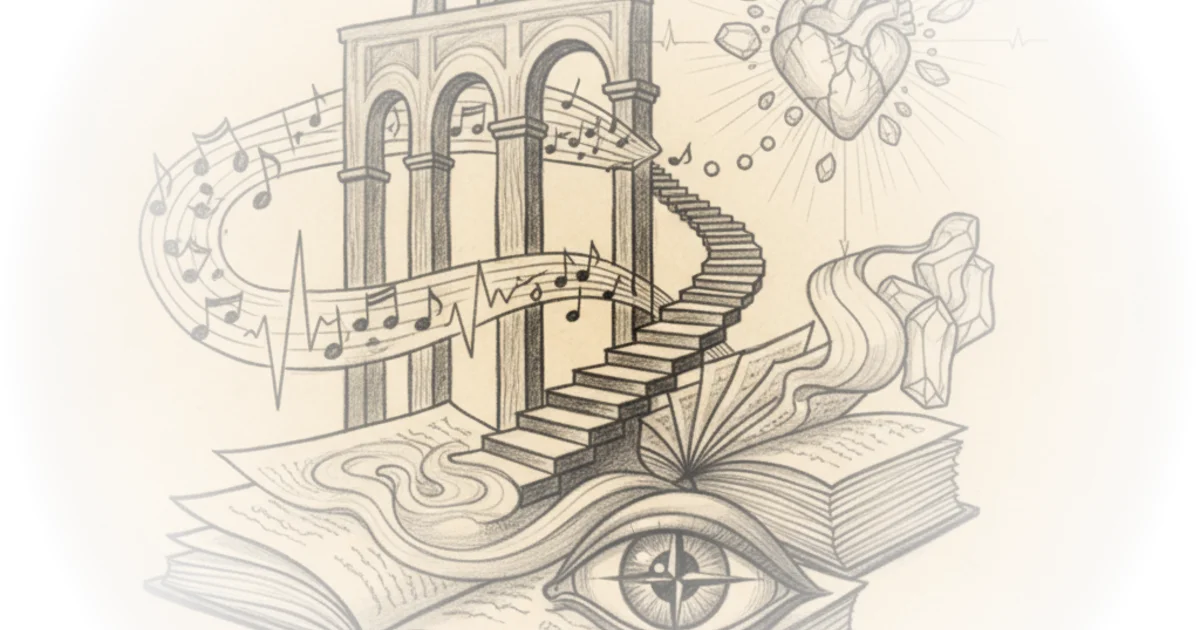
The Spenserian stanza analysis demonstrates how visual structure carries readers through story — those "little digestible chunks" guiding us through a knight's description, with rhyme schemes creating closure at couplets. The lecture shows audible structure doing emotional work too: the extra foot at each stanza's end giving "a sense of finality" and "weight or significance." These are observations that reward rereading.
Mary Sidney's Psalm gets less attention but offers similar structural richness — the repetition of "wind" calling back to "behind," creating an echo that works both thematically and phonically. The lecturer calls this "a literal hinge" — a geometric inversion in sound.
The emotional structure section feels thinner, relying on Samuel Johnson's elegy without fully demonstrating how form moves with feeling. The counterargument writes itself: does visual structure really matter more than semantic meaning? The lecture doesn't fully answer that, but it does show how to listen for it.
Structure isn't decoration — it's the experience before the words even land
Bottom Line
This lecture earns its keep by showing that poetry's shape carries meaning. Its biggest strength is demonstrating form as narrative action — Herbert's decaying meter tells the story. Its vulnerability is the emotional structure section, which promises more than it delivers with Johnson's elegy. For readers wanting to hear poetry differently, this is a useful reset: start with how it greets you on the page.